
.243 Winchester
Introduced 1955Winchester Repeating ArmsCIP standard
Also known as 243 Win., .243 Win: the same cartridge under different names, all of which find this page.
Dimensions and pressure
Generated from the schema, like every specification table on this site, so a figure recorded on this entry cannot be missing from the table.
Identity
- Designed by
- Winchester Repeating Arms
- Introduced
- 1955
- Production
- not recorded
- Standards body
- C.I.P.
- Case type
- Rimless
- Case shape
- Bottleneck
Dimensions
- Bullet diameter
- 6.17 mm0.2429 insource
Cartridge maximum, dimension G1.
- Bore diameter
- not recorded
- Case length
- 51.94 mm2.045 insource
Cartridge maximum, dimension L3. The parent .308 Winchester case is 51.18 mm; necking down lengthens it slightly.
- Overall length
- 68.83 mm2.710 insource
Cartridge maximum, dimension L6.
- Rim diameter
- 12.01 mm0.4728 insource
Dimension R1. The .308 Winchester head, unaltered.
- Neck diameter
- 7.01 mm0.2760 insource
Dimension H2.
- Base diameter
- 11.96 mm0.4709 insource
Dimension P1.
Pressure
- Maximum pressure
- 415 MPa60,191 psisource
Pmax 4150 bar. SAAMI rates the same chambering at 60,000 psi by its own method, and the two figures are not interchangeable.
- Pressure standard
- C.I.P.
SAAMI and C.I.P. measure pressure differently and their figures are not interchangeable, which is why the body is always named beside the figure.
Loads
Velocity is recorded per barrel length as published. A gun page interpolates between these points and never projects beyond them.
58 gr V-MAX
- Bullet mass
- 3.758 g57.99 grsource
58 gr as published in the article's ballistics table, converted to grams. It is the lightest bullet the table lists.
- Cartridge mass
- not recorded
- Bullet type
- V-MAX
- G1 BC
- not recorded
- G7 BC
- not recorded
| Barrel | Velocity |
|---|---|
| 609.6 mm24.00 in | 1,196 m/s3,924 fps |
85 gr TSX
Barnes
- Bullet mass
- 5.508 g85.00 grsource
85 gr as published in the article's ballistics table, converted to grams.
- Cartridge mass
- not recorded
- Bullet type
- TSX
- G1 BC
- not recorded
- G7 BC
- not recorded
| Barrel | Velocity |
|---|---|
| 609.6 mm24.00 in | 975.4 m/s3,200 fps |
100 gr boat-tail soft point
- Bullet mass
- 6.48 g100.0 grsource
100 gr as published in the article's ballistics table, converted to grams. It is the heaviest bullet the table lists, and the weight the 1-in-10-inch twist was chosen for.
- Cartridge mass
- not recorded
- Bullet type
- BTSP
- G1 BC
- not recorded
- G7 BC
- not recorded
| Barrel | Velocity |
|---|---|
| 609.6 mm24.00 in | 902.2 m/s2,960 fps |
Chambered in
Computed from every entry that lists this cartridge. Nothing here is hand-maintained.
No entry on the site is chambered in it yet.
Gallery
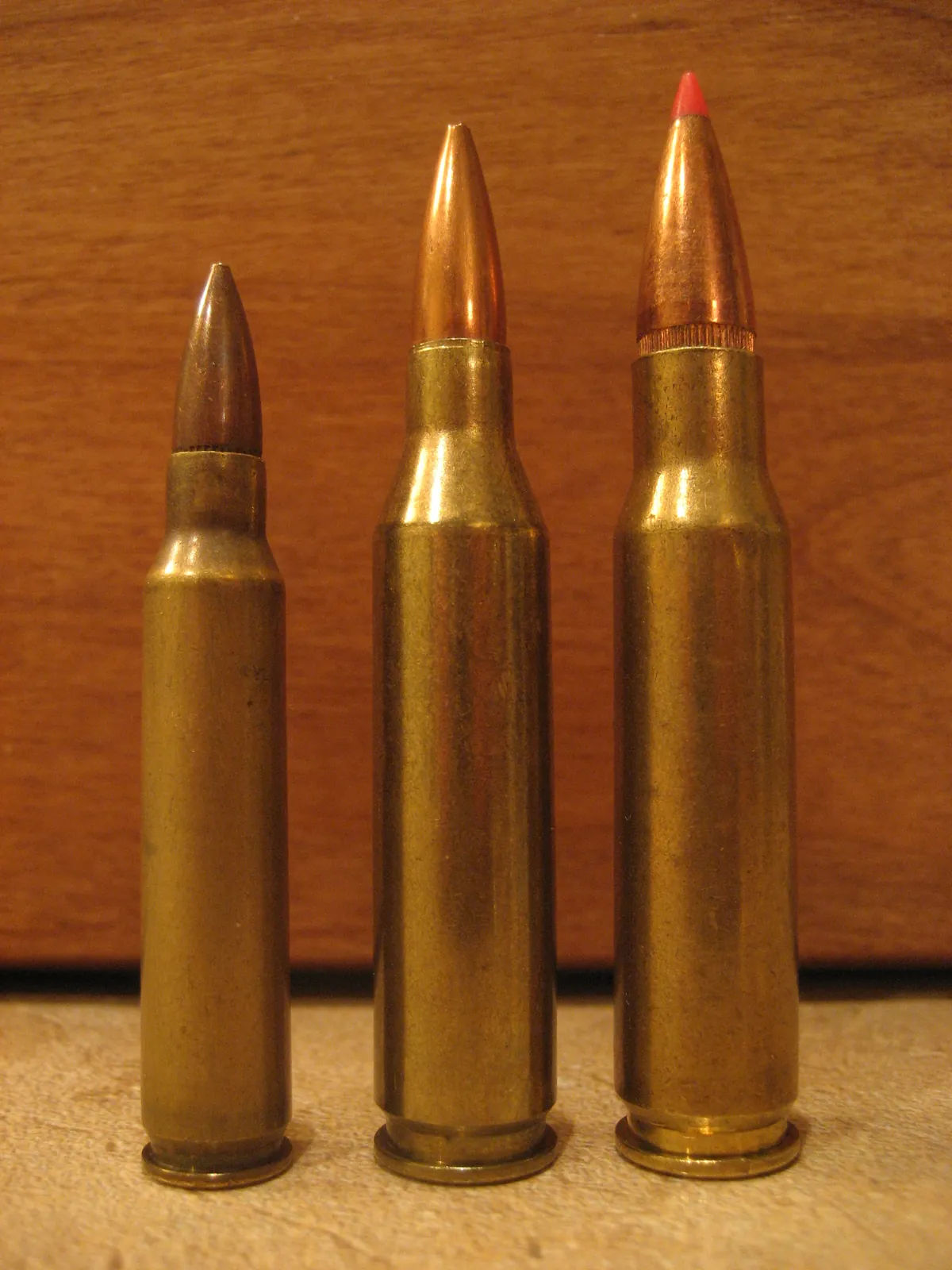
Image credit
- Title
- File:.223, .243, .308.JPG
- Author
- Derek280
- Licence
- Public domain
- Source
- https://commons.wikimedia.org/wiki/File:.223,_.243,_.308.JPG

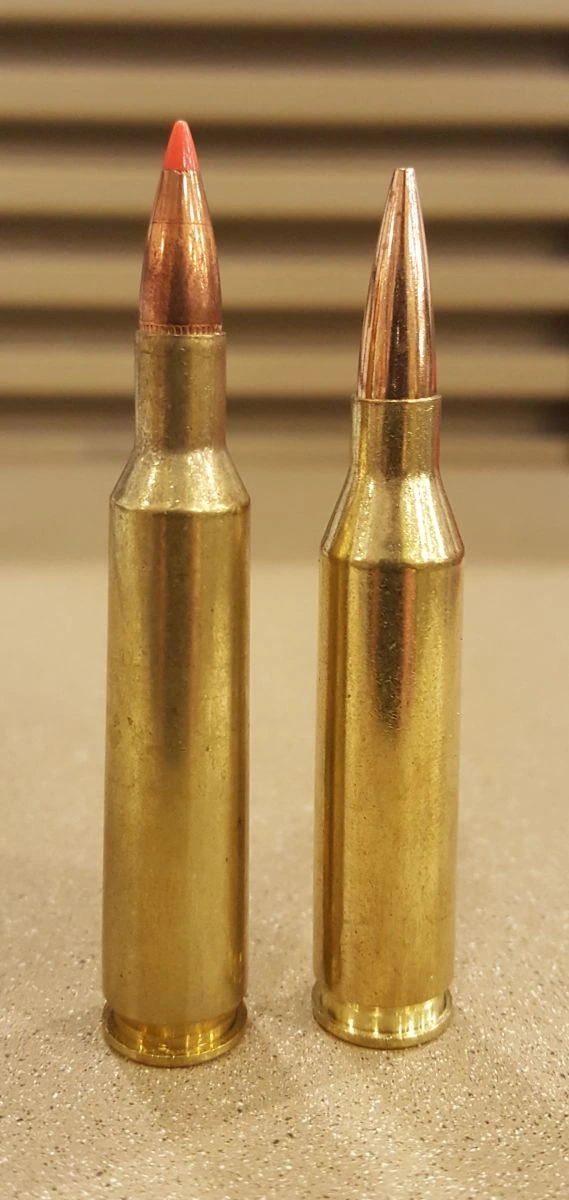
Image credit
- Title
- File:6mm + 243.jpg
- Author
- Hellbus(attribution required)
- Licence
- CC BY-SA 4.0
- Source
- https://commons.wikimedia.org/wiki/File:6mm_+_243.jpg

Detail
The .243 Winchester is a .308 Winchester necked down to take a 6.17 mm bullet, and it went on sale in 1955 (three years after its parent) in the Winchester Model 70 and Model 88. It began as a wildcat worked up by the Field and Stream editor Warren Page, who started necking the .308 down as soon as that case existed; Winchester turned it into a factory round after his write-ups had already made the case for it.
The dimensions are the parent’s, almost unchanged. The head is 11.96 mm, the same rim and the same bolt face, so a short action needs only a barrel; the case is 51.94 mm rather than 51.18 mm, because pushing the shoulder forward while necking down buys back a little of the capacity the smaller mouth loses. What made the round unusual in 1955 was not the case but the pair of factory loads Winchester shipped with it: a light bullet for varmints and a 100-grain one for deer-sized game, out of one rifle. Nothing else in the catalogue was being sold that way.
The barrel is what decided its fate against the competition. Remington launched the .244 in the same year, on a different parent case with slightly more capacity, but rifled for lighter bullets; Winchester rifled the .243 one turn in ten inches, fast enough to stabilise a 100-grain bullet, and that single choice is the difference between a cartridge still in every catalogue and one that had to be relaunched under a new name as the 6mm Remington. Shooters wanting bullets heavier than 100 grains today generally need one turn in eight or seven, which is a barrel decision rather than a cartridge one.
Gaps on this page: three of the five rows in the encyclopedia’s ballistics table are recorded here, one for each bullet-weight class it covers; the table states a single 24-inch test barrel and names Barnes, Federal and Hornady factory specifications together with a shooting website, without saying which row came from which, so all three are attributed to the article rather than to a manufacturer. No ballistic coefficient is published beside any of them. The C.I.P. figures transcribed here are the European maxima; SAAMI’s 60,000 psi ceiling is measured differently and is noted rather than stored.
References
- C.I.P. TDCC datasheet, 243 Win. · Tab. I, adopted 1984-06-14, revised 2002-05-15 · read 2026-09-01
- .243 Winchester · 1368413860 · read 2026-09-01
Last verified 2026-09-01 · review status: agent-populated