
.600 Nitro Express
Introduced 1899W. J. Jeffery & Co.CIP standard
Dimensions and pressure
Generated from the schema, like every specification table on this site, so a figure recorded on this entry cannot be missing from the table.
Identity
- Designed by
- W. J. Jeffery & Co.
- Introduced
- 1899
- Production
- not recorded
- Standards body
- C.I.P.
- Case type
- Rimmed
- Case shape
- Tapered
Dimensions
- Bullet diameter
- 15.75 mm0.6201 insource
Cartridge maximum, dimension G1.
- Bore diameter
- not recorded
- Case length
- 76.2 mm3.000 insource
Dimension L3.
- Overall length
- 93.98 mm3.700 insource
Dimension L6.
- Rim diameter
- 20.57 mm0.8098 insource
Dimension R1.
- Neck diameter
- 16.51 mm0.6500 insource
Dimension H2.
- Base diameter
- 17.78 mm0.7000 insource
Dimension P1.
Pressure
- Maximum pressure
- 245 MPa35,534 psisource
Pmax 2450 bar.
- Pressure standard
- C.I.P.
SAAMI and C.I.P. measure pressure differently and their figures are not interchangeable, which is why the body is always named beside the figure.
Loads
Velocity is recorded per barrel length as published. A gun page interpolates between these points and never projects beyond them.
900 gr (standard loading)
- Bullet mass
- 58.32 g900.0 grestimated
From Frank Barnes' Cartridges of the World and John Taylor's African Rifles and Cartridges, as cited on Wikipedia (900 gr). Both are books, so the figure is recorded as estimated rather than verified.
- Cartridge mass
- not recorded
- Bullet type
- not recorded
- G1 BC
- not recorded
- G7 BC
- not recorded
| Barrel | Velocity |
|---|---|
| 711 mm27.99 in | 563.9 m/s1,850 fps |
900 gr (medium loading)
- Bullet mass
- 58.32 g900.0 grestimated
From Frank Barnes' Cartridges of the World and John Taylor's African Rifles and Cartridges, as cited on Wikipedia (900 gr). Both are books, so the figure is recorded as estimated rather than verified.
- Cartridge mass
- not recorded
- Bullet type
- not recorded
- G1 BC
- not recorded
- G7 BC
- not recorded
| Barrel | Velocity |
|---|---|
| 711 mm27.99 in | 594.4 m/s1,950 fps |
900 gr (heaviest loading)
- Bullet mass
- 58.32 g900.0 grestimated
From Frank Barnes' Cartridges of the World and John Taylor's African Rifles and Cartridges, as cited on Wikipedia (900 gr). Both are books, so the figure is recorded as estimated rather than verified.
- Cartridge mass
- not recorded
- Bullet type
- not recorded
- G1 BC
- not recorded
- G7 BC
- not recorded
| Barrel | Velocity |
|---|---|
| 711 mm27.99 in | 624.8 m/s2,050 fps |
Chambered in
Computed from every entry that lists this cartridge. Nothing here is hand-maintained.
No entry on the site is chambered in it yet.
Gallery
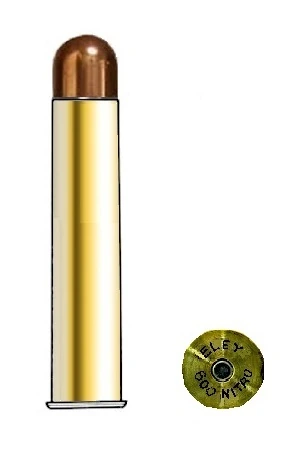
Image credit
- Title
- File:600 NE 3D color metalic.jpg
- Author
- Undefined
- Licence
- Public domain
- Source
- https://commons.wikimedia.org/wiki/File:600_NE_3D_color_metalic.jpg

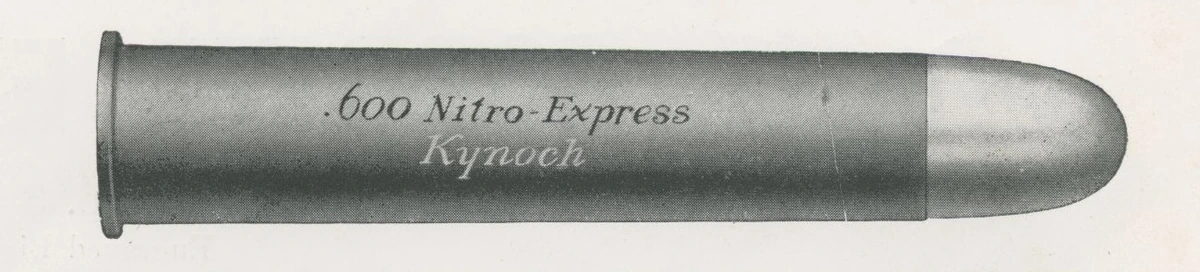
Image credit
- Title
- File:.600 Nitro Express, Kynoch.jpg
- Author
- Unknown author Unknown author
- Licence
- Public domain
- Source
- https://commons.wikimedia.org/wiki/File:.600_Nitro_Express,_Kynoch.jpg

Detail
The .600 Nitro Express is a large-bore rimmed rifle cartridge the London gunmaker W. J. Jeffery & Co. developed around 1900 for hunting dangerous game, firing a 900-grain, roughly .620-inch bullet in one of three standard factory loadings that varied its muzzle velocity. Jeffery built its rifles for the round in four different break-open and falling-block actions, producing perhaps seventy in total; until the .700 Nitro Express arrived in 1988, it stood as the most powerful cartridge offered in a commercially available sporting rifle, and by one 2009 estimate only around a hundred rifles chambered for it had ever been made.
Its recoil is heavy enough that period rifles built for it typically weighed up to about 7 kg, and one British sniping officer who used a .600-chambered rifle during the First World War recorded that firing it from a prone position had broken a colleague’s collarbone. That wartime use came about because German snipers were operating from behind steel plates immune to standard .303 British rifle ammunition; the British War Office purchased a small number of large-bore sporting rifles, including four in .600 Nitro Express, and issued them to regiments to defeat those plates. Because it was too heavy to carry all day, the round also found a niche among professional big-game hunters as a backup weapon carried by a gun bearer for close-range use in thick cover.
All three published velocity figures come from secondary reference books (Frank Barnes’ Cartridges of the World and John Taylor’s African Rifles and Cartridges) rather than a clickable primary source, so they are recorded as estimated. The cartridge’s case and pressure dimensions, by contrast, come from C.I.P.’s own published standard and are recorded as verified.
References
- .600 Nitro Express · 1328663939 · read 2026-09-24
- C.I.P. TDCC datasheet — 600 N.E. · 2002-05-15 · read 2026-09-24
Last verified 2026-09-24 · review status: agent-populated