
.44-40 Winchester
Introduced 1873Winchester Repeating Arms CompanyCIP standard
Also known as .44 WCF, .44 Largo: the same cartridge under different names, all of which find this page.
Dimensions and pressure
Generated from the schema, like every specification table on this site, so a figure recorded on this entry cannot be missing from the table.
Identity
- Designed by
- Winchester Repeating Arms Company
- Introduced
- 1873
- Production
- not recorded
- Standards body
- C.I.P.
- Case type
- Rimmed
- Case shape
- not recorded
Dimensions
- Bullet diameter
- 10.85 mm0.4272 insource
C.I.P. G1, maximum bullet diameter.
- Bore diameter
- not recorded
- Case length
- 33.15 mm1.305 insource
C.I.P. L3, maximum case length.
- Overall length
- 40.44 mm1.592 insource
C.I.P. L6, maximum cartridge overall length.
- Rim diameter
- 13.34 mm0.5252 insource
C.I.P. R1.
- Neck diameter
- 11.25 mm0.4429 insource
C.I.P. H2.
- Base diameter
- 11.97 mm0.4713 insource
C.I.P. P1.
Pressure
- Maximum pressure
- 110 MPa15,954 psisource
C.I.P. Pmax 1100 bar; 1 bar = 0.1 MPa exactly.
- Pressure standard
- C.I.P.
SAAMI and C.I.P. measure pressure differently and their figures are not interchangeable, which is why the body is always named beside the figure.
Loads
No load data recorded yet. Without a sourced bullet mass and velocity there is nothing honest to compute, so the ballistic figures on pages that chamber this cartridge stay blank rather than being estimated into existence.
Chambered in
Computed from every entry that lists this cartridge. Nothing here is hand-maintained.
- Colt Single Action Army
Colt's Manufacturing Company
- Winchester Model 1873
Winchester Repeating Arms Company
Gallery
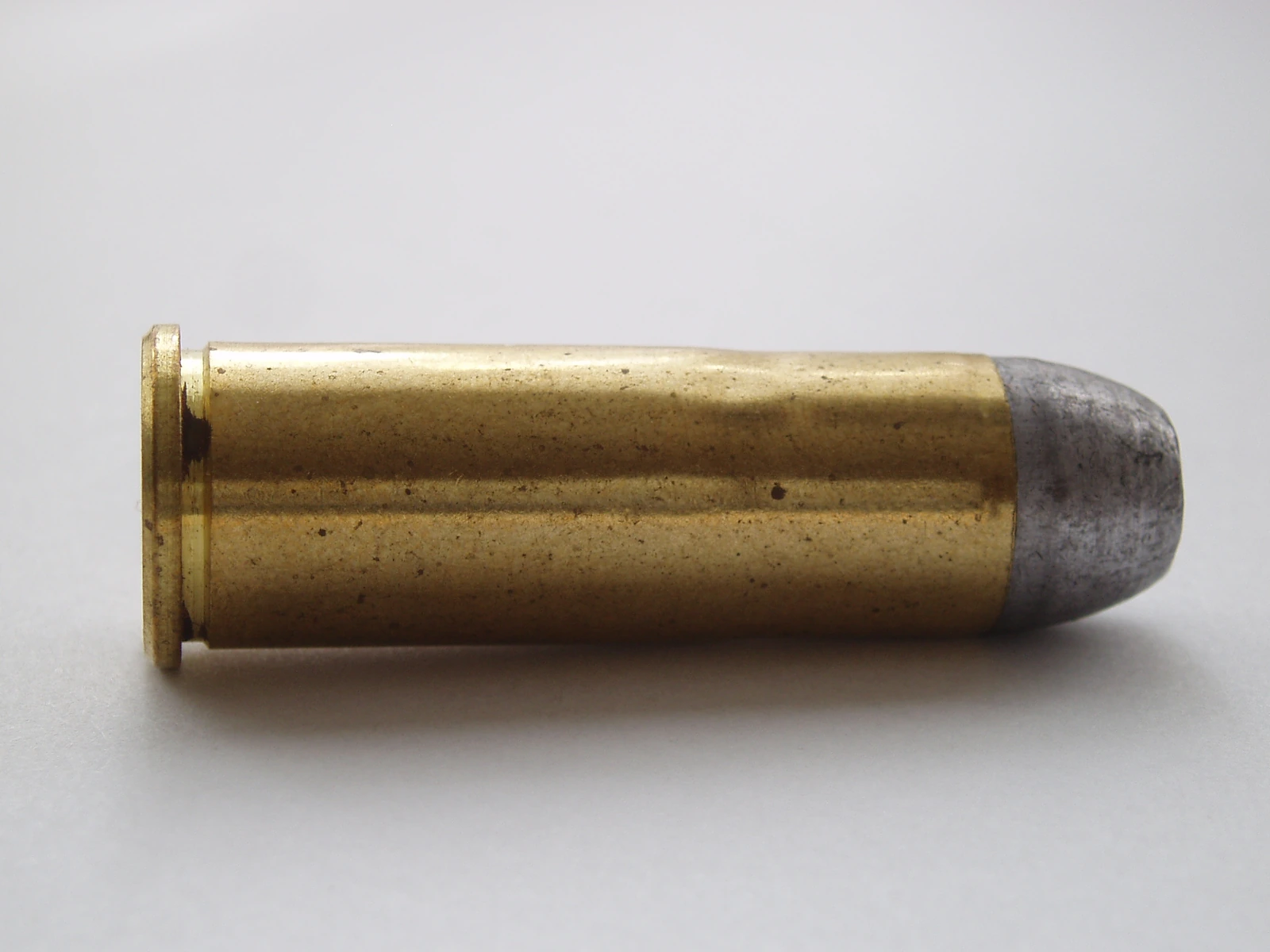
Image credit
- Title
- File:44-40 Winchester - 1.jpg
- Author
- Malis
- Licence
- Public domain
- Source
- https://commons.wikimedia.org/wiki/File:44-40_Winchester_-_1.jpg

Detail
The first centre-fire cartridge Winchester made for itself, introduced with the Model 1873 and adopted almost immediately by Colt for the Single Action Army. That coincidence (one cartridge feeding both a rifle and a revolver) is the whole reason it mattered: a rider could carry one kind of ammunition for both arms, which in 1873 was a logistical argument rather than a marketing one.
The case is nominally straight-walled and is not quite. It tapers and then necks slightly, with thin brass at the mouth, and the combination is famously easy to crumple when seating a bullet by hand.
Its C.I.P. pressure ceiling of 110 MPa is among the lowest on this site, and it is a modern figure set for antique guns rather than a description of what the 1873 load did.
References
- C.I.P. TDCC datasheet — 44-40 Win. · 2002-05-15 · read 2026-08-31
- .44-40 Winchester · 1351556125 · read 2026-08-31
Last verified 2026-08-31 · review status: agent-populated