
.38 S&W
Introduced 1877Smith & WessonCIP standard
Also known as .38 Colt New Police: the same cartridge under different names, all of which find this page.
Dimensions and pressure
Generated from the schema, like every specification table on this site, so a figure recorded on this entry cannot be missing from the table.
Identity
- Designed by
- Smith & Wesson
- Introduced
- 1877
- Production
- not recorded
- Standards body
- C.I.P.
- Case type
- Rimmed
- Case shape
- Straight
Dimensions
- Bullet diameter
- 9.17 mm0.3610 insource
Dimension G1.
- Bore diameter
- not recorded
- Case length
- 19.69 mm0.7752 insource
Cartridge maximum, dimension L3.
- Overall length
- 31.5 mm1.240 insource
Dimension L6.
- Rim diameter
- 11.18 mm0.4402 insource
Dimension R1.
- Neck diameter
- 9.79 mm0.3854 insource
Dimension H2.
- Base diameter
- 9.82 mm0.3866 insource
Dimension P1.
Pressure
- Maximum pressure
- 120 MPa17,405 psisource
Pmax 1200 bar, C.I.P. method.
- Pressure standard
- C.I.P.
SAAMI and C.I.P. measure pressure differently and their figures are not interchangeable, which is why the body is always named beside the figure.
Loads
Velocity is recorded per barrel length as published. A gun page interpolates between these points and never projects beyond them.
158 gr LSWC
- Bullet mass
- 10.24 g158.0 grestimated
158 gr bullet, Wikipedia infobox. No test-barrel length is stated for the load's published velocity, so velocity is not recorded.
- Cartridge mass
- not recorded
- Bullet type
- LSWC
- G1 BC
- not recorded
- G7 BC
- not recorded
195 gr LRN
- Bullet mass
- 12.64 g195.1 grestimated
195 gr bullet, Wikipedia infobox. No test-barrel length is stated, so velocity is not recorded.
- Cartridge mass
- not recorded
- Bullet type
- LRN
- G1 BC
- not recorded
- G7 BC
- not recorded
200 gr LRN
- Bullet mass
- 12.96 g200.0 grestimated
200 gr bullet, Wikipedia infobox. The published velocity for this load does not reproduce its own published energy figure under either ft/s or m/s, so it is not recorded.
- Cartridge mass
- not recorded
- Bullet type
- LRN
- G1 BC
- not recorded
- G7 BC
- not recorded
Chambered in
Computed from every entry that lists this cartridge. Nothing here is hand-maintained.
No entry on the site is chambered in it yet.
Gallery
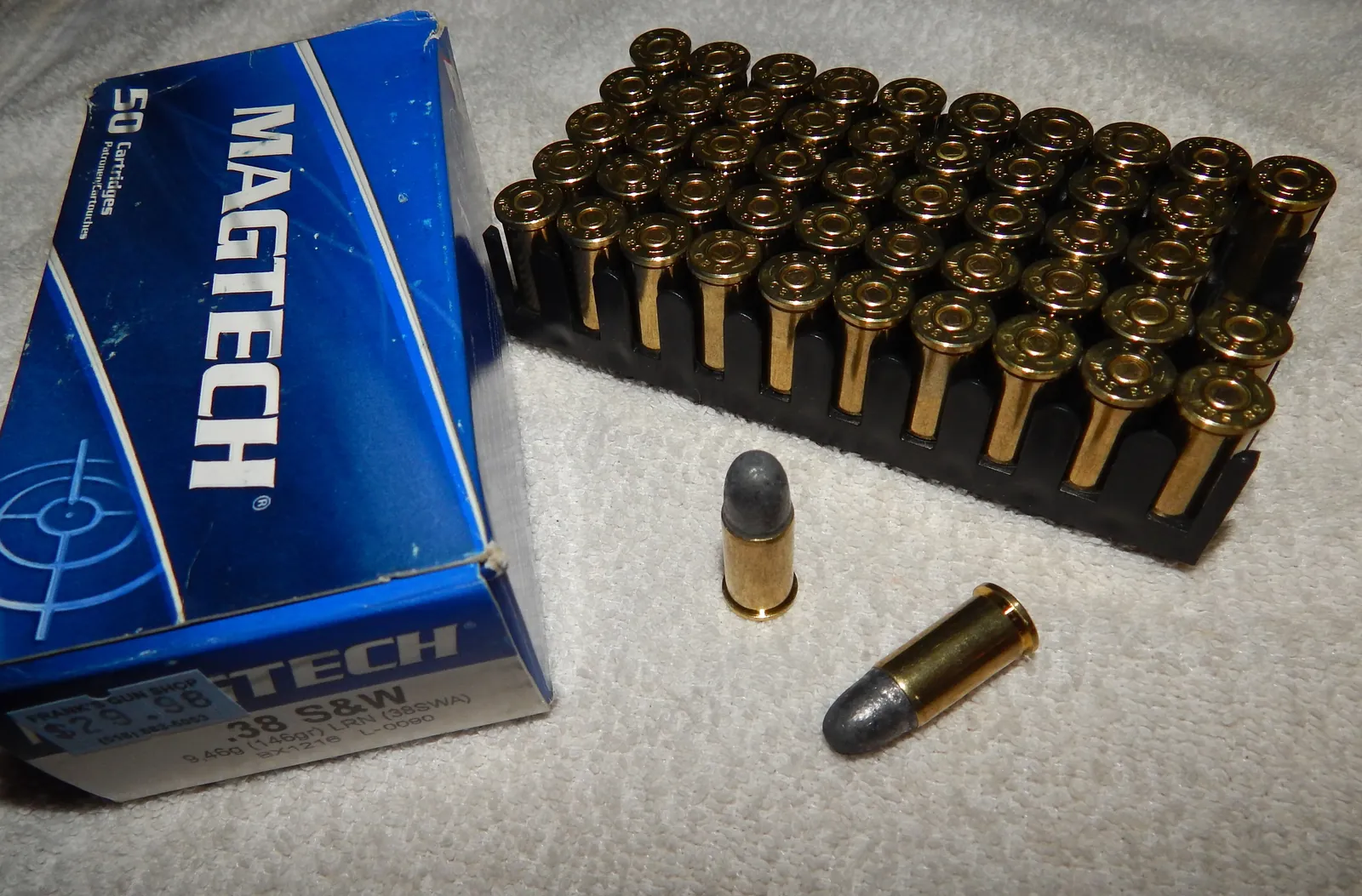
Image credit
- Title
- File:.38 Smith & Wesson.jpg
- Author
- MorganDWright(attribution required)
- Licence
- CC BY-SA 4.0
- Source
- https://commons.wikimedia.org/wiki/File:.38_Smith_&_Wesson.jpg

Detail
The .38 S&W is a rimmed, straight-walled revolver cartridge Smith & Wesson introduced in 1877 for its own top-break pocket revolvers. Despite its name, it is a distinct, shorter and wider round from the later, far more widely used .38 Special, and the two are not interchangeable. Colt chambered the same round in its own revolvers under the name .38 Colt New Police.
The British armed forces adopted a loading of this case, known there as the .380 Revolver round, putting it into service from 1922 and using it through the Second World War and the Korean War before retiring it in 1963. American production of the round for the civilian market has continued since its introduction, though it has long since been overshadowed commercially by .38 Special.
All dimensional and pressure figures on this page come from C.I.P.’s published standard and are recorded as verified. Three bullet weights are recorded from Wikipedia’s infobox; no test-barrel length is stated for two of the associated velocities, and the third does not reproduce its own published energy figure under either imperial or metric units, so no velocity or energy is recorded for this cartridge. No photograph of a revolver chambered for it appears on this site.
References
- .38 S&W · 1375942971 · read 2026-09-24
- C.I.P. TDCC datasheet — 38 S&W · 2020-04-21 · read 2026-09-24
Last verified 2026-09-24 · review status: agent-populated