
.38 Special
Introduced 1898Smith & WessonCIP standard
Also known as 9×29mmR: the same cartridge under different names, all of which find this page.
Dimensions and pressure
Generated from the schema, like every specification table on this site, so a figure recorded on this entry cannot be missing from the table.
Identity
- Designed by
- Smith & Wesson
- Introduced
- 1898
- Production
- not recorded
- Standards body
- C.I.P.
- Case type
- Rimmed
- Case shape
- Straight
Dimensions
- Bullet diameter
- 9.12 mm0.3591 insource
C.I.P. G1, maximum bullet diameter.
- Bore diameter
- not recorded
- Case length
- 29.34 mm1.155 insource
C.I.P. L3, maximum case length.
- Overall length
- 39.37 mm1.550 insource
C.I.P. L6, maximum cartridge overall length.
- Rim diameter
- 11.18 mm0.4402 insource
C.I.P. R1.
- Neck diameter
- 9.63 mm0.3791 insource
C.I.P. H2.
- Base diameter
- 9.63 mm0.3791 insource
C.I.P. P1.
Pressure
- Maximum pressure
- 150 MPa21,756 psisource
C.I.P. Pmax 1500 bar; 1 bar = 0.1 MPa exactly.
- Pressure standard
- C.I.P.
SAAMI and C.I.P. measure pressure differently and their figures are not interchangeable, which is why the body is always named beside the figure.
Loads
Velocity is recorded per barrel length as published. A gun page interpolates between these points and never projects beyond them.
158 gr lead round nose
- Bullet mass
- 10.24 g158.0 grsource
Ballistics table of the cited article, which publishes bullet mass in grams.
- Cartridge mass
- not recorded
- Bullet type
- LRN
- G1 BC
- not recorded
- G7 BC
- not recorded
| Barrel | Velocity |
|---|---|
| 101.6 mm4.000 in | 230.1 m/s754.9 fps |
130 gr full metal jacket
- Bullet mass
- 8.4 g129.6 grsource
Ballistics table of the cited article.
- Cartridge mass
- not recorded
- Bullet type
- FMJ
- G1 BC
- not recorded
- G7 BC
- not recorded
| Barrel | Velocity |
|---|---|
| 101.6 mm4.000 in | 243.8 m/s799.9 fps |
Chambered in
Computed from every entry that lists this cartridge. Nothing here is hand-maintained.
- Colt Single Action Army
Colt's Manufacturing Company
- Taurus Raging Bull
Taurus Armas
Gallery
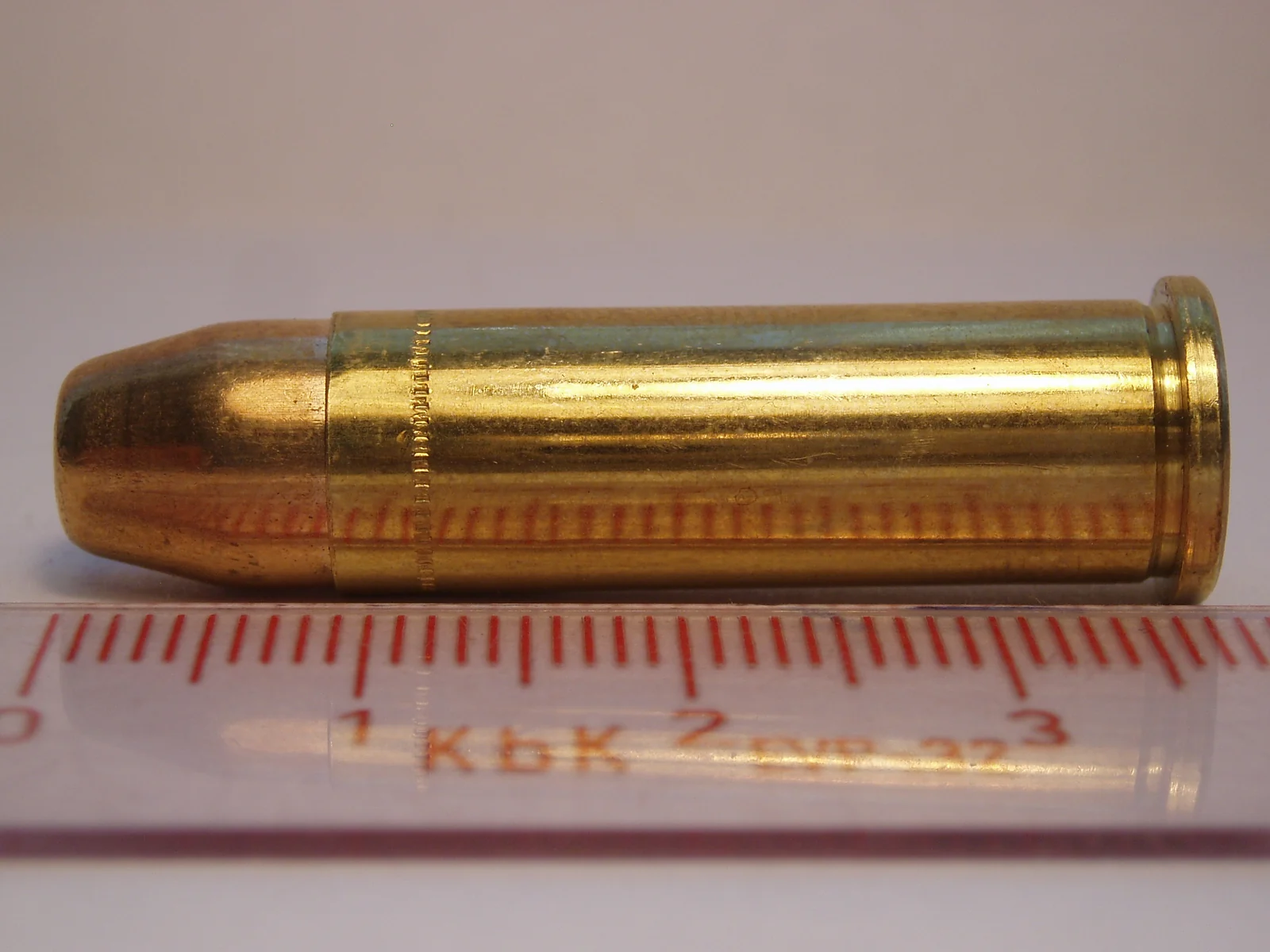
Image credit
- Title
- File:38 Special - FMJ - SB - 2.jpg
- Author
- user:Malis
- Licence
- Public domain
- Source
- https://commons.wikimedia.org/wiki/File:38_Special_-_FMJ_-_SB_-_2.jpg

Detail
Smith & Wesson lengthened the .38 Long Colt in 1898 because the shorter round had performed badly in the Philippines, and the result became the standard American police cartridge for most of the twentieth century. It is mild, accurate and cheap, and a revolver chambered for it can be small.
The vented test barrel in the load rows below is worth understanding. A revolver loses gas through the gap between cylinder and forcing cone, so a velocity measured in a sealed pressure barrel overstates what the gun actually produces. C.I.P. and SAAMI both specify a vented barrel for revolver cartridges, and figures from one cannot be compared with figures from the other.
Its own case became the .357 Magnum’s simply by being made longer, which is also a safety feature, since the magnum will not chamber in a .38.
References
- C.I.P. TDCC datasheet — 38 Special · 2000-06-07 · read 2026-08-31
- .38 Special · 1371269158 · read 2026-08-31
Last verified 2026-08-31 · review status: agent-populated