
.223 Remington
Introduced 1964Remington ArmsCIP standard
Also known as 223 Rem., 5.56x45mm: the same cartridge under different names, all of which find this page.
Dimensions and pressure
Generated from the schema, like every specification table on this site, so a figure recorded on this entry cannot be missing from the table.
Identity
- Designed by
- Remington Arms
- Introduced
- 1964
- Production
- not recorded
- Standards body
- C.I.P.
- Case type
- Rimless
- Case shape
- Bottleneck
Dimensions
- Bullet diameter
- 5.7 mm0.2244 insource
Cartridge maximum, dimension G1.
- Bore diameter
- not recorded
- Case length
- 44.7 mm1.760 insource
Cartridge maximum, dimension L3.
- Overall length
- 57.4 mm2.260 insource
Cartridge maximum, dimension L6.
- Rim diameter
- 9.6 mm0.3780 insource
Dimension R1.
- Neck diameter
- 6.43 mm0.2531 insource
Dimension H2.
- Base diameter
- 9.58 mm0.3772 insource
Dimension P1.
Pressure
- Maximum pressure
- 430 MPa62,366 psisource
Pmax 4300 bar, transducer method.
- Pressure standard
- C.I.P.
SAAMI and C.I.P. measure pressure differently and their figures are not interchangeable, which is why the body is always named beside the figure.
Loads
Velocity is recorded per barrel length as published. A gun page interpolates between these points and never projects beyond them.
Chambered in
Computed from every entry that lists this cartridge. Nothing here is hand-maintained.
- AR-15 platform
- CAR-15 XM177 Commando
Colt's Manufacturing Company
- Daewoo Precision Industries K1A
SNT Motiv
- Heckler & Koch HK33
Heckler & Koch
- Smith & Wesson M&P15 Sport III
Smith & Wesson
Gallery
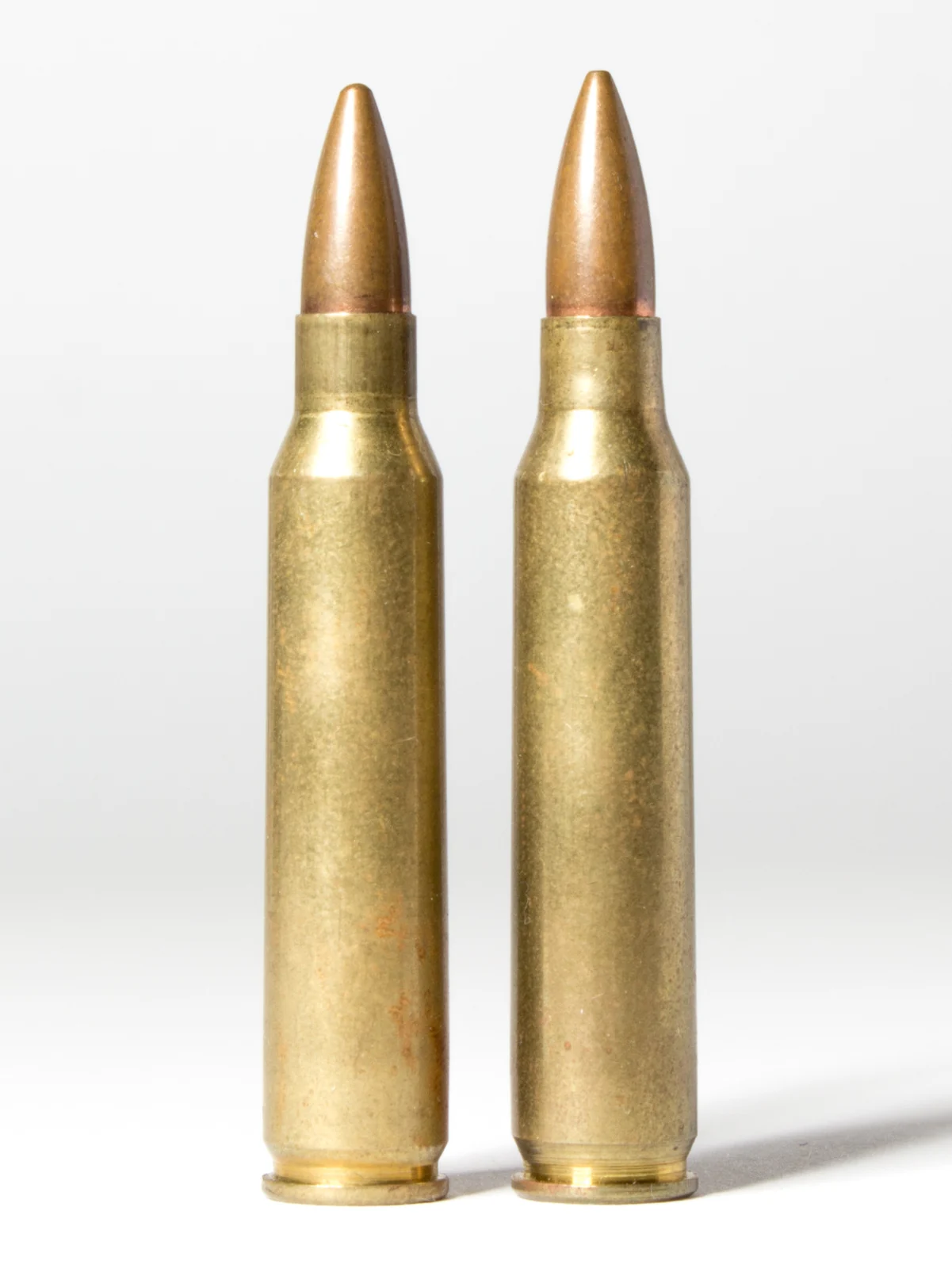
Image credit
- Title
- Caliber cartridge comparison - .223 Remington and 5.56x45mm NATO
- Author
- Grasyl(attribution required)
- Licence
- CC BY-SA 4.0
- Source
- https://commons.wikimedia.org/wiki/File:Caliber_cartridge_comparison_-_.223_Remington_and_5.56x45mm_NATO.jpg

Detail
Remington released this in 1964 as the commercial form of the experimental round developed for the ArmaLite AR-15 trials. It is the civil twin of the 5.56x45mm NATO cartridge and the pair are not symmetric: a rifle chambered for the NATO round will fire either, while a rifle chambered and proof-tested to the commercial specification should be fed only the commercial round. The difference is in the throat ahead of the case mouth rather than in the ammunition.
The two standards bodies do not agree on the pressure either, and not because they disagree about the cartridge. C.I.P. records 430 MPa and SAAMI records 55,000 psi, which is about 379 MPa; the figures are taken at different points by different methods and cannot be compared as though they were the same measurement. The C.I.P. number is the one recorded here, and the field beside it names the body.
No velocity is listed. Federal publishes 3,240 feet per second for this load and does not publish the barrel length it was measured in, and a velocity without a barrel length is not a fact about anything.
References
- C.I.P. TDCC datasheet, 223 Rem. · Tab. I, dated 1984-06-14, revision 2017-05-17 · read 2026-08-27
- American Eagle Rifle .223 Rem 55 grain FMJ (AE223) · read 2026-08-27
Last verified 2026-08-27 · review status: spot-checked