
.221 Remington Fireball
Introduced 1963Remington / Wayne Leek
Also known as .221 Fireball: the same cartridge under different names, all of which find this page.
Dimensions and pressure
Generated from the schema, like every specification table on this site, so a figure recorded on this entry cannot be missing from the table.
Identity
- Designed by
- Remington / Wayne Leek
- Introduced
- 1963
- Production
- not recorded
- Standards body
- No standards body
- Case type
- Rimless
- Case shape
- Bottleneck
Dimensions
- Bullet diameter
No free SAAMI or C.I.P. datasheet exists for this cartridge. Published as .224 in, the standard bullet diameter shared with every other .22-centerfire cartridge derived from the .222 Remington case.
- Bore diameter
- not recorded
- Case length
No free SAAMI or C.I.P. datasheet exists for this cartridge. Value read from Accurate Powder's reloading-guide dimensional drawing (1.400 in / 35.56 mm), which matches the figure in the Wikipedia infobox.
- Overall length
No free SAAMI or C.I.P. datasheet exists for this cartridge. Value read from Accurate Powder's reloading-guide dimensional drawing (1.830 in / 46.48 mm), which matches the figure in the Wikipedia infobox.
- Rim diameter
No free SAAMI or C.I.P. datasheet exists for this cartridge. Value read from Accurate Powder's reloading-guide dimensional drawing (.378 in / 9.60 mm).
- Neck diameter
No free SAAMI or C.I.P. datasheet exists for this cartridge. Value read from Accurate Powder's reloading-guide dimensional drawing (.253 in / 6.43 mm).
- Base diameter
No free SAAMI or C.I.P. datasheet exists for this cartridge. Value read from Accurate Powder's reloading-guide dimensional drawing (.376 in / 9.55 mm).
Pressure
- Maximum pressure
- not recorded
- Pressure standard
- not recorded
SAAMI and C.I.P. measure pressure differently and their figures are not interchangeable, which is why the body is always named beside the figure.
Loads
Velocity is recorded per barrel length as published. A gun page interpolates between these points and never projects beyond them.
Nosler 45 gr SP
- Bullet mass
- 2.916 g45.00 grsource
Published as 45 gr.
- Cartridge mass
- not recorded
- Bullet type
- SP
- G1 BC
- not recorded
- G7 BC
- not recorded
Hornady 50 gr SX
- Bullet mass
- 3.24 g50.00 grsource
Published as 50 gr.
- Cartridge mass
- not recorded
- Bullet type
- SX
- G1 BC
- not recorded
- G7 BC
- not recorded
Nosler 55 gr SBT
- Bullet mass
- 3.564 g55.00 grsource
Published as 55 gr.
- Cartridge mass
- not recorded
- Bullet type
- SBT
- G1 BC
- not recorded
- G7 BC
- not recorded
Chambered in
Computed from every entry that lists this cartridge. Nothing here is hand-maintained.
No entry on the site is chambered in it yet.
Gallery
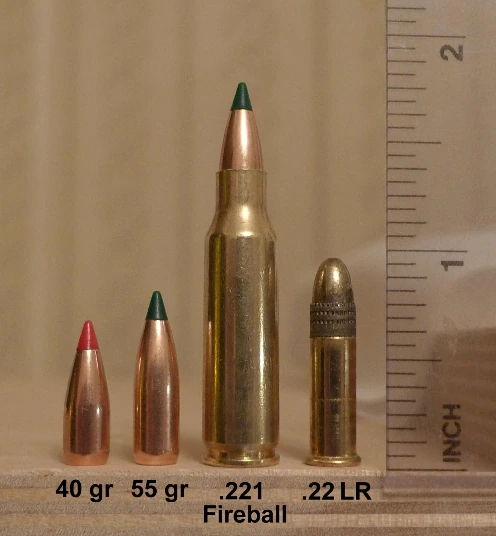
Image credit
- Title
- File:221 Remington Fireball.PNG
- Author
- CaboverPete
- Licence
- CC0, public domain dedication
- Source
- https://commons.wikimedia.org/wiki/File:221_Remington_Fireball.PNG

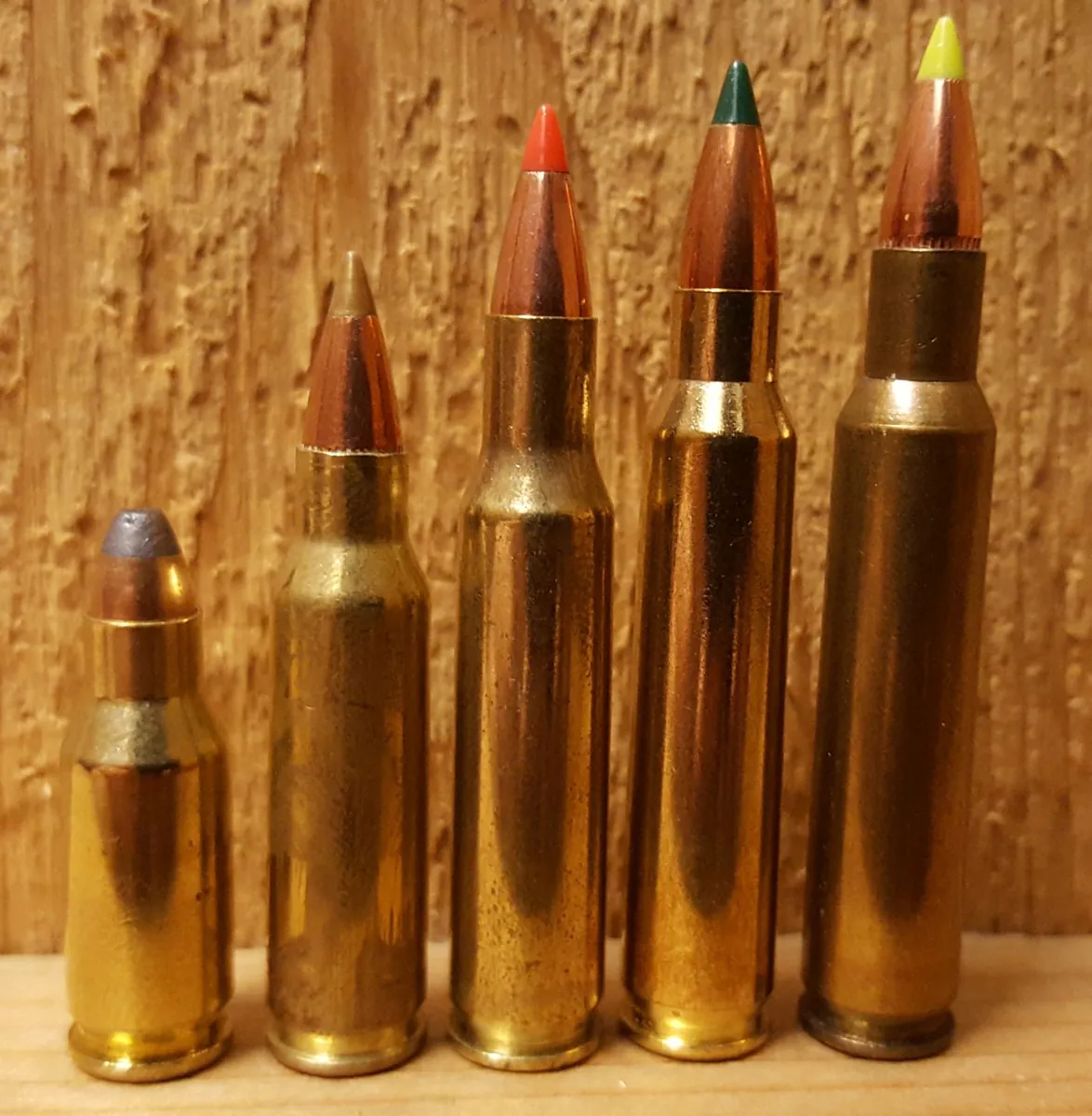
Image credit
- Title
- File:222 extended family.jpg
- Author
- Hellbus(attribution required)
- Licence
- CC BY-SA 4.0
- Source
- https://commons.wikimedia.org/wiki/File:222_extended_family.jpg

Detail
Remington introduced the .221 Fireball in 1963 by shortening the .222 Remington’s case to 35.56 mm, purpose-built for the single-shot, bolt-action XP-100 pistol the company launched alongside it. Cutting the case down meant less powder capacity than the rifle round it was derived from, so Remington’s engineers raised the maximum average pressure to 52,000 CUP (against 46,000 CUP for the full-length .222), specifically to limit the velocity lost to a handgun-length barrel.
The result was, and remains, one of the fastest handgun cartridges ever placed in commercial production, built around the idea that a short, high-pressure case in a long single-shot barrel could still deliver rifle-like performance from a pistol-length gun. It went on to be chambered in bolt-action and single-shot rifles as well as the Contender-pattern pistols it was designed for, serving both as a varmint round and as a platform for wildcatters, including the .17 Remington Fireball derived from it decades later.
No free SAAMI or C.I.P. dimensional standard was found for this cartridge, so its case and bullet
dimensions here are estimated from a Thompson/Center reloading-data sheet published by Accurate
Powder, cross-checked against the Wikipedia infobox figures, which they match. No velocity is
recorded at all. The three bullet weights below are the ones that sheet is built around, but every
velocity published for this cartridge that could be found is a handloading figure: the speed a
particular charge produced at the top of a load ladder, which is a property of that recipe rather
than of the cartridge, and which this site does not record. Factory-ammunition velocities with a
stated test barrel, the kind recorded everywhere else here, were not found. No maximum pressure is
recorded either: the only figure found is in CUP, a pressure-testing method with no fixed
conversion to the pascal-based figures this site stores, and converting between the two would be
presenting an estimate as a measurement.
References
- .221 Remington Fireball · 1336106401 · read 2026-09-01
- .221 Remington Fireball — Thompson/Center Contender pistol reload data (page 48) · read 2026-09-01
Last verified 2026-09-01 · review status: agent-populated