
.22 Winchester Magnum Rimfire
Introduced 1959Winchester Repeating Arms CompanyCIP standard
Also known as .22 WMR, .22 Magnum, .22 Mag, 22 Win. Mag. R.F.: the same cartridge under different names, all of which find this page.
Dimensions and pressure
Generated from the schema, like every specification table on this site, so a figure recorded on this entry cannot be missing from the table.
Identity
- Designed by
- Winchester Repeating Arms Company
- Introduced
- 1959
- Production
- 1959–present
- Standards body
- C.I.P.
- Case type
- Rimmed
- Case shape
- Straight
Dimensions
- Bullet diameter
- 5.7 mm0.2244 insource
Cartridge maximum, dimension G1.
- Bore diameter
- not recorded
- Case length
- 26.8 mm1.055 insource
Cartridge maximum, dimension L3.
- Overall length
- 34.29 mm1.350 insource
Cartridge maximum, dimension L6.
- Rim diameter
- 7.47 mm0.2941 insource
Dimension R1.
- Neck diameter
- 6.15 mm0.2421 insource
Dimension H2. The case is straight-walled, so neck and base are the same figure.
- Base diameter
- 6.15 mm0.2421 insource
Dimension P1.
Pressure
- Maximum pressure
- 160 MPa23,206 psisource
Pmax 1600 bar. The SAAMI ceiling is quoted elsewhere as 24,000 psi; the two bodies measure differently and their figures are not interchangeable.
- Pressure standard
- C.I.P.
SAAMI and C.I.P. measure pressure differently and their figures are not interchangeable, which is why the body is always named beside the figure.
Loads
Velocity is recorded per barrel length as published. A gun page interpolates between these points and never projects beyond them.
30 gr hollow point
- Bullet mass
- 1.944 g30.00 grsource
30 gr as published, converted to grams.
- Cartridge mass
- not recorded
- Bullet type
- HP
- G1 BC
- not recorded
- G7 BC
- not recorded
| Barrel | Velocity |
|---|---|
| 609.6 mm24.00 in | 701 m/s2,300 fps |
40 gr jacketed hollow point
- Bullet mass
- 2.592 g40.00 grsource
40 gr as published, converted to grams. This is the original 1959 bullet weight.
- Cartridge mass
- not recorded
- Bullet type
- JHP
- G1 BC
- not recorded
- G7 BC
- not recorded
| Barrel | Velocity |
|---|---|
| 609.6 mm24.00 in | 571.5 m/s1,875 fps |
50 gr jacketed hollow point
- Bullet mass
- 3.24 g50.00 grsource
50 gr as published, converted to grams.
- Cartridge mass
- not recorded
- Bullet type
- JHP
- G1 BC
- not recorded
- G7 BC
- not recorded
| Barrel | Velocity |
|---|---|
| 609.6 mm24.00 in | 466.3 m/s1,530 fps |
Chambered in
Computed from every entry that lists this cartridge. Nothing here is hand-maintained.
No entry on the site is chambered in it yet.
Gallery
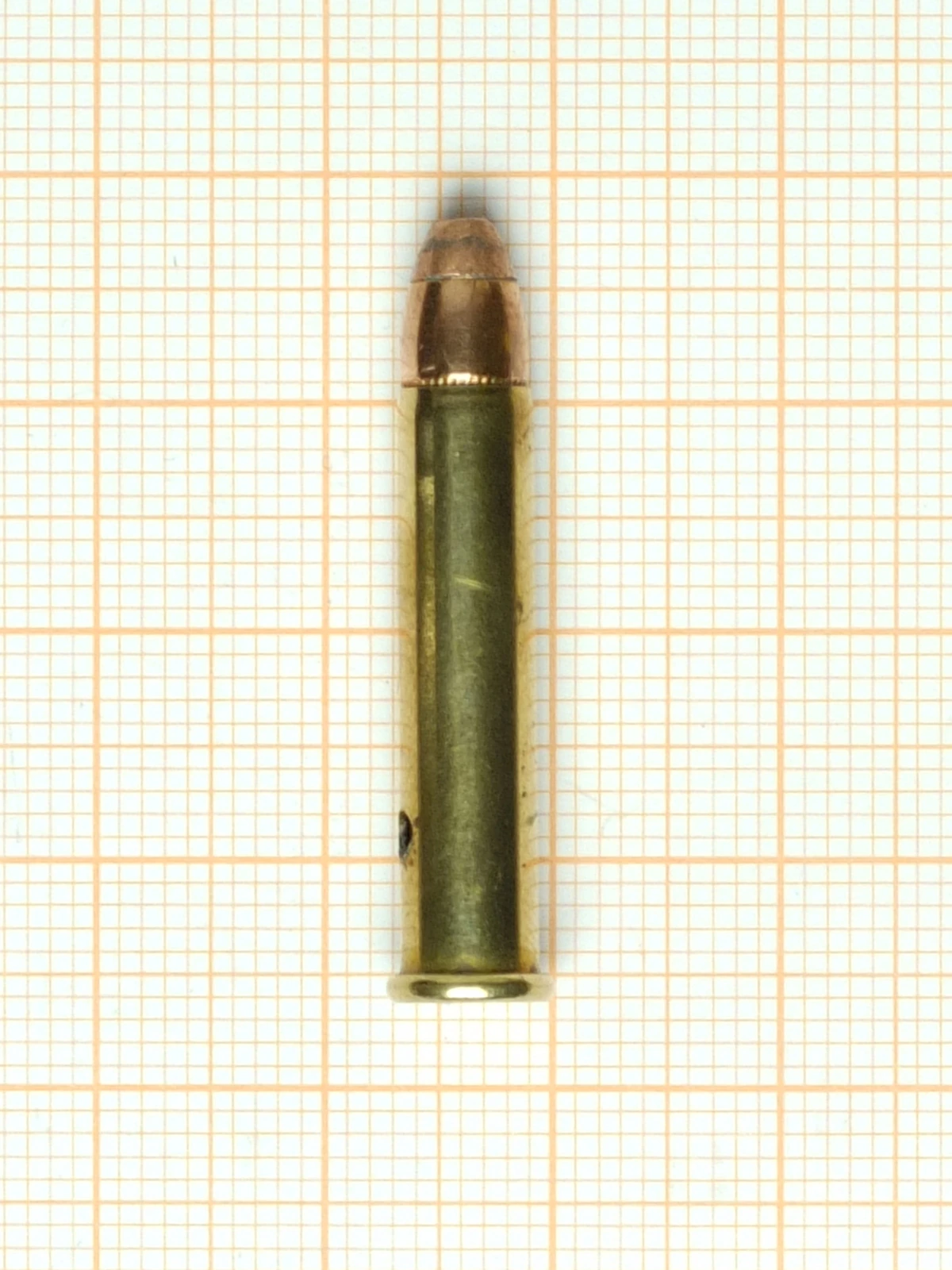
Image credit
- Title
- File:Cartridge .22 Magnum.jpg
- Author
- Grasyl(attribution required)
- Licence
- CC BY-SA 4.0
- Source
- https://commons.wikimedia.org/wiki/File:Cartridge_.22_Magnum.jpg

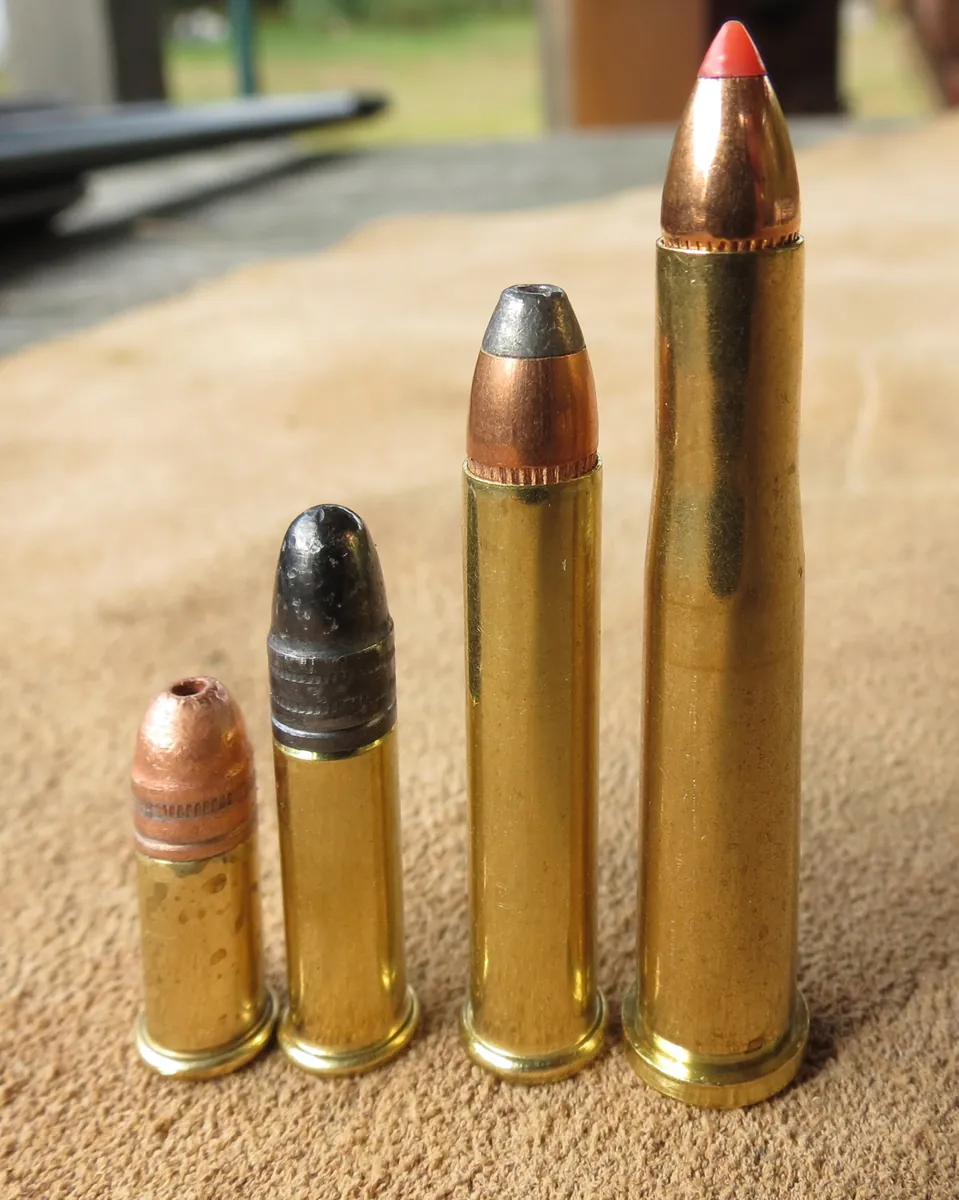
Image credit
- Title
- File:22 short 22 long rifle 22 magnum 22 hornet.JPG
- Author
- Noahsachs(attribution required)
- Licence
- CC BY-SA 3.0
- Source
- https://commons.wikimedia.org/wiki/File:22_short_22_long_rifle_22_magnum_22_hornet.JPG

Detail
Winchester introduced this round in 1959 by lengthening the case of its own obsolete .22 Winchester Rimfire, and it was designed from the start around a jacketed bullet rather than the bare lead every rimfire before it had used. It has been in continuous production since, chambered in rifles, in revolvers and in a handful of self-loading pistols.
What separates it from the .22 Long Rifle is geometry rather than pressure: the two run at nearly the same C.I.P. ceiling. A .22 Long Rifle uses a heeled bullet: the bullet is as wide as the outside of the case and is stepped down at its base to fit into the mouth, so a band of lubricated lead rides exposed into the chamber throat, and that surface is what limits how fast the bullet can be driven before it strips in the rifling. The .22 WMR instead seats a full-diameter bullet inside a wider case, where it can carry a copper jacket and never touches the throat unjacketed. Eleven extra millimetres of case supply the volume, and the jacket is what allows the velocity to be used.
The consequence is that the two rounds are not interchangeable in either direction. A .22 WMR will not enter a .22 Long Rifle chamber, and a .22 Long Rifle dropped into a .22 WMR chamber is unsupported at the case walls. Revolver makers answer this with two cylinders and one frame, sold as a convertible pair.
Because it headspaces on a rim and cannot be reloaded, the round has stayed a factory-only proposition, which is why the load table below is short: the three published weights are 30, 40 and 50 grains, all measured out of the same 24-inch test barrel. The 40-grain load is the original.
Gaps on this page: no manufacturer’s own ballistics sheet was found for these loads, so the velocities come from an encyclopedia table citing Cartridges of the World rather than from a maker. Every figure in the table shares one 24-inch barrel, so there is only a single sourced point per load and no barrel-length curve can be drawn; a .22 WMR out of a revolver is a substantially slower cartridge and this page cannot say by how much. The pressure ceiling recorded here is the C.I.P. one; the SAAMI figure is quoted in the same encyclopedia article but the two bodies do not measure the same way.
References
- C.I.P. TDCC datasheet — 22 Win. Mag. R.F. · Tab. V, adopted 1984-06-14, revised 2008-09-23 · read 2026-08-31
- .22 Winchester Magnum Rimfire · 1369626875 · read 2026-08-31
Last verified 2026-08-31 · review status: agent-populated