
.22 short
Introduced 1857Smith & WessonCIP standard
Also known as .22 Kurz, .22 Court: the same cartridge under different names, all of which find this page.
Dimensions and pressure
Generated from the schema, like every specification table on this site, so a figure recorded on this entry cannot be missing from the table.
Identity
- Designed by
- Smith & Wesson
- Introduced
- 1857
- Production
- not recorded
- Standards body
- C.I.P.
- Case type
- Rimmed
- Case shape
- Straight
Dimensions
- Bullet diameter
- 5.72 mm0.2252 insource
C.I.P. G1, maximum bullet diameter.
- Bore diameter
- not recorded
- Case length
- 10.69 mm0.4209 insource
C.I.P. L3, maximum case length.
- Overall length
- 17.65 mm0.6949 insource
C.I.P. L6, maximum cartridge overall length.
- Rim diameter
- 7.06 mm0.2780 insource
C.I.P. R1.
- Neck diameter
- 5.72 mm0.2252 insource
C.I.P. H2.
- Base diameter
- 5.74 mm0.2260 insource
C.I.P. P1.
Pressure
- Maximum pressure
- 105 MPa15,229 psisource
C.I.P. Pmax 1050 bar; 1 bar = 0.1 MPa exactly.
- Pressure standard
- C.I.P.
SAAMI and C.I.P. measure pressure differently and their figures are not interchangeable, which is why the body is always named beside the figure.
Loads
No load data recorded yet. Without a sourced bullet mass and velocity there is nothing honest to compute, so the ballistic figures on pages that chamber this cartridge stay blank rather than being estimated into existence.
Chambered in
Computed from every entry that lists this cartridge. Nothing here is hand-maintained.
No entry on the site is chambered in it yet.
Gallery
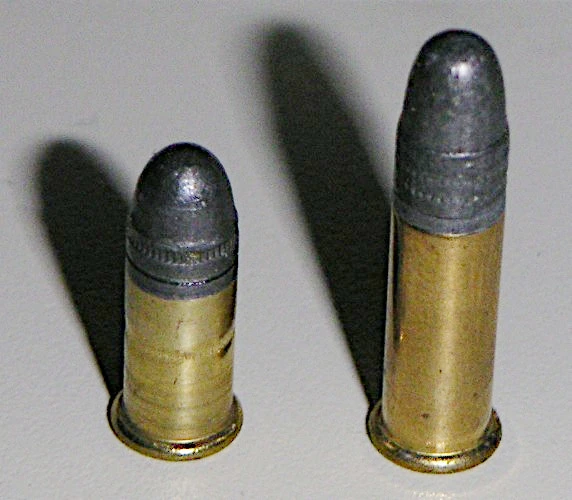
Image credit
- Title
- File:22short22lr.jpg
- Author
- Bloodshedder (Wikimedia Commons)(attribution required)
- Licence
- CC BY-SA 3.0
- Source
- https://commons.wikimedia.org/wiki/File:22short22lr.jpg

Detail
The .22 Short is the first American metallic cartridge, developed in 1857 for the original Smith & Wesson Model 1 revolver. It combined the .22 caliber rimfire priming system, then new, with a straight, rimmed brass case just under 11 mm long, and it went into production alongside the pistol it was built for at a moment when nearly every American handgun still loaded from the muzzle.
Renamed “Short” only in 1871, when the longer .22 Long arrived beside it, the cartridge has outlived the revolver it was designed for by more than a century and a half. Its low recoil and mild report kept it in production for gallery guns at shooting arcades and fairs, for a handful of pocket pistols and mini-revolvers built specifically around its small dimensions, and, until the discipline moved to air pistols in 2004, for Olympic 25-metre rapid-fire pistol shooting, where its light recoil suited five shots fired in as little as four seconds. It is still made today, mostly for the recreational and gallery-gun market, largely unchanged from the shape it had in the nineteenth century.
This entry’s dimensions and maximum pressure are transcribed from the current C.I.P. datasheet
and are verified. No manufacturer publishes a muzzle velocity for this cartridge alongside a
stated test-barrel length (the figures that circulate for it in ballistics tables and
encyclopedia entries give a velocity with no barrel length attached, which this site’s own rule
treats as no measurement at all), so no load is recorded here. The photograph shows a specimen
beside a .22 Long Rifle round for scale; no image of the cartridge on its own, isolated, was
found under a free licence.
References
- .22 short · 1356291673 · read 2026-09-01
- C.I.P. TDCC datasheet — 22 Short · 2008-09-23 · read 2026-09-01
Last verified 2026-09-01 · review status: agent-populated