
.218 Bee
Introduced 1937WinchesterCIP standard
Dimensions and pressure
Generated from the schema, like every specification table on this site, so a figure recorded on this entry cannot be missing from the table.
Identity
- Designed by
- Winchester
- Introduced
- 1937
- Production
- not recorded
- Standards body
- C.I.P.
- Case type
- Rimmed
- Case shape
- Bottleneck
Dimensions
- Bullet diameter
- 5.7 mm0.2244 insource
C.I.P. G1, maximum bullet diameter.
- Bore diameter
- not recorded
- Case length
- 34.16 mm1.345 insource
C.I.P. L3, maximum case length.
- Overall length
- 42.67 mm1.680 insource
C.I.P. L6, maximum cartridge overall length.
- Rim diameter
- 10.36 mm0.4079 insource
C.I.P. R1.
- Neck diameter
- 6.15 mm0.2421 insource
C.I.P. H2.
- Base diameter
- 8.87 mm0.3492 insource
C.I.P. P1.
Pressure
- Maximum pressure
- 320 MPa46,412 psisource
C.I.P. Pmax 3200 bar; 1 bar = 0.1 MPa exactly.
- Pressure standard
- C.I.P.
SAAMI and C.I.P. measure pressure differently and their figures are not interchangeable, which is why the body is always named beside the figure.
Loads
Velocity is recorded per barrel length as published. A gun page interpolates between these points and never projects beyond them.
Hornady 45 gr HP
Hornady
- Bullet mass
- 2.916 g45.00 grsource
Published as 45 gr on Hornady's own product page.
- Cartridge mass
- not recorded
- Bullet type
- HP (InterLock)
- G1 BC
- not recorded
- G7 BC
- not recorded
| Barrel | Velocity |
|---|---|
| 609.6 mm24.00 in | 838.2 m/s2,750 fps |
Chambered in
Computed from every entry that lists this cartridge. Nothing here is hand-maintained.
- Taurus Raging Bull
Taurus Armas
Gallery
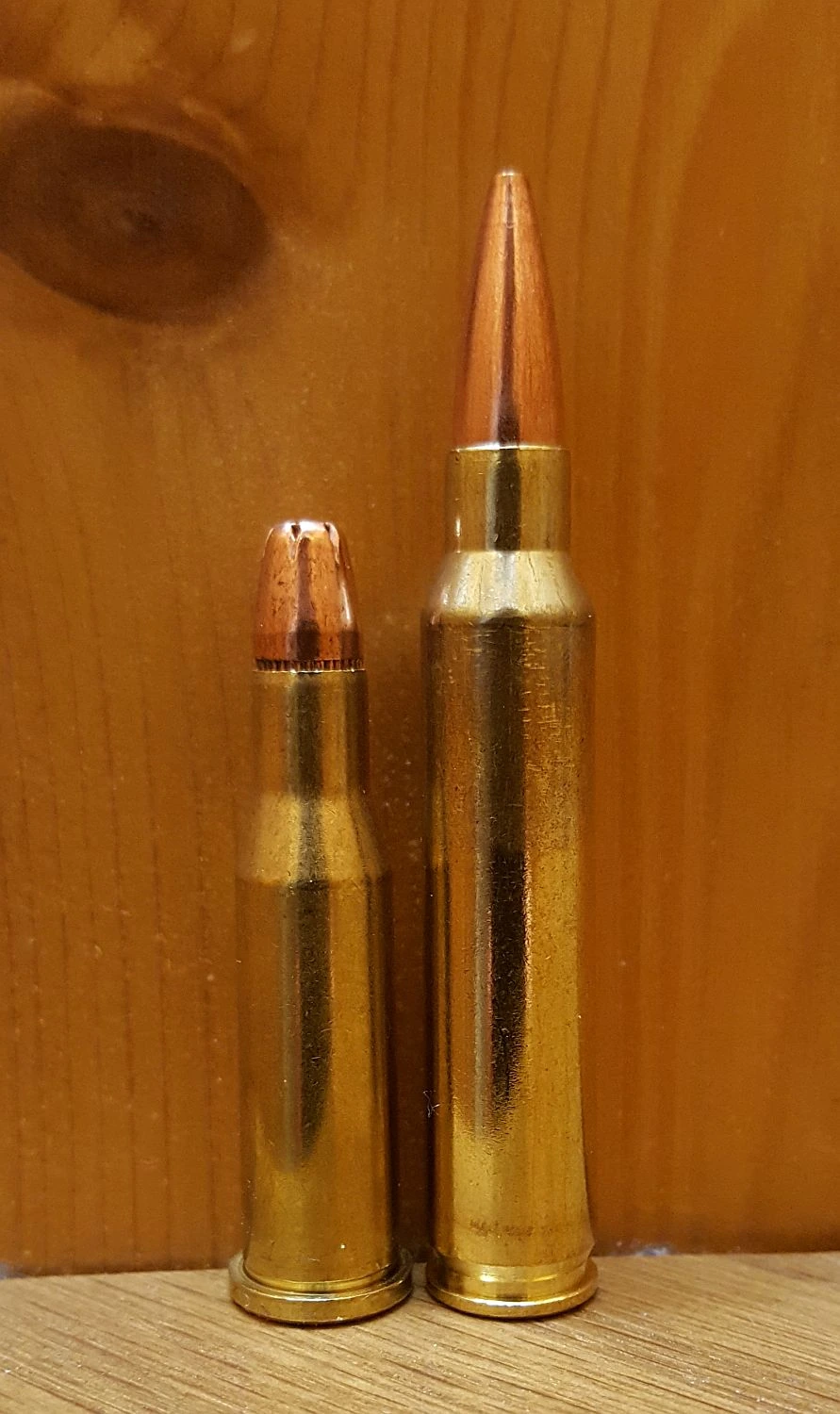
Image credit
- Title
- File:218 Bee.jpg
- Author
- Hellbus(attribution required)
- Licence
- CC BY-SA 4.0
- Source
- https://commons.wikimedia.org/wiki/File:218_Bee.jpg

Detail
Winchester introduced the .218 Bee in 1937 by necking the older .32-20 Winchester case down to take a .224-inch bullet, producing a small rimmed, bottlenecked round for single-shot and lever-action rifles built to handle a light, fast varmint cartridge rather than the pistol-length rounds those actions had traditionally fired. It arrived alongside Winchester’s Model 65 lever rifle and was later chambered in the company’s bolt-action Model 43, giving hunters a cartridge built specifically to shoot small game and varmints without the report or recoil of a full-size rifle round.
The Bee’s rimmed case suited the tubular-magazine and single-shot actions available when it was introduced, at the cost of the smoother, box-magazine feeding that a rimless case like the .222 Remington would later offer purpose-built bolt rifles. That competition, arriving in the 1950s, left the Bee as a niche cartridge rather than a mainstream one; it survives today mainly through handloaders and a small range of factory ammunition rather than as a widely stocked commercial round.
Case and pressure figures here are transcribed from the current C.I.P. datasheet and are
verified. Hornady’s own product page for its 45-grain hollow-point load states both a muzzle
velocity and the 24-inch test barrel it was measured from, which is what lets this entry carry a
sourced velocity point. Most of the loads that appear in reloading tables for this cartridge
publish a velocity with no barrel length at all, and those are left out rather than recorded as
something they are not. No further factory loads with a stated test barrel were found.
References
- .218 Bee · 1316856743 · read 2026-09-01
- C.I.P. TDCC datasheet — 218 Bee · 2002-05-15 · read 2026-09-01
- 218 Bee 45 gr HP · read 2026-09-01
Last verified 2026-09-01 · review status: agent-populated