
10mm Auto
Introduced 1983Jeff Cooper with FFV Norma ABCIP standard
Also known as 10 mm Auto, 10mm Automatic, 10x25mm: the same cartridge under different names, all of which find this page.
Dimensions and pressure
Generated from the schema, like every specification table on this site, so a figure recorded on this entry cannot be missing from the table.
Identity
- Designed by
- Jeff Cooper with FFV Norma AB
- Introduced
- 1983
- Production
- not recorded
- Standards body
- C.I.P.
- Case type
- Rimless
- Case shape
- Straight
Dimensions
- Bullet diameter
- 10.17 mm0.4004 insource
Cartridge maximum, dimension G1.
- Bore diameter
- not recorded
- Case length
- 25.2 mm0.9921 insource
Cartridge maximum, dimension L3.
- Overall length
- 32 mm1.260 insource
Cartridge maximum, dimension L6.
- Rim diameter
- 10.8 mm0.4252 insource
Dimension R1. Equal to the base diameter, because the case is rimless.
- Neck diameter
- 10.74 mm0.4228 insource
Dimension H2. It is within 0.06 mm of the base diameter because the case is straight-walled and headspaces on its mouth.
- Base diameter
- 10.8 mm0.4252 insource
Dimension P1.
Pressure
- Maximum pressure
- 230 MPa33,359 psisource
Pmax 2300 bar, transducer method. SAAMI rates the same chambering at 37,500 psi, so the two bodies' ceilings are not interchangeable figures.
- Pressure standard
- C.I.P.
SAAMI and C.I.P. measure pressure differently and their figures are not interchangeable, which is why the body is always named beside the figure.
Loads
Velocity is recorded per barrel length as published. A gun page interpolates between these points and never projects beyond them.
American Eagle 180 gr FMJ
Federal
- Bullet mass
- 11.66 g179.9 grsource
180 gr as published, converted to grams.
- Cartridge mass
- not recorded
- Bullet type
- FMJ
- G1 BC
- not recorded
- G7 BC
- not recorded
| Barrel | Velocity |
|---|---|
| 127 mm5.000 in | 313.9 m/s1,030 fps |
Punch 200 gr JHP
Federal
- Bullet mass
- 12.96 g200.0 grsource
200 gr as published, converted to grams.
- Cartridge mass
- not recorded
- Bullet type
- JHP
- G1 BC
- not recorded
- G7 BC
- not recorded
| Barrel | Velocity |
|---|---|
| 127 mm5.000 in | 335.3 m/s1,100 fps |
Chambered in
Computed from every entry that lists this cartridge. Nothing here is hand-maintained.
- Brügger & Thomet APC9
Brügger & Thomet
Gallery
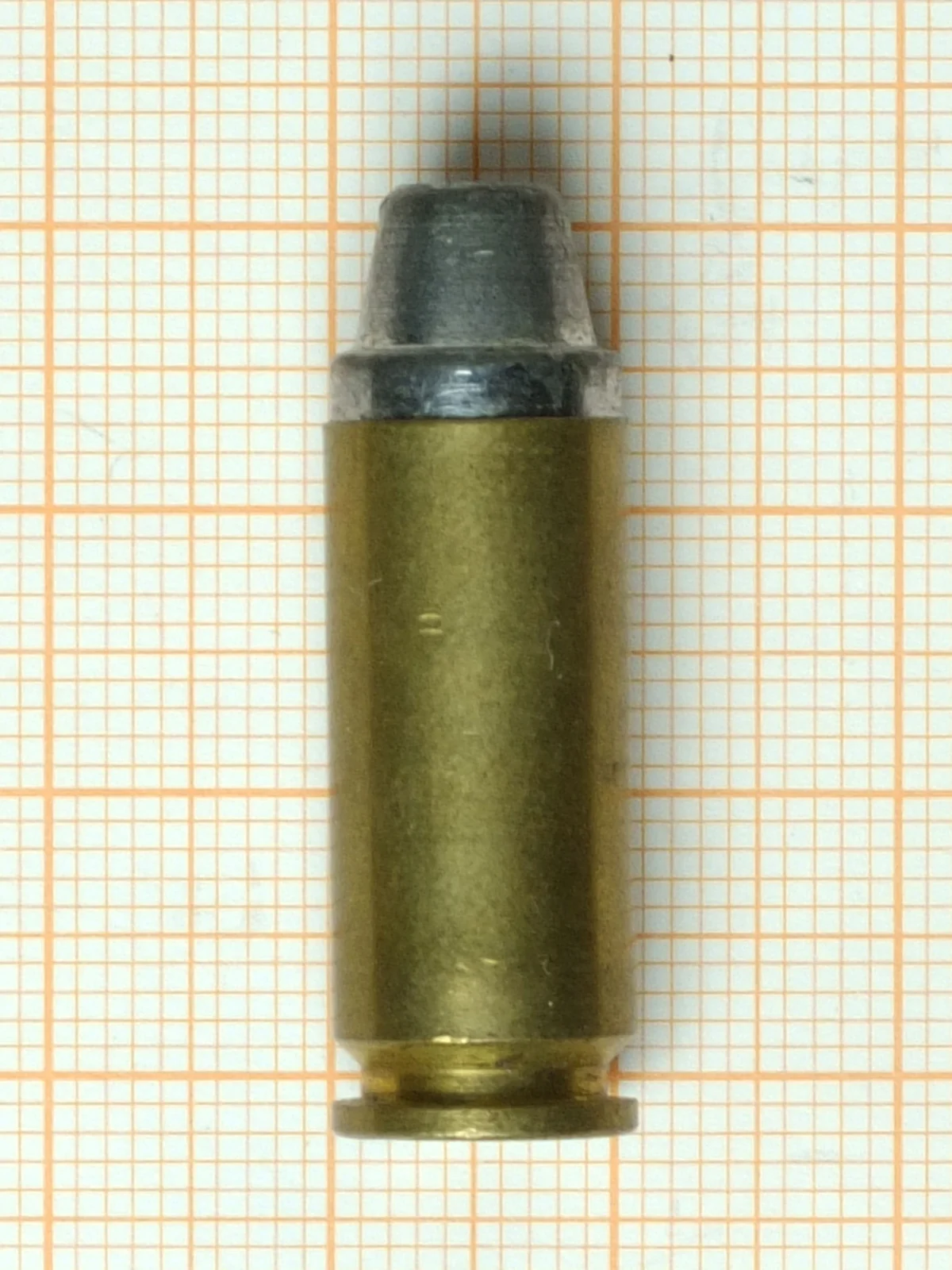
Image credit
- Title
- File:Cartridge 10mm Auto CC BY-SA 4.0 by Grasyl.jpg
- Author
- Grasyl(attribution required)
- Licence
- CC BY-SA 4.0
- Source
- https://commons.wikimedia.org/wiki/File:Cartridge_10mm_Auto_CC_BY-SA_4.0_by_Grasyl.jpg

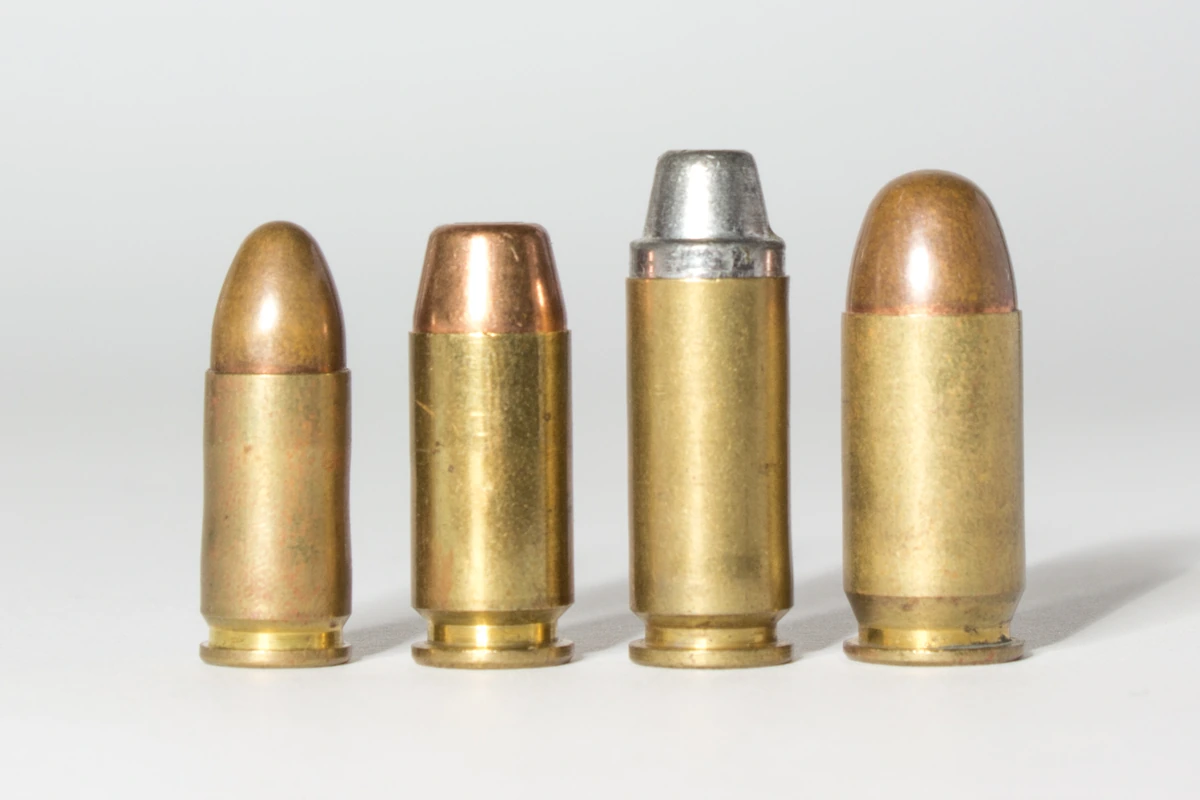
Image credit
- Title
- File:Pistol calibre cartridges comparison - 9x19mm Para, .40 S&W, 10mm Auto and .45 ACP.jpg
- Author
- Grasyl(attribution required)
- Licence
- CC BY-SA 4.0
- Source
- https://commons.wikimedia.org/wiki/File:Pistol_calibre_cartridges_comparison_-_9x19mm_Para,_.40_S&W,_10mm_Auto_and_.45_ACP.jpg

Detail
The 10mm Auto was drawn up in 1983 by FFV Norma AB of Åmotfors for a single pistol, the Bren Ten, and it was made deliberately stronger than the concept Jeff Cooper had proposed. The result is a rimless straight-walled case that carries revolver-magnum energy in a length a self-loading pistol can cycle, and a round whose commercial history is mostly the story of people finding that energy inconvenient.
The case is 25.2 mm long and 10.8 mm across the head, both figures much closer to a rifle-derived case than to the pistol rounds it competes with. There is no shoulder and almost no taper: the neck measures 10.74 mm against a base of 10.80 mm, so the case headspaces on its own mouth and the extractor has nothing to grip but the groove. That geometry is what makes the round awkward to load down. The FBI adopted it in 1989 and immediately specified a reduced charge, and Smith & Wesson observed that the same performance fitted in a case shortened to 22 mm, which is the .40 S&W, introduced in 1990 in pistols sized for 9mm. The parent round went on being loaded at full pressure, and the two now share a bullet diameter and a bolt face while differing by 3.6 mm of case.
Its second life is as a hunting and outdoor cartridge rather than a service one. It is the largest common chambering in a full-size polymer service pistol, which is a different proposition from a magnum revolver of comparable energy, and it is one of the few pistol rounds regularly loaded with 200-grain bullets at over 1,000 feet per second.
Gaps on this page: the C.I.P. and SAAMI figures for this round genuinely differ (C.I.P. gives a bullet diameter of 10.17 mm and a ceiling of 2300 bar, SAAMI 0.4005 in and 37,500 psi), and the C.I.P. sheet is the one transcribed throughout, with SAAMI’s pressure noted beside it rather than stored as a second value. The two loads recorded here are both Federal’s, because Federal is the maker that publishes the test barrel length its velocities were measured in; the velocities quoted in the encyclopedia infobox carry no barrel length that can be attributed to any particular row, so none of them is used.
References
- C.I.P. TDCC datasheet, 10 mm Auto · Tab. IV, dated 1984-10-03, revision 2012-05-30 · read 2026-08-31
- American Eagle Handgun 10mm Auto 180 grain FMJ (AE10A) · read 2026-08-31
- Punch Handgun 10mm Auto 200 grain JHP (PD10P1) · read 2026-08-31
- 10mm Auto · 1371072486 · read 2026-08-31
Last verified 2026-08-31 · review status: agent-populated