
Masala Chai
Black tea, milk and a spice blend boiled together, roadside-stall style.
Black tea steeped in simmered spiced milk, the lighter home-kitchen build.

CC BY-SA 4.0 · Cropped, white-balanced, graded and re-encoded to WebP by eXir.
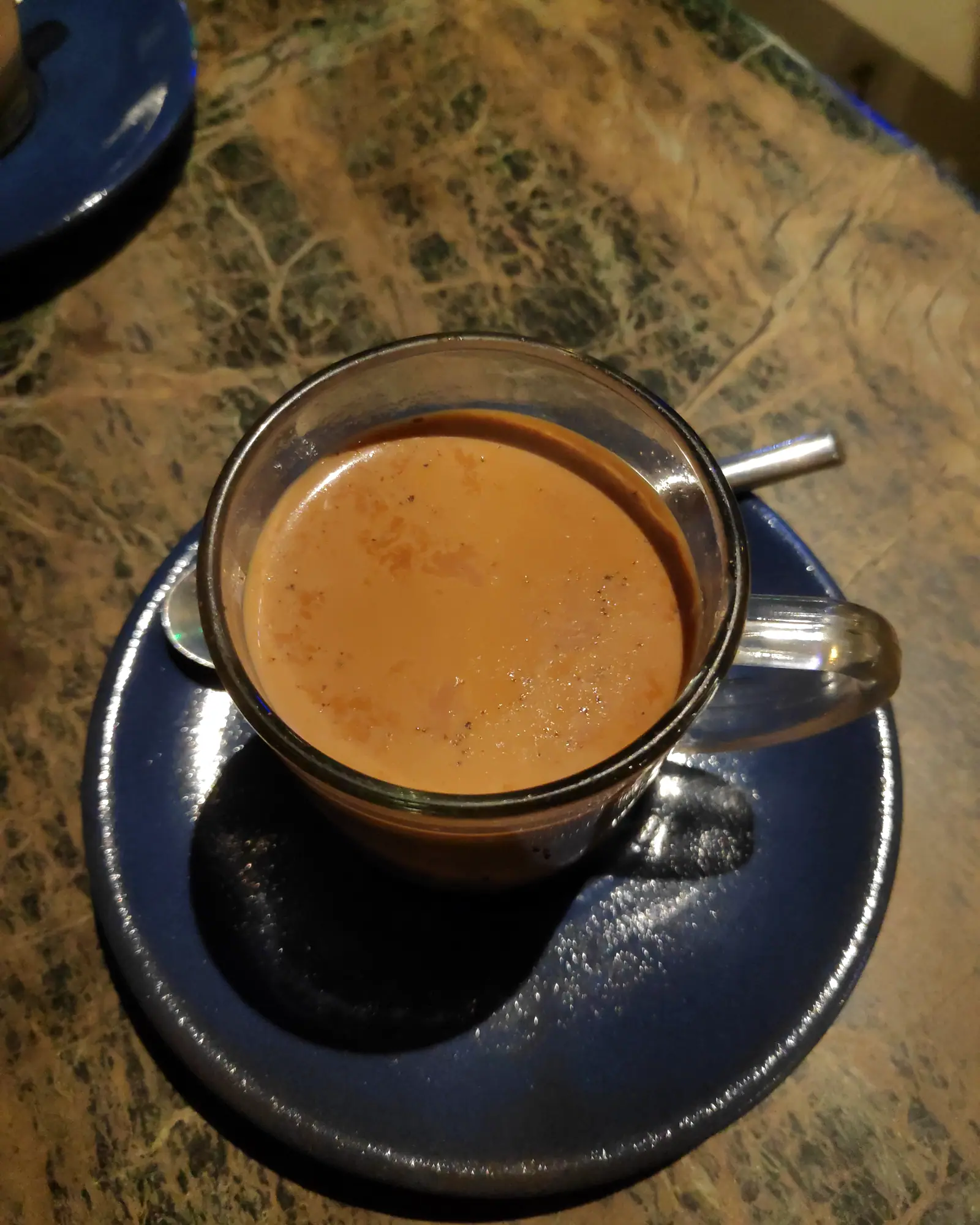
Overhead view of masala chai in a glass cup on a saucer, milky tan-coloured with a thin foam
Serving
Drink spec, per drink
Every figure above is per drink and does not move with the count, which is what makes the two service modes comparable. Sugar per litre, strength and standard drinks stay in the units their own authorities publish, because they are figures for comparing rather than for pouring.
Diet and allergen labels are computed from the ingredients listed on this page and nothing else. They cannot account for cross-contamination or for the particular product you buy, and they are not medical or safety guidance.
Extraction
This brew works out at 50.0 g of coffee per litre of water, against the 49.5 to 60.5 g/L the standard allows, so it sits inside it. The comparison is made in grams per litre and not on the ratio, because a ratio is the reciprocal of a strength and a symmetric band on one is an asymmetric band on the other. The water temperature also sits outside the standard. Source: Golden Cup Standard, Specialty Coffee Association.
No extraction yield is shown. It needs a measured dissolved-solids figure from the finished cup, nothing on a bag of coffee supplies one, and estimating it from the method would be inventing the single number the calculation exists to establish.
Ingredients
 100 ml water
 5 g black tea
 1 g crushed cardamom pods
 2 g cinnamon bark
 4 g fresh ginger
 0.5 g cracked black pepper
 15 g granulated sugar
 80 ml whole milk
- 100 ml water
- 5 g black tea
- 1 g crushed cardamom pods
- 2 g cinnamon bark
- 4 g fresh ginger
- 0.5 g cracked black pepper
- 15 g granulated sugar
- 80 ml whole milk
Glass
Vessel
199 ml of liquid, served without ice, inside the 350 ml the glass holds. The build fails if a recipe ever exceeds its stated vessel.
A batch needs a vessel that closes and fits a fridge shelf.
Drink spec, per drink
Every figure above is per drink and does not move with the count, which is what makes the two service modes comparable. Sugar per litre, strength and standard drinks stay in the units their own authorities publish, because they are figures for comparing rather than for pouring.
Diet and allergen labels are computed from the ingredients listed on this page and nothing else. They cannot account for cross-contamination or for the particular product you buy, and they are not medical or safety guidance.
Extraction
No extraction yield is shown. It needs a measured dissolved-solids figure from the finished cup, nothing on a bag of coffee supplies one, and estimating it from the method would be inventing the single number the calculation exists to establish.
Ingredients
- 60 ml water
- 120 ml whole milk
- 1 g crushed cardamom pods
- 3 g fresh ginger
- 4 g black tea
- 12 g granulated sugar
- 60 ml water
- 120 ml whole milk
- 1 g crushed cardamom pods
- 3 g fresh ginger
- 4 g black tea
- 12 g granulated sugar
Glass
Vessel
238 ml of liquid, served without ice, inside the 350 ml the glass holds. The build fails if a recipe ever exceeds its stated vessel.
A batch needs a vessel that closes and fits a fridge shelf.
Method
4 steps · 5mCombine the 100 ml water, the 5 g black tea, the 1 g crushed cardamom pods, the 2 g cinnamon bark, the 4 g fresh ginger, the 0.5 g cracked black pepper and the 15 g granulated sugar in a small pan, bring to a boil, then lower the heat and simmer for 3m.
Stir in the 80 ml whole milk.
Bring back to a boil and simmer again for 2m, until the colour is an even, deep tan.
The tea, spices and sugar go into the water from the start and are brought back to a boil a second time once the milk goes in, the roadside-stall build that gets a spiced, sweetened cup of this strength to come out smooth rather than merely stewed.
Strain into a mug, leaving the leaf and spices behind.
Common pitfallBringing the milk to a hard boil unwatched, rather than lowering the heat as soon as it rises, boils it straight over the side of the pan; the second boil needs watching in a way the first, water-only one does not.
Keeping and make-ahead
Boiled to order in a small pan. Reheating a made batch splits the milk proteins that the first boil bound successfully.
Method
3 steps · 5mCombine the 60 ml water, the 120 ml whole milk, the 1 g crushed cardamom pods and the 3 g fresh ginger in a small pan and bring to a gentle simmer for 2m.
Take off the heat, stir in the 4 g black tea and the 12 g granulated sugar, and steep for 3m.
The tea goes in only once the milk is already hot and spiced, then steeps rather than boils, which is what keeps this version lighter and less tannic than the roadside-stall build boiled straight through.
Strain into a mug, leaving the leaf and spices behind.
Common pitfallLetting the leaf steep well past the stated time in already-hot milk still pulls out real bitterness, even without a second boil; this build is gentler than the boiled version, not exempt from over-steeping.
Keeping and make-ahead
Simmered and steeped to order in a small pan; the milk splits if a made batch is reheated for a second serving.
About
Black tea boiled with milk, sugar and a spice blend, an Indian street invention that grew out of a colonial-era marketing campaign it was never designed to produce.
Before tea reached most of India as a drink, kadha already existed there: an Ayurvedic decoction of spices such as ginger, cardamom and pepper, boiled in water for medicinal use rather than refreshment 1. Black tea itself arrived as a colonial export crop. The British East India Company began planting Assamese tea in the 1830s specifically to break a Chinese near-monopoly on supply, and by 1900 Indian and Ceylonese tea had displaced most Chinese tea in Britain's own market, but almost none of it was drunk in India, where it was grown, packed and shipped straight to London 2 1.
That changed once the Indian Tea Association, facing an oversupply of tea it could no longer sell abroad, began a domestic marketing campaign in the early twentieth century, subsidising tea breaks in factories and mills and tea stalls along the expanding railway network 2. The Association pushed the plain English method of steeping tea in water alone; independent chaiwalas at those same stalls did the opposite, stretching a smaller dose of cheap tea dust with milk, sugar and the older kadha spice mix, both to cut cost and to suit a market already used to spiced drinks 1. The Association initially objected to the practice as wasteful of the tea it was trying to promote 2.
The version that won out was the chaiwalas', not the Association's, and it spread through homes, markets and railway platforms as an everyday drink rather than a colonial import 2. What counts as the spice blend is not fixed: cardamom, ginger and cinnamon are close to universal, and cloves, black pepper, star anise or fennel appear depending on region and household 2.
- 1The True History of Masala Chai: Did the British Invent It?teatrade.co.uk
- 2Masala chaien.wikipedia.org