
Gluhwein
Red wine warmed with cinnamon, star anise and orange, poured plain with no spirit added, the way German Christmas markets serve it.

CC BY 2.0 · Cropped, white-balanced, graded and re-encoded to WebP by eXir.
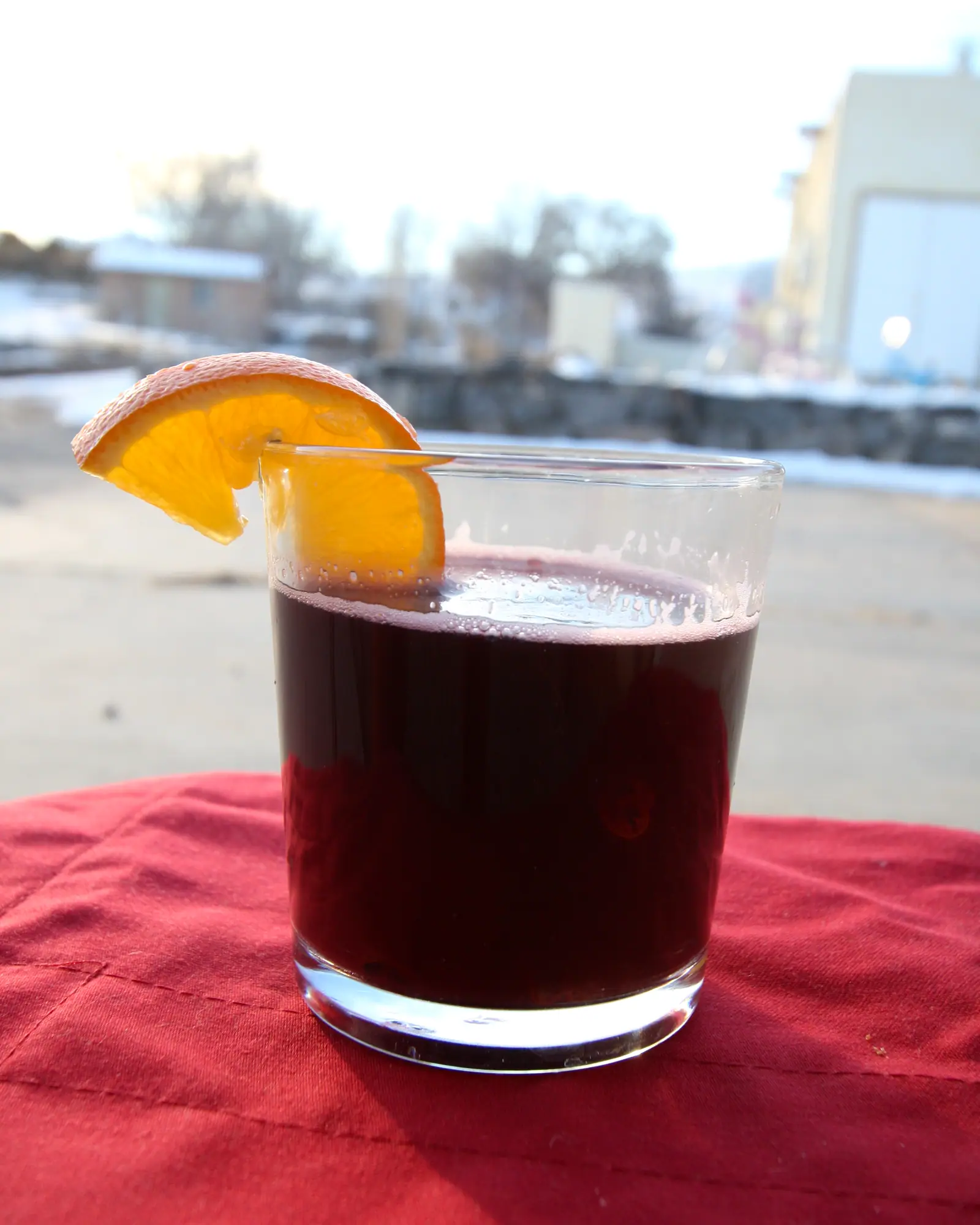
A glass of dark red Glühwein with an orange slice at the rim
Serving
Drink spec, per drink
Every figure above is per drink and does not move with the count, which is what makes the two service modes comparable. Sugar per litre, strength and standard drinks stay in the units their own authorities publish, because they are figures for comparing rather than for pouring.
Many red wines are fined with isinglass, gelatine or egg white or casein; unfiltered or vegan-labelled bottles are not. The finished wine contains at most a trace of the fining agent, but the label is the only way to know which was used for a given bottle.
Diet and allergen labels are computed from the ingredients listed on this page and nothing else. They cannot account for cross-contamination or for the particular product you buy, and they are not medical or safety guidance.
Ingredients
 300 ml red wine
 25 g granulated sugar
 4 g cinnamon bark
 1 g cloves
 2 g star anise
 ½ orange (30 g)
- 300 ml red wine
- 25 g granulated sugar
- 4 g cinnamon bark
- 1 g cloves
- 2 g star anise
- ½ orange (30 g)
Glass
Vessel
158 ml of liquid, served without ice, inside the 350 ml the glass holds. The build fails if a recipe ever exceeds its stated vessel.
A batch needs a vessel that closes and fits a fridge shelf.
Method
3 steps · 15mCombine the 300 ml red wine, the 25 g granulated sugar, the 4 g cinnamon bark, the 1 g cloves, the 2 g star anise and the ½ orange (30 g) in a pot and warm gently until the sugar dissolves and the wine steams.
The wine never comes to a boil, only a bare steam, since boiling both drives off alcohol and turns the star anise bitter over time.
Take off the heat, cover and let the spices steep for 10m.
Warm through again briefly and strain hot into mugs.
Common pitfallNo spirit goes into a Gluhwein at any point; stirring in a shot of something stronger is what turns this specific drink into a Glogg instead, whatever the spice mix in the pot.
Keeping and make-ahead
Batched ahead, this keeps sealed and cold. The water line the engine adds is the dilution figure from the spec panel, not a rule of thumb.
About
Spiced red wine warmed with cinnamon and citrus, the standard drink of German Christmas markets, tracing its name to a "glowing" method of heating wine that predates the markets themselves by centuries.
Heated, spiced wine is recorded as far back as Roman antiquity: the playwright Plautus refers to it in his second-century-BC comedy Curculio, and Roman legions are credited with carrying both viticulture and the practice of heating wine north along the Rhine and Danube as they expanded into Europe 1. A named Roman recipe for spiced wine, conditum paradoxum, appears in the cookbook attributed to Apicius, built from wine, honey and spices including pepper, bay leaf and saffron 2.
The name Gluhwein itself is German for "glow-wine," and the oldest surviving vessel made specifically for it, a tankard dated to around 1420, belonged to Count John IV of Katzenelnbogen 1. One account of the name ties it to a specific heating method: an iron rod heated in a fire until it glowed, then plunged directly into a cup of wine, which is said to have briefly glowed at the point of contact 2. A separate account instead traces "glowing wine" to a sixteenth-century Swedish coinage, glödgad vin, which is also the root given for the Swedish Glogg, rather than to any German source 2; the two explanations are not reconciled between the sources consulted here.
Gluhwein's specific association with Christmas markets is a later development. Vienna's Christmas market dates to 1298, and Gluhwein is described as an established feature of German-speaking Christmas markets by the seventeenth century, sold from stalls to marketgoers against the cold 2. It remains the standard hot drink at Christmas markets from Munich to Vienna today, and in Alsace it is said to be the only alcoholic drink sold at the market at all 1. Unlike its Nordic counterpart, it is not built with an added spirit.
- 1Mulled wineen.wikipedia.org
- 2Mull It Over — The History of Glühweincrushmag-online.com