Japanese · Main Course
Yakitori
Chicken thigh and spring onion threaded onto skewers and grilled over charcoal, finished with a reduced soy and mirin glaze.
Also known asNegima · Japan
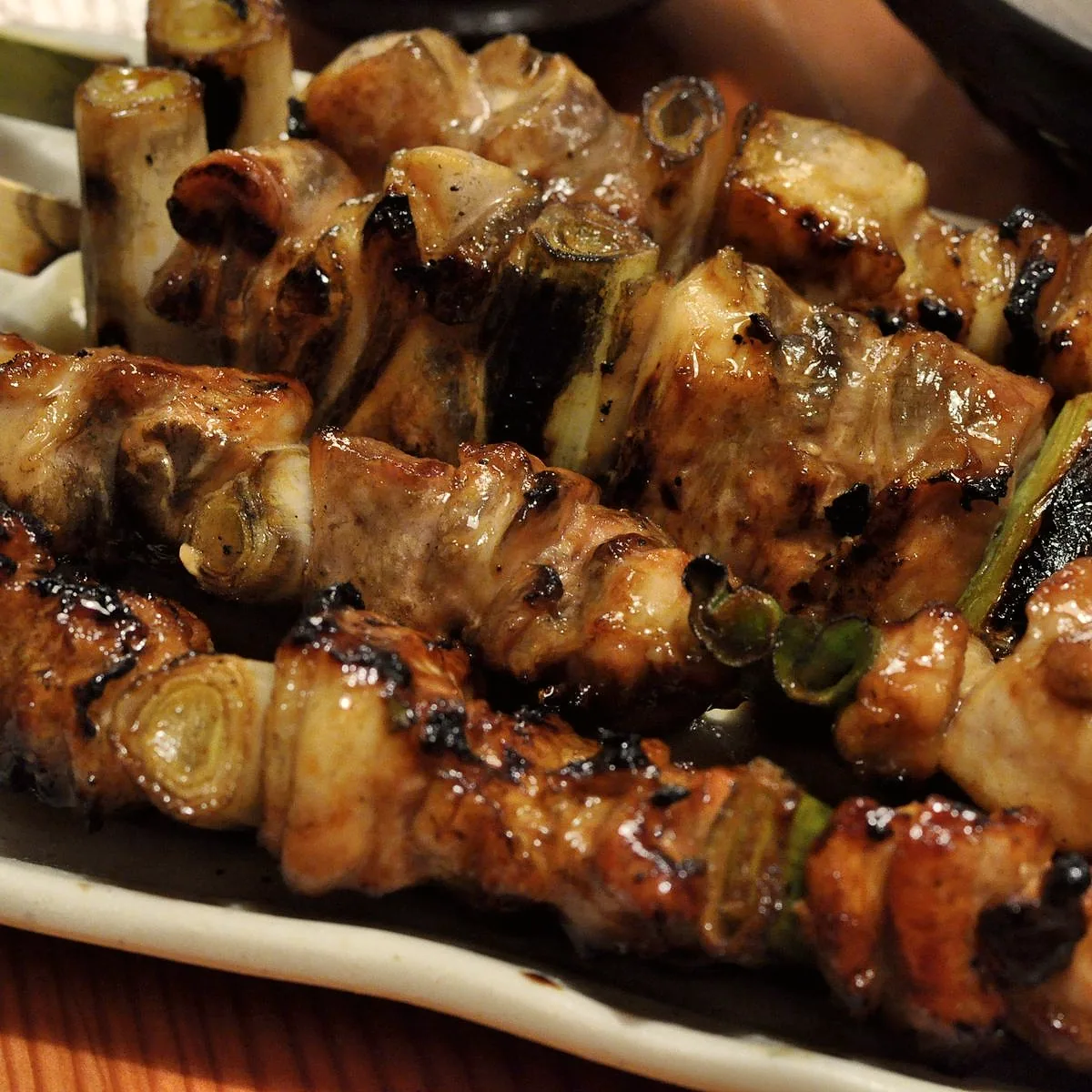

CC0. Cropped and colour-adjusted for this site.
The same dish, adapted. Every quantity, time and figure below changes with the version.
Method
Thread the 500 g chicken thigh onto skewers, alternating each piece with a length of the 4 spring onions (60 g).
Meanwhile, combine the 60 ml light soy sauce, 60 ml mirin, 40 ml sake and 20 g caster sugar in a small saucepan and simmer for 12m, until reduced by roughly a third and syrupy enough to coat the back of a spoon.
Grill the skewers over direct charcoal heat for 12m, turning regularly and brushing with the tare on each turn, until the chicken is cooked through and the glaze has caramelised into a dark, sticky lacquer.
The tare is brushed on in thin layers over several passes rather than poured on once, so each coat has time to set and caramelise instead of burning against the coals or sliding off.
Method
Thread the 500 g chicken thigh onto skewers, alternating each piece with a length of the 4 spring onions (60 g).
Season the skewers all over with the 6 g fine sea salt and grill them over direct charcoal heat for 12m, turning regularly, until well charred in places and the chicken is cooked through.
With no glaze to caramelise and hide behind, shio relies entirely on the char from direct heat for flavour, so the skewers sit closer to the coals than a tare-glazed batch would.
The word yakitori is old, but what it named at first was not quite today's dish. It appears in Ryori Monogatari, published in 1643 and generally reckoned Japan's oldest surviving cookbook, though the food it describes under that name was most likely grilled poultry without a skewer at all; a related but separate term, kushiyaki, covered skewered grilling in that period [2]. A closer ancestor of the modern skewer turns up later, in the 1785 text Manpo Ryori Himitsubako, under the name Nagasaki Toridengaku [2].
Chicken specifically, and the street-stall format recognisable today, arrived later still. Cultural resistance to eating meat had kept poultry a marginal food in Japan for centuries, and yakitori's popularisation followed the Meiji Restoration, when that resistance eased and inexpensive off-cuts and offal from newly common poultry slaughter gave stallholders cheap, quick-cooking food to sell [2]. The dish kept growing through hardship rather than plenty: it is described as becoming an everyday food after the 1923 Great Kanto Earthquake, when offal became a valued source of protein, and again after the Second World War, when yakitori stalls proliferated in the black markets around stations such as Shinbashi and Shinjuku [2]. Chicken did not become the standard yakitori meat until the 1960s, once mass-produced broiler chickens made it the cheapest bird on the market [2]. The two seasoning styles served today (tare, the sweet soy glaze, and shio, salt alone) are both sold side by side at the same stalls, with the choice between them left to the customer rather than fixed by the dish itself [1].
Sources
- Yakitori, WikipediaDescribes the dish's current form, seasoning styles and sale from street stalls.
- Learning about the Endless Variety of Yakitori Flavors from History, SHUNGATETraces the word to the 1643 cookbook Ryori Monogatari, the 1785 Nagasaki Toridengaku skewer reference, and the post-Meiji spread of chicken yakitori.