Caribbean · Side
Tostones
Green plantain fried once to soften, flattened, then fried again until crisp outside and tender within. Tostones are a Caribbean side eaten wherever plantains are.
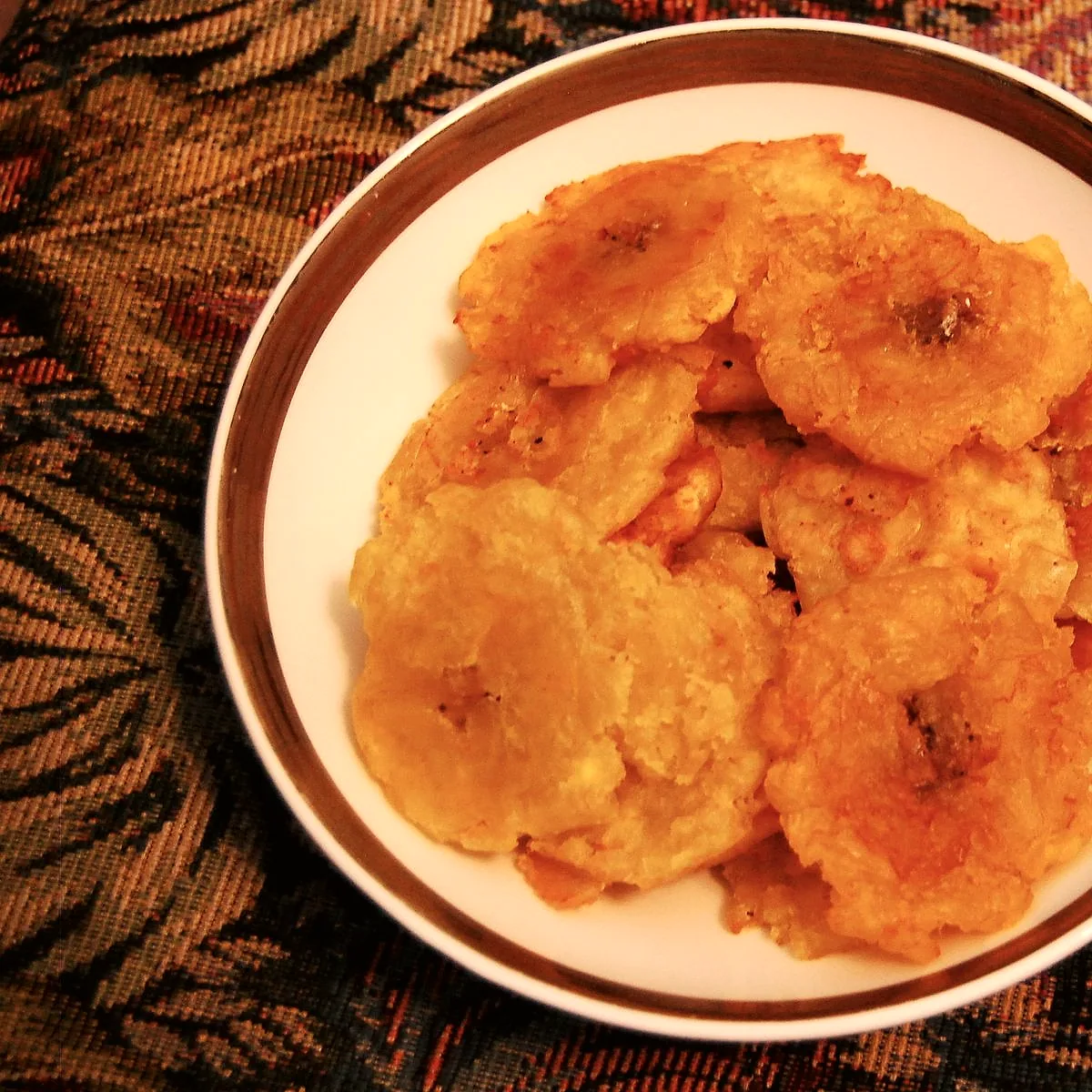

CC BY-SA 3.0. Cropped and colour-adjusted for this site.
Method
Heat the 700 ml vegetable oil in a deep, heavy pan and fry the 500 g green plantain for 8m, until pale gold and just tender but not browned. Lift out and drain, leaving the oil in the pan.
Press each piece flat with a tostonera, the base of a glass, or the flat side of a knife, to about half its original thickness. This takes about 5m.
Common pitfallPlantain flattened straight from the hot oil tears easily; letting it cool for a few seconds first, or pressing gently rather than all at once, keeps the disc in one piece.
Stir the 1 garlic clove (5 g) and 5 g fine sea salt into the 300 ml water, then dip each flattened piece briefly in the water and lift straight back out. This takes about 3m.
The brief dunk in salted, garlicky water between fryings seasons the flattened plantain all the way through and adds back a little moisture, which is what keeps the second fry from drying the centre out even as the outside crisps.
Return the plantain to the hot oil and fry for 5m, until deeply golden and crisp at the edges. Drain and season with the 3 g fine sea salt while still hot.
Plantains reached the Caribbean with Spanish colonisers, but the knowledge that turned them into a staple food, and the techniques for cooking them, travelled with enslaved Africans, who brought both agricultural expertise and a tradition of making the most of an abundant starch [1]. Food historian Von Diaz frames the logic behind dishes like tostones plainly: faced with an abundance of one ingredient, cooks find every possible way to use it [1].
Even the dish's name is not settled. "Tostón" is documented as the name of a colonial Spanish silver coin, itself descended from the Italian "testone," a coin struck in Milan from 1470 bearing a ruler's head [2]; the fried plantain disc, roughly coin-shaped once flattened, is often said to take its name from that resemblance. A second, more literal candidate ties the word instead to the Spanish verb tostar, "to toast". It is a plausible rival that the documented coin sense does not rule out.
What is not in dispute is the dish's reach. The same twice-fried plantain, softened by an initial fry, flattened, and crisped by a second, appears under different names wherever the fruit itself does: tostones in Puerto Rico and Cuba, bannann peze in Haiti, patacones in Peru and much of northern South America [1]. The technique is constant even as the name, the dipping sauce and the accompaniment change from island to island and coast to coast.
Sources
- Behind the Recipes: Tostones, America's Test KitchenCites food historian Von Diaz on plantains becoming a Caribbean staple through African agricultural and culinary knowledge, and describes regional variants including Haitian bannann peze and Peruvian patacones.
- Tostón, por qué le decimos así a los billetes y monedas de 50, México DesconocidoStates that "tostón" descends from the Italian coin name "testone," referring to coins struck in Milan bearing a ruler's head, first circulated in 1470 and later used for Spanish colonial silver coins of half a real.