Central Asian · Main Course
Shashlik
Cubed lamb leg marinated overnight with onion, vinegar and oil, then threaded and grilled hard over charcoal.
Also known asShashlyk
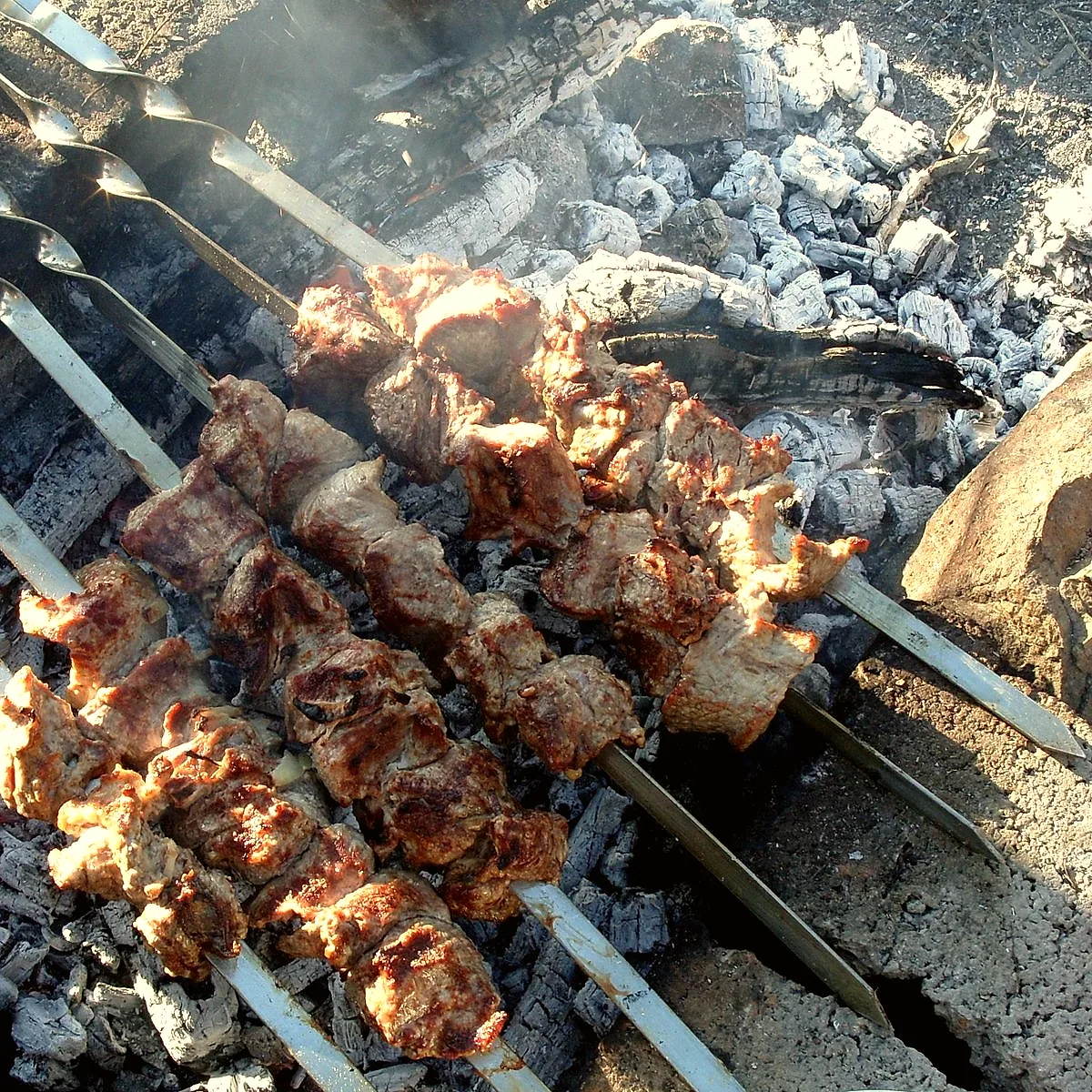

CC BY-SA 4.0. Cropped and colour-adjusted for this site.
Method
Trim the 600 g lamb leg of any excess fat and sinew, and cut it into even cubes.
Layer the cubed lamb with the 150 g yellow onion in a non-reactive container, then add the 30 ml red wine vinegar, 15 ml extra-virgin olive oil, 6 g fine sea salt and 2 g ground black pepper and turn everything together so the meat is well coated. Cover and marinate, refrigerated, for 8h.
The onion is layered through the meat rather than only added as a flavouring; its juice, along with the vinegar, is what tenderises the leg meat over the long marinating time.
Lift the lamb from the marinade, shaking off the excess, and thread it tightly onto skewers, alternating with pieces of the marinated onion.
Grill the skewers over fierce, direct charcoal heat, turning often, for 12m, until well charred outside and cooked through with a hint of pink remaining at the centre.
The word gives the history away. Shashlik comes from Crimean Tatar şış, "spit," borrowed into Russian by the Zaporozhian Cossacks in the eighteenth century [1]. Accounts of the exact root differ (one reading gives Crimean Tatar шыш as "piece," with шашлык as "in pieces," rather than a word for the spit itself [2]), but they agree on the route: a Turkic word entering Russian from the Crimea in that century. Before that borrowing, Russian used its own term for skewered meat, cooked на вертеле, "on a spit," with the dish itself called vertelnoye [1][2], so the dish and its cooking method were already established across the Caucasus and Central Asia among Turkic and Caucasian peoples well before the word, or the dish under that name, became part of Russian cuisine.
Shashlik's spread through the Russian Empire tracks a specific piece of nineteenth- century political history. It became widely known in Russia only after Georgia, Azerbaijan and part of Armenia were absorbed into the empire in the mid-nineteenth century, and it remained largely unknown in Moscow until the century's later decades [1]. From there it moved quickly: shashlik was an established feature of St Petersburg restaurant menus by the 1910s and had become a common street food across urban Russia within another decade [1]. What reads today as a distinctively Russian dish is, by its own name, a Caucasian and Central Asian one that Russian cuisine adopted comparatively late.
Sources
- Shashlik, WikipediaGives the Crimean Tatar etymology, the eighteenth-century entry into Russian and the nineteenth-century spread following the annexation of Georgia, Azerbaijan and Armenia.
- All About Shashlyk (BBQ from the Caucasus), FolkwaysIndependently corroborates the pre-borrowing Russian term for spit-cooked meat and offers an alternate reading of the Crimean Tatar root.