Brazilian · Snack
Pão de Queijo
Small, chewy cassava-starch rolls bound with cheese, with no wheat flour at all.
Also known asBrazilian cheese bread · International
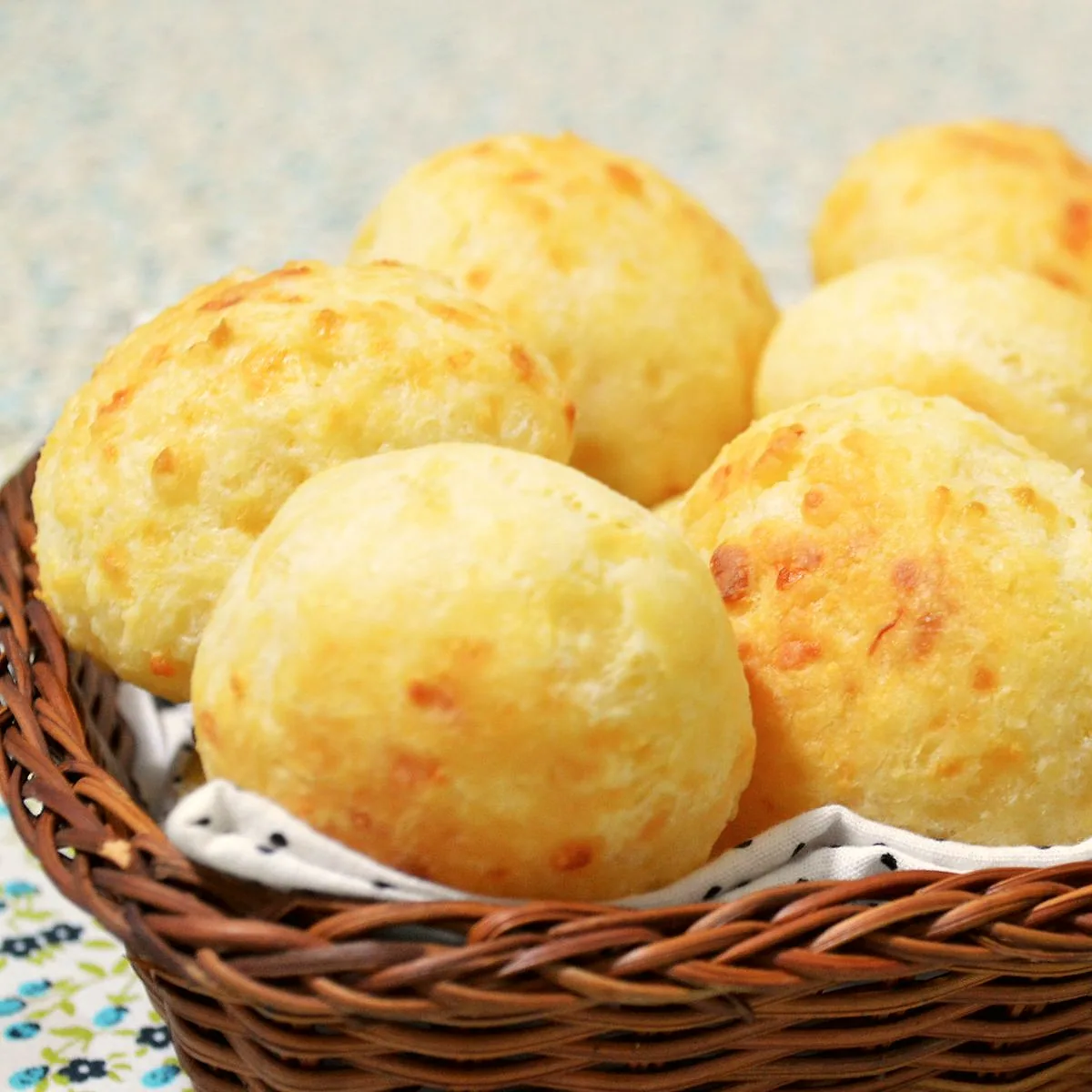

CC BY-SA 4.0. Cropped and colour-adjusted for this site.
Method
Bring the 250 ml milk, 120 ml vegetable oil and 8 g fine sea salt to a full boil in a saucepan.
Combine the 250 g sour tapioca starch and 250 g tapioca starch in a large bowl. Pour over the hot liquid and stir until it forms a rough, sticky, partially cooked dough.
Pouring the hot milk and oil straight over the raw starch partially cooks it, which is what gives the dough its stretch and the baked roll its characteristic chew; a dough mixed cold from the same ingredients bakes up dense and short instead.
Let the dough cool for 15m, until only warm to the touch.
Knead in the 2 eggs (100 g) and the 250 g fresh Minas cheese until the dough is smooth, glossy and elastic; it will look loose at first and come together as the eggs are absorbed.
Common pitfallAdding the eggs while the scalded starch is still hot cooks them on contact and streaks the dough. It needs to cool until only warm before the eggs go in.
Roll the dough into small balls and space them on lined trays.
Bake at 180 °C for 25m, until puffed and golden, with a firm crust over a chewy centre.
Pão de queijo is older than any precise date attached to it, and the two best-documented accounts of its early history do not fully agree. Both trace the dish to Minas Gerais during Brazil's colonial gold-mining boom of the eighteenth century, which drew a huge workforce, enslaved and free, into the region [1][2]. Cassava, already grown in the area before Portuguese arrival, filled the gap left by wheat, which the region's distance from the coast and its soil made impractical to grow or import affordably [1][2].
Where the accounts diverge is timing, and specifically cheese. Wikipedia's history, drawing on the journalist Xavier Graziano's 2014 account in the newspaper Estadão, ties cheese's entry into the recipe to the later, post-abolition growth of Minas Gerais's dairy industry, well over a century after the gold rush that started the cassava-starch habit in the first place. It is one version of the story, offered without a document precise enough to fully confirm it. A separate account from the Brazilian broadcaster Rede 98, citing the food researcher Vani Fonseca, dates the dish closer to 1750 and describes cheese entering the recipe far earlier, as leftover scraps saved from artisanal cheesemaking on Minas Gerais farms, folded into polvilho dough on weekends, well before the timeline the abolition-era story assumes [2]. Neither account cites a document precise enough to settle the question, and readers should treat pão de queijo's exact date, and the moment cheese joined the starch, as genuinely unresolved rather than fixed to either telling.
What both versions agree on is the shape of the story: a cassava-starch staple, born of a region that could not easily grow wheat, later enriched with the region's own dairy into the roll eaten today (crisp-shelled, chewy inside, and leavened by nothing but egg and steam rather than yeast).
The dish's second life, as a commercial product sold well beyond Minas Gerais, is better dated. The engineer Mário Carneiro founded Casa do Pão de Queijo in São Paulo in 1967, selling rolls made to his mother Dona Arthêmia's recipe; the chain's later franchised growth carried the roll into the rest of Brazil and eventually abroad, where it is now sold as "Brazilian cheese bread" [3].
Sources
- Pão de queijo, WikipediaDates the dish's origin to the Minas Gerais gold-mining boom of around 1700, and its adoption of cheese to the late nineteenth century, citing Xavier Graziano's 2014 history published in the newspaper Estadão.
- A verdadeira origem do pão de queijo: história, ciência e o segredo do 'ouro branco' de Minas, Rede 98Brazilian radio-station news feature citing food researcher Vani Fonseca, dating the recipe to around 1750 and describing cheese scraps from farm dairies being folded into the starch dough well before the century Wikipedia's account assumes.
- Casa do Pão de Queijo: como a rede de cafés e lanches chegou à recuperação judicial, Bloomberg LíneaBusiness journalism account of Mário Carneiro founding Casa do Pão de Queijo in 1967 on his mother Dona Arthêmia's recipe, and the chain's later franchised growth.