Levantine · Dessert
Knafeh Nabulsieh
A round of melting akkawi cheese under a golden semolina crust, turned out and drenched in hot rose-scented syrup. One serving is a wedge cut from the tray.
Not the same asKünefe (Turkey's Hatay version of the same syrup-on-hot-pastry idea, built on shredded kadayıf rather than a semolina crust and layered with its own local unsalted cheese; treated here as a separate dish.)
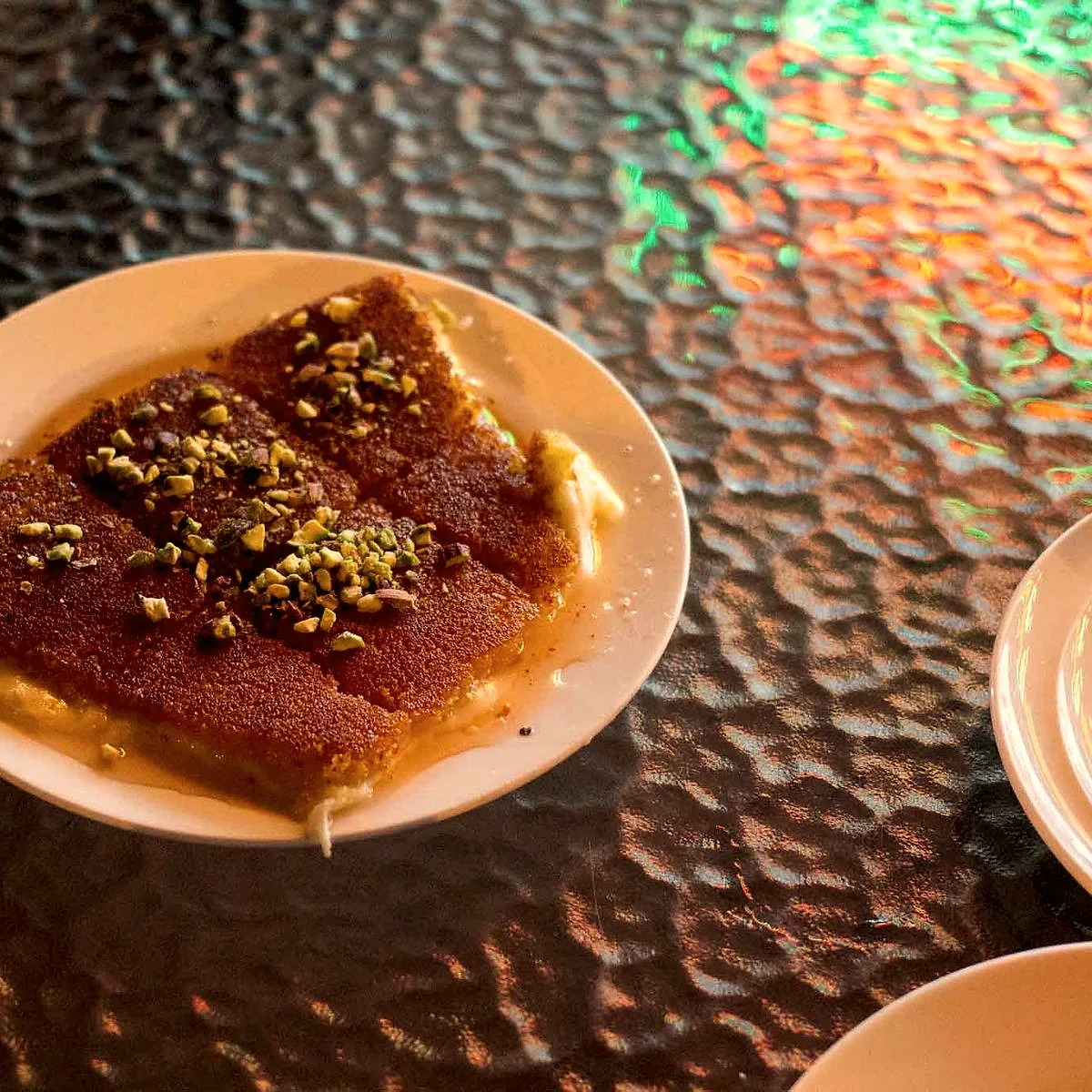
.jpg)
CC BY 2.0. Cropped and colour-adjusted for this site.
Method
Cover the 500 g akkawi with cold water and leave it to soak for 2h, changing the water once or twice, until it tastes only mildly salty. Drain well and slice thinly.
Akkawi is a brined cheese. Soaking it in several changes of water draws out enough salt that it melts sweetly under the syrup instead of fighting it.
Meanwhile, combine the 350 g caster sugar, 220 ml water and 15 ml freshly squeezed lemon juice in a small pan and bring to the boil, stirring until the sugar has dissolved. Simmer for 8m, then take off the heat, stir in the 10 ml rose water and set aside to cool.
Rub the 130 g unsalted butter through the 300 g semolina and 30 g caster sugar until the mixture looks like damp, even sand. This takes 6m.
Grease a round baking tray with the 20 g unsalted butter. Lay the sliced 500 g akkawi over the base in an even layer, then press the semolina crust mixture evenly on top, right to the edges, smoothing the surface with the back of a spoon. This takes 15m.
Bake at 200 °C for 35m, until the crust is deep golden and the cheese underneath has melted.
Run a knife around the edge and invert the tray onto a serving platter so the golden crust is now on top. Pour the cooled syrup evenly over the surface while the knafeh is still hot, then scatter over the 40 g raw pistachios. Cut into wedges once the syrup has soaked in, after 5m.
Common pitfallPouring the syrup on while the tray is still searingly hot boils it straight back out. It goes on the moment the knafeh comes out of the oven, but only once the worst of the sizzle has settled.
Knafeh's best-known origin story reaches back to the medieval Islamic world: a popular legend has Levantine dessert makers preparing it to satisfy caliphs during Ramadan, set variously in Fatimid Egypt or in Umayyad Damascus for Mu'awiya I [1]. The story is old enough to feel like settled history, but the dish it describes almost certainly is not the one served today. The tenth-century Baghdad cookbook Kitab al-Tabikh, by Ibn Sayyar al-Warraq, includes recipes for qatayif but has no knafeh in it at all, and the version that does appear a few centuries later, in a thirteenth-century Andalusian manuscript, is described as a pancake-like dumpling thinner than qatayif and cooked on a flat pan, and so nothing resembling the cheese-and-pastry dish this page describes [1].
The cheese-filled knafeh has a documented history that is shorter still. The food historian Mary Isin has found no record of it before the nineteenth century, and the earliest known recipes for it appear in an 1885 Beirut cookbook, Ustadh al-Tabbakhin by Khalil Khattar Sarkis, which gives four versions of knafeh including cheese-filled ones [1]. Nablus's particular claim to the dish is close behind: the scholar Khalil Totah described knafeh as part of Nabulsi daily life as early as 1923 [1], and the city has kept the association ever since, lending its name to both the dish and to Nabulsi cheese, which is named for Nablus and desalted before use precisely so it can go under a knafeh crust [2]. Akkawi, the cheese used here, plays the same role and is treated in Nablus's own kitchens as an accepted stand-in for the harder-to-find Nabulsi.
Whatever its documentary gaps, knafeh's standing in Palestinian life today is not in question: it is the dish brought out for weddings, engagements, graduations and reconciliations, its semolina or noodle topping soaked in a syrup marinated with rose or orange blossom water over the stretch of warm, lightly salted cheese [3].
Sources
- Kanafeh, WikipediaCovers the caliph-and-Ramadan legend, the absence of knafeh from the tenth-century al-Warraq cookbook, the 1885 Beirut cookbook's cheese-filled recipes, and the 1923 Khalil Totah reference tying knafeh to Nablus.
- Nabulsi cheese, WikipediaConfirms the cheese takes its name from Nablus, is desalted before use, and is knafeh's defining ingredient.
- The Palestinian pride behind the sweet journey of knafeh, The New ArabPalestinian-focused news outlet; describes Nabulsi cheese as one of Palestine's most popular white brined cheeses, the syrup-soaked semolina or noodle topping marinated with rose or orange blossom water, and knafeh's place at weddings, engagements, graduations and reconciliations.