Indian · Breakfast
Idli
Steamed rice-and-lentil cakes from Tamil Nadu, risen entirely by their own overnight fermentation rather than any added leavener.
Not the same asDosa (Made from a thinner, more rice-heavy version of the same style of batter, spread on a hot griddle rather than steamed in moulds. It is a pancake next to idli's steamed cake.)
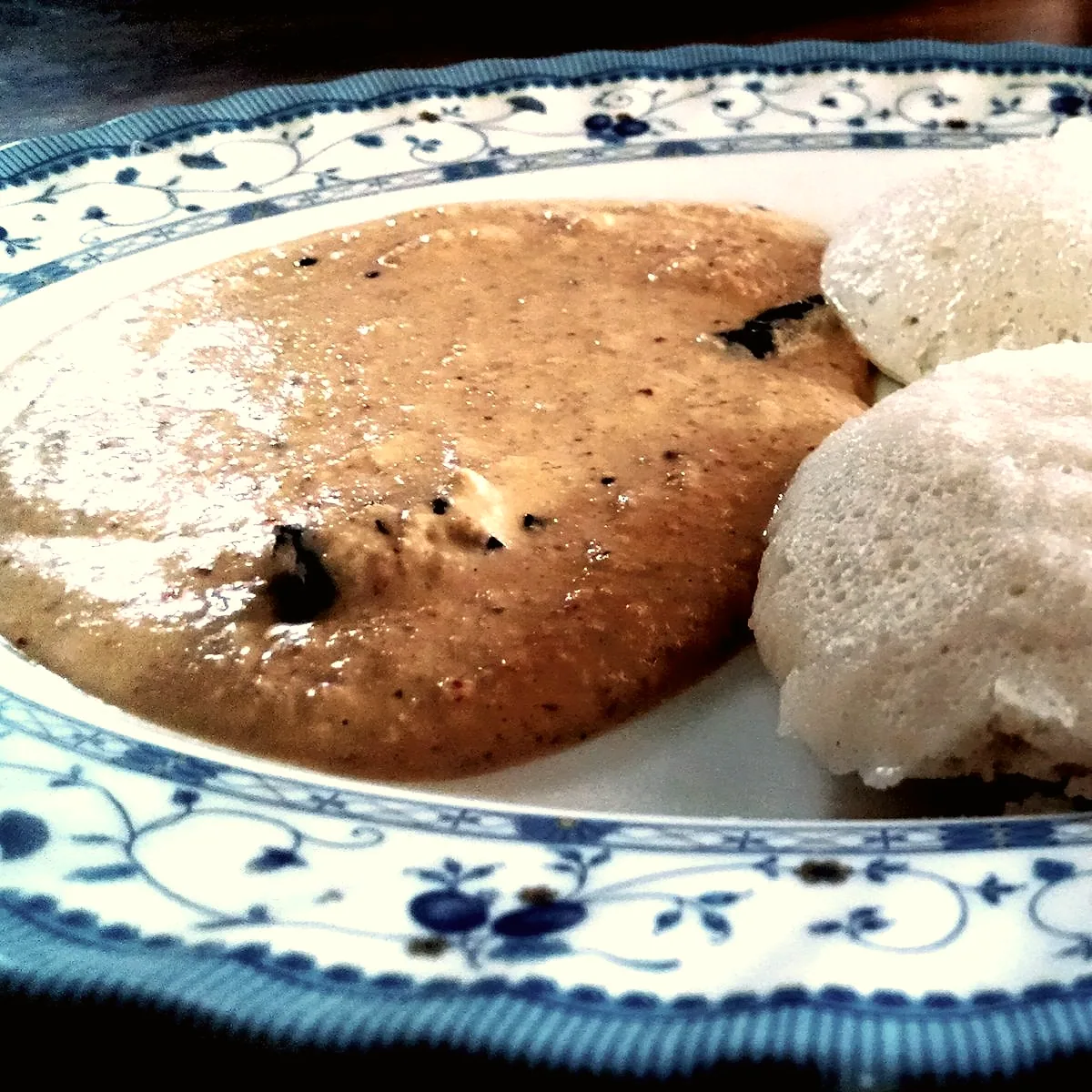

CC BY-SA 4.0. Cropped and colour-adjusted for this site.
Method
Cover the 300 g rice and, in a separate bowl, the 100 g urad dal and 4 g fenugreek seeds with the 500 ml water, dividing it between the two bowls. Leave both to soak at room temperature for 4h, then drain.
Grind the drained dal and fenugreek first, adding the 150 ml water a little at a time, until the paste is pale, light and roughly doubled in volume. Grind the drained rice separately to a slightly grainy paste, then fold the two together with the 8 g fine sea salt in a large bowl, leaving plenty of headroom for it to rise.
Common pitfallGrinding the dal to a genuinely light, aerated paste is what gives idli its texture; a coarse, dense dal paste ferments the same but steams into a heavy cake.
Cover the bowl loosely and leave it somewhere warm to ferment for 12h, until the batter has visibly risen and smells faintly sour and yeasty.
Wild yeasts and bacteria on the rice and dal do the leavening. There is no added yeast or raising agent anywhere in the recipe; the fermentation is the only thing that makes the batter rise.
Brush the idli moulds with the 6 g peanut oil and spoon in the batter without stirring it down. Steam over boiling water for 12m, until a skewer pushed into a cake comes out clean. Rest for a minute before unmoulding.
Idli has one of the older food-word trails in South Indian writing. The tenth-century Kannada text Vaddaradhane describes "iddalige" made only from a black gram batter, and the eleventh-century Lokopakara of Chavundaraya II gives a preparation of black gram soaked in buttermilk, ground to a paste and mixed with the clear water of curd and spices [1]. A recipe for something called iḍḍarikā appears again in the Manasollasa, a twelfth-century encyclopedia compiled for the Western Chalukya king Someshwara III [1].
None of these early versions is quite the dish made today. They leave out rice, the long overnight fermentation, and steaming (the three things that define modern idli), and texts describing the complete recipe do not appear until after the thirteenth century [1]. What changed in between is disputed. The food historian K. T. Achaya proposed that the steamed, fermented idli was developed in Indonesia, where fermented foods have a long history, and carried back to India by cooks attached to Hindu courts trading with the archipelago between the ninth and thirteenth centuries; other historians argue that fermentation was just as plausibly worked out independently in India, since nearly every food culture arrives at it in some form [1]. Tamil Nadu and Karnataka both claim the dish as their own, and the argument is old enough that it predates any surviving record precise enough to settle it [2].
What is not in question is the technique, which has stayed remarkably stable once it appears fully formed: rice and dehusked black gram, ground separately, combined, and left to rise on their own wild fermentation rather than any added raising agent, then steamed in small moulds. It remains a genuinely lentil-heavy batter next to its griddled relative dosa, which is part of why it steams into a cake rather than spreading into a pancake.
Sources
- Idli, WikipediaOn the early Kannada textual references, what they describe, and the Achaya theory of an Indonesian origin for the steamed, fermented form.
- The Surprising Origins of Idli, Swiggy DiariesOn the competing claims between Tamil Nadu and Karnataka and the general historical outline.