Sri Lankan · Breakfast
Hoppers
A Sri Lankan bowl-shaped pancake of fermented rice flour and coconut milk, cooked in a small curved pan into a lacy, crisp-edged shell around a soft, spongy centre.
Also known asAppa · Sri Lanka
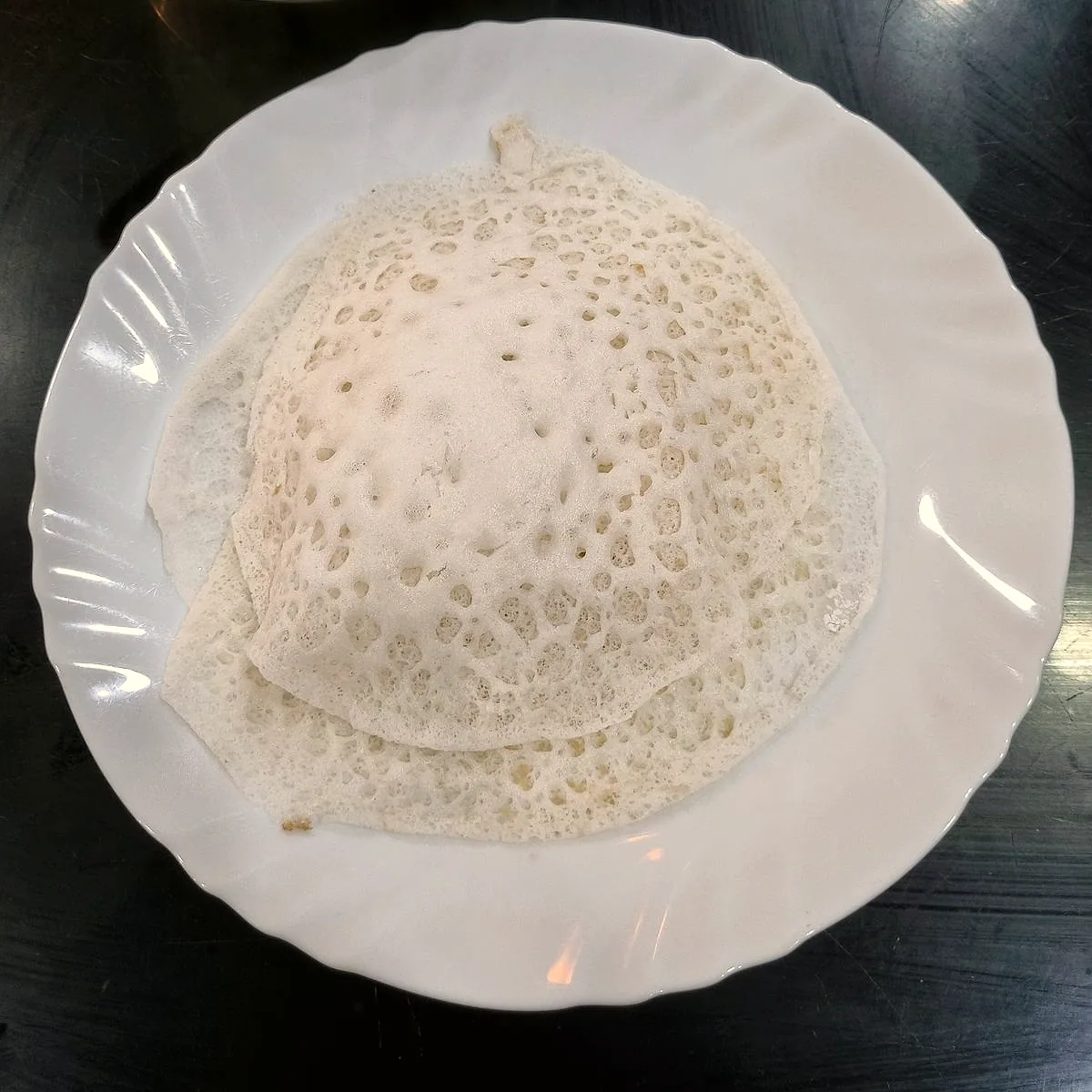

CC BY-SA 4.0. Cropped and colour-adjusted for this site.
The same dish, adapted. Every quantity, time and figure below changes with the version.
Method
Whisk the 300 g rice flour, 15 g caster sugar, 4 g dried yeast and 4 g fine sea salt together, then whisk in the 300 ml coconut milk and the 200 ml water for 10m, until completely smooth and about as thin as pouring cream.
Cover the bowl and leave it somewhere warm to ferment for 4h, until bubbled and risen.
Heat a small curved hopper pan over a high heat and wipe it with a little of the 8 g peanut oil. Ladle in a portion of batter and immediately swirl and tilt the pan so the batter climbs partway up the sides, leaving a thin lacy edge and a pool in the middle. Cover and cook for a share of 25m, until the edges are golden and crisp and the centre has set but stayed soft. Loosen with a thin spatula and lift out. Repeat with the remaining batter, re-oiling the pan between hoppers.
Swirling the batter up the sides rather than pouring it flat is what gives a hopper its shape, a thin, crisp lace rim and a thicker, soft, faintly spongy base.
Common pitfallA lid left off lets the centre stay wet and undercooked while the rim scorches. Covering the pan traps steam that finishes the centre gently while the rim crisps.
Method
Whisk the 300 g rice flour, 15 g caster sugar, 4 g dried yeast and 4 g fine sea salt together, then whisk in the 300 ml coconut milk and the 200 ml water for 10m, until completely smooth and about as thin as pouring cream.
Cover the bowl and leave it somewhere warm to ferment for 4h, until bubbled and risen.
Heat a small curved hopper pan over a high heat and wipe it with a little of the 8 g peanut oil. Ladle in a portion of batter and immediately swirl and tilt the pan so the batter climbs partway up the sides, leaving a thin lacy edge and a pool in the middle. Cook uncovered for a share of 20m, until the rim has set and started to crisp at the edges.
Crack the 4 eggs (200 g) into the pool at the centre, keeping the yolk whole. Cover the pan and cook for a share of 6m, until the white has just set and the yolk is still soft. Loosen with a thin spatula and lift out whole. Repeat with the remaining batter and egg, re-oiling the pan between hoppers.
Common pitfallCracking the egg in before the base has set lets it run down through the batter instead of sitting in the well at the centre. It goes in only once the rim is already lacy and crisping.
The name almost certainly comes from the Sanskrit apupa, a fried dainty, and the dish it names is old enough to appear in Sangam-era Tamil literature. The Perumpāṇāṟṟuppaṭai describes vendors selling appams "like honeycombs" alongside another sweet called modakam, placing something recognisably like this pancake in Tamil regions well over a thousand years before it took its current form [1].
How it reached Sri Lanka specifically is not precisely documented, but the general route is well understood: trade, colonial administration and migration between South India and Sri Lanka carried the dish across the strait along with a great deal of the rest of Tamil and South Indian cooking [2]. The English name is a later, separate layer: "hopper" is generally taken to be a British colonial-era anglicisation of appa, the word settling into English usage rather than being translated [2].
What varies most across the dish's range is how the batter is leavened. Fermentation methods differ from place to place and household to household: some Kerala cooks, notably in the Cochin Jewish community, have historically used fresh toddy in place of yeast, leaning on the same wild fermentation that gives the batter its rise and faint sourness by other means [1]. The constant across all of them is the shape: a batter swirled up the sides of a small curved pan so it sets thin and lacy at the rim and soft in the middle, which is what separates a hopper from a flat-cooked dosa made from a similar kind of batter.
Sources
- Appam, WikipediaOn the Sangam-era literary reference in the Perumpāṇāṟṟuppaṭai, the Sanskrit etymology of the name, and the dish's spread across South India and Sri Lanka.
- Hoppers, Sri Lanka's Famous Breakfast Staple Traverses the Road of Kerala's Appams, SlurrpOn the South Indian origin of appam and its spread to Sri Lanka through trade, colonialism and migration, and on "hopper" as an Anglicised form of "appa".