American · Main Course
Grilled Cheese
Sliced white bread and American cheese, pressed and browned slowly in butter until the outside is crisp and the inside has fully melted.
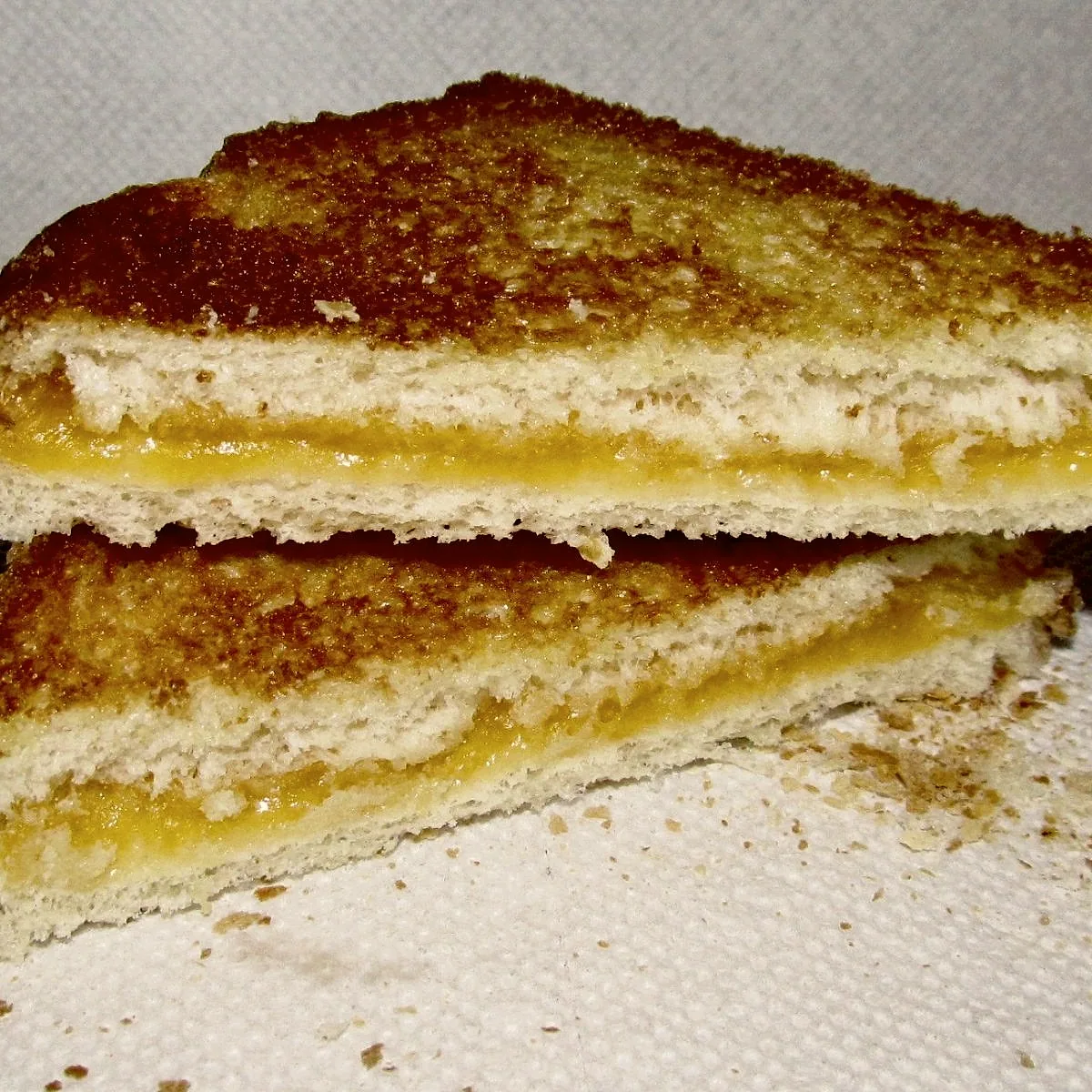
.jpg)
CC BY-SA 2.0. Cropped and colour-adjusted for this site.
Method
Spread the 20 g unsalted butter evenly over one side of each slice of the 90 g sandwich bread, all the way to the edges.
Lay the 50 g American cheese between the slices, buttered sides facing outward.
Set the sandwich in a cold pan over a low heat and cook for 8m, turning once, until both faces are deep golden brown and the cheese has melted completely through to the middle.
A low, patient heat is what lets the cheese finish melting before the crust darkens past golden. Turning up the heat to save time browns the outside long before the middle is ready.
Common pitfallPressing down on the sandwich squeezes out melted cheese at the edges instead of speeding the melt in the middle. Leave it alone and let the heat do the work.
The sandwich depends on two separate inventions of the 1920s arriving at once. Otto Rohwedder's automatic bread slicer made pre-sliced loaves a household staple, and James L. Kraft's patented processed cheese, developed a few years earlier, melted smoothly under heat instead of turning greasy and breaking the way an aged cheese does [2]. Without both, the sandwich as it now exists could not easily be made at home.
Its earliest form was not a sandwich at all in the modern sense: a single slice of bread topped with melted cheese and eaten open-faced, a cheap and filling dish that spread widely during the Great Depression [1]. A second slice was added on top later, closing it into what is now recognised as a grilled cheese, and the name itself is a relatively late arrival: the dish was called a toasted or melted cheese sandwich for decades before "grilled cheese" became the common term [1].
Processed American cheese remains the diner standard for a practical reason rather than a nostalgic one: it is formulated to melt evenly at a moderate heat without separating, which is exactly the behaviour a pan-fried sandwich needs and a traditional cheddar cannot reliably supply [2]. The method below follows that logic: a slow, low heat that gives the cheese time to melt through before the crust has finished browning.
Sources
- The History of the Grilled Cheese Sandwich, HowStuffWorksOn the 1920s convergence of sliced bread and Kraft's processed cheese, the sandwich's open-faced WWII-era form, and the second slice added decades later.
- What Exactly is American Cheese?, Mental FlossOn James L. Kraft's 1916 patent and the melting behaviour processed cheese owes to it.