Nordic · Starter
Gravlax
Raw salmon cured under salt, sugar and dill for a long, unhurried spell in the refrigerator, then sliced paper-thin and eaten cold, without ever touching heat.
Also known asGravad Lax · SwedenGravlaks · Norway
Not the same asSmoked salmon (Cured and then hot- or cold-smoked. Gravlax is never smoked, and the smoke is what most separates their flavour and texture.)Lox (Brine-cured salmon, traditionally without sugar or dill and considerably saltier. Gravlax is dry-cured and sweeter.)
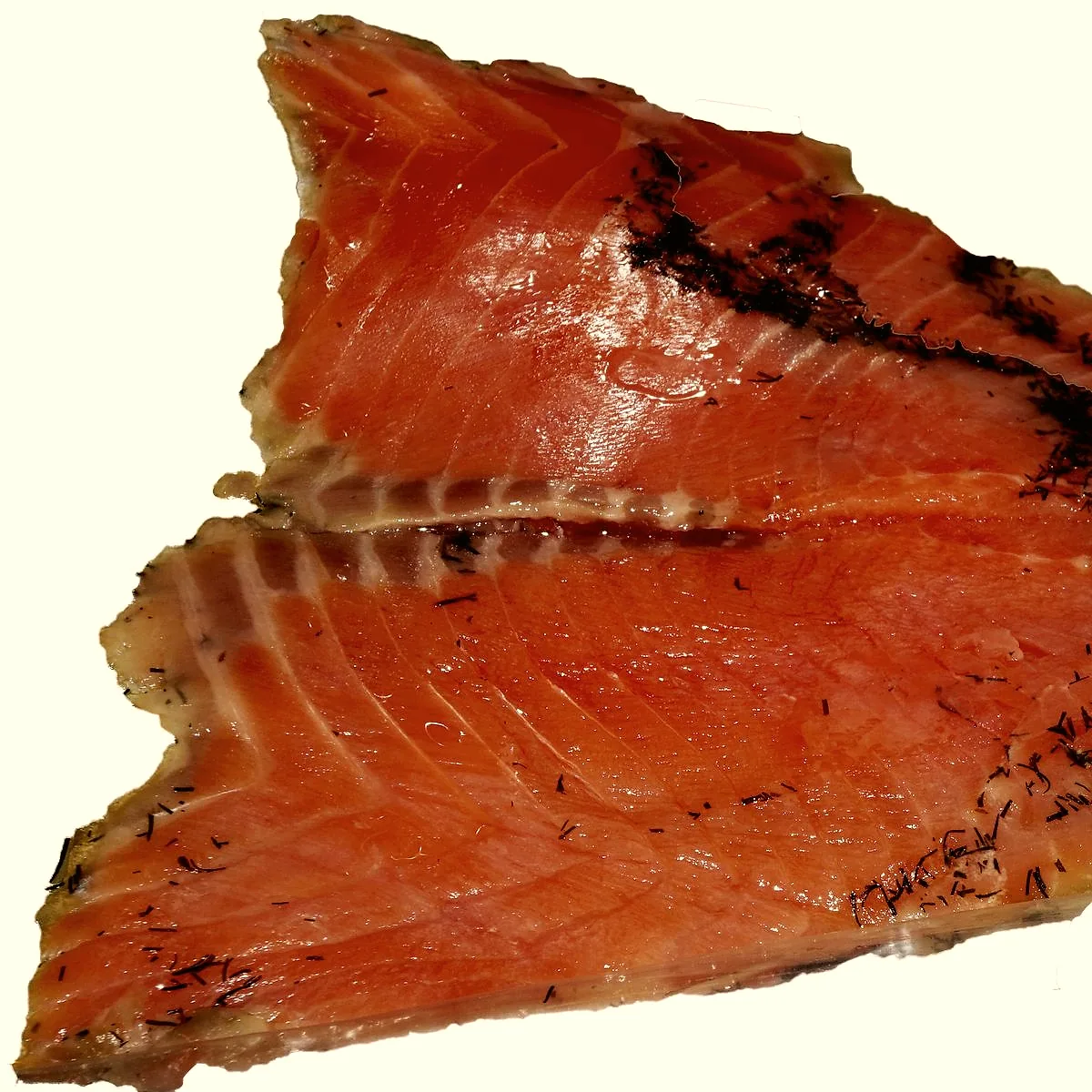

CC BY-SA 4.0. Cropped and colour-adjusted for this site.
Method
Run a finger along the flesh side of the 800 g salmon to find any pin bones and draw them out with tweezers, then pat the fillet dry with paper towel.
Common pitfallCuring does not cook the fish and does not reliably kill parasites, so the salmon needs to have been previously frozen solid for several days first; fresh, never-frozen fish is not safe prepared this way.
Stir the 60 g fine sea salt, 50 g caster sugar and 6 g ground black pepper together in a small bowl until evenly combined.
Sugar softens the harshness of an all-salt cure and moderates how hard it pulls, so the flesh ends up firm rather than rubbery.
Lay the salmon skin-side down on a large sheet of plastic wrap and pack the salt mixture evenly over the flesh, working it right to the edges. Scatter the 25 g dill over the top in an even layer, then wrap the fillet tightly and set it on a tray.
Set another tray on top of the parcel and weight it down evenly, then refrigerate at 4 °C or below for 48h, turning the parcel over once around the midpoint so both sides sit in the liquid the cure draws out.
Weighting the parcel holds the flesh in even contact with the cure and the liquid it releases, so the salt and sugar penetrate evenly instead of pooling on one side.
Unwrap the fillet, scrape away the dill and the spent cure, and discard the liquid left in the wrapping. Pat the salmon dry with paper towel rather than rinsing it.
Common pitfallRinsing the cure off under the tap waterlogs the surface and washes away flavour the curing time took days to build. Wiping it dry instead keeps both the texture and the seasoning intact.
Working from the tail end with a long, thin-bladed knife held almost flat against the skin, slice the salmon into thin sheets, leaving the skin behind. Scatter the 10 g dill over the slices before serving.
The name means buried salmon: Swedish grava, "to dig," and lax, "salmon" [1]. The earliest documented trace of the word is not a recipe but a nickname, borne by a delegate to a Norwegian salmon fishery and recorded in the Diplomatarium Norvegicum in 1348 [1].
What that name described in the Middle Ages was not what is eaten today. Coastal fishermen salted salmon and buried it in the sand above the high-tide line, where it lightly fermented rather than simply cured [1]. The technique belonged to a wider Nordic family of buried and fermented fish (Swedish surlax, Norwegian rakfisk among them) developed where a short, enormous catch met a real scarcity of salt, and producing a soft, strongly flavoured result far from a modern cured fillet [2].
Almost none of that survives in the dish sold under the name now. Fermentation has been dropped entirely: the salmon is no longer buried in the ground but wrapped in a dry cure of salt, sugar and dill, and left for as little as twelve hours [1]. Nothing in the record fixes when that change happened: the sources describe the two methods without dating the shift between them, so the honest position is that a centuries-old name has been carried by a considerably younger process for an unknown stretch of that history.
What survived the change is the logic, not the microbiology: salt drawing water out of the flesh, and time doing the rest without heat. That is also why the modern, unfermented version leans on a safeguard of its own: fish that has already been frozen, since a dry cure alone does nothing to the parasites that only cooking, or freezing, reliably deals with.
Sources
- Gravlax, WikipediaOn the etymology, the 1348 Diplomatarium Norvegicum reference, and the shift from buried fermentation to a dry cure.
- Gravlax – a buried salmon, Nordic Food LabOn gravlax's place among Nordic buried and fermented fish techniques and the conditions that produced them.