American · Breakfast
Eggs Benedict
A toasted English muffin topped with ham, a poached egg and hollandaise sauce. One serving is one whole muffin, split into two halves.
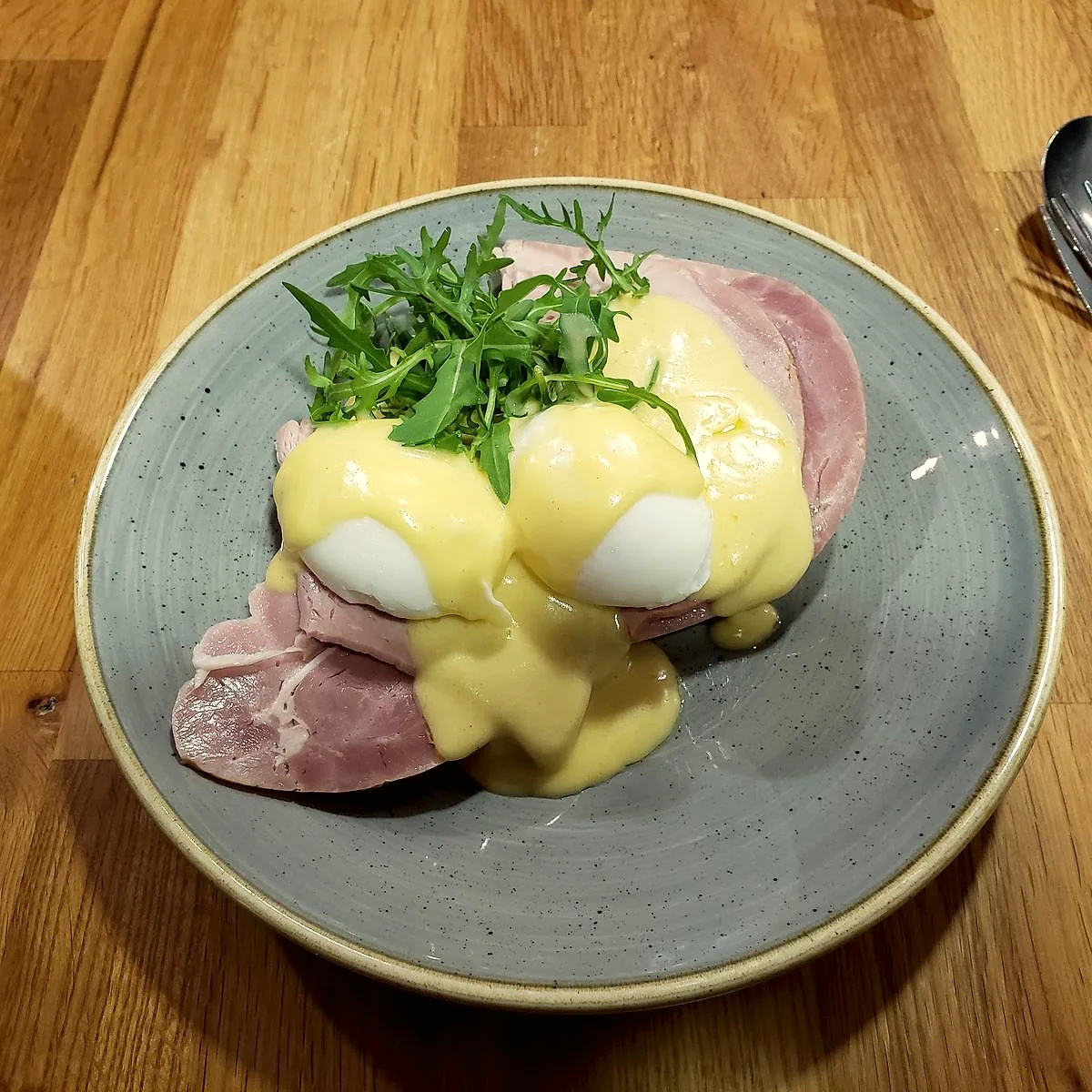

CC0. Cropped and colour-adjusted for this site.
Method
Melt the 75 g unsalted butter gently and skim off the pale, milky solids that rise to the top, leaving the clear golden fat. This takes 5m and keeps the finished sauce from tasting of raw milk solids.
Whisk the 3 egg yolks (51 g) with the 15 ml freshly squeezed lemon juice in a heatproof bowl set over a pan of barely simmering water, without letting the bowl touch the water. Whisk constantly for 8m, until the mixture is thick, pale and doubled in volume, then take the bowl off the heat and trickle in the warm clarified butter, whisking constantly, until fully emulsified. Season with the 1 g ground cayenne pepper and the 2 g fine sea salt and keep warm.
Whisking the yolks over gentle, indirect heat before the butter goes in cooks them just enough to thicken and stabilise the sauce; direct heat or butter added too fast splits the emulsion instead of building it.
Warm the 160 g sliced ham in a dry pan over a medium heat for 4m, turning once, until heated through and lightly coloured at the edges.
Toast the 4 English muffins (228 g), cut sides up, until golden, over 4m.
Bring a wide pan of water to a bare simmer and add the 15 ml cider vinegar. Crack the 4 eggs (200 g) one at a time into a cup and slide each gently into the water, holding the white close to the yolk with a spoon for the first few seconds. Poach for 4m, until the white is set and the yolk still soft, then lift out with a slotted spoon onto kitchen paper.
Common pitfallWater at a rolling boil tears a poached egg into ragged strands. It should be barely trembling, with the vinegar and a gentle whirlpool doing the work of holding the white together.
Top each toasted muffin half with a piece of the warm ham, then a poached egg, and spoon the hollandaise generously over the top. Serve immediately, over 3m, while the sauce is still warm and the yolk still runs.
Eggs Benedict has two competing origin stories, both set in New York in the 1890s, and no surviving evidence settles which, if either, is true.
In one version, a Wall Street stockbroker named Lemuel Benedict walked into the Waldorf Hotel nursing a hangover and ordered poached eggs, bacon, buttered toast and a pitcher of hollandaise sauce off-menu; the maître d'hôtel, Oscar Tschirky, is said to have liked the combination enough to put a version of it on the menu, swapping in an English muffin for the toast [2]. In the other, a regular at Delmonico's named Mrs LeGrand Benedict complained to chef Charles Ranhofer that nothing on the lunch menu appealed to her, and Ranhofer devised the dish for her on the spot, later publishing it as "Eggs à la Benedick" in his 1894 cookbook The Epicurean [1].
Neither story has independent confirmation. Oscar Tschirky himself never publicly confirmed the Lemuel Benedict account attributed to him [2], and Ranhofer's own published version differs enough from the modern dish that it is not a clean match either. The more likely explanation, on the evidence available, is that both restaurants arrived at closely related poached-egg-and-hollandaise dishes independently around the same period, and that a single precise moment of invention never existed at all [1].
Sources
- Eggs Benedict, Restaurant-ing Through HistoryFood-history blog collating the competing Delmonico's and Waldorf origin accounts.
- The Warring Theories About How Eggs Benedict Was Invented, ChowhoundSets out the Lemuel Benedict and Mrs LeGrand Benedict accounts side by side.