Chinese · Snack
Scallion Pancake
An unleavened wheat dough rolled with oil and spring onion, coiled and rolled again into layers, then pan-fried until the outside is crisp and the inside stays chewy.
Also known asCong you bing
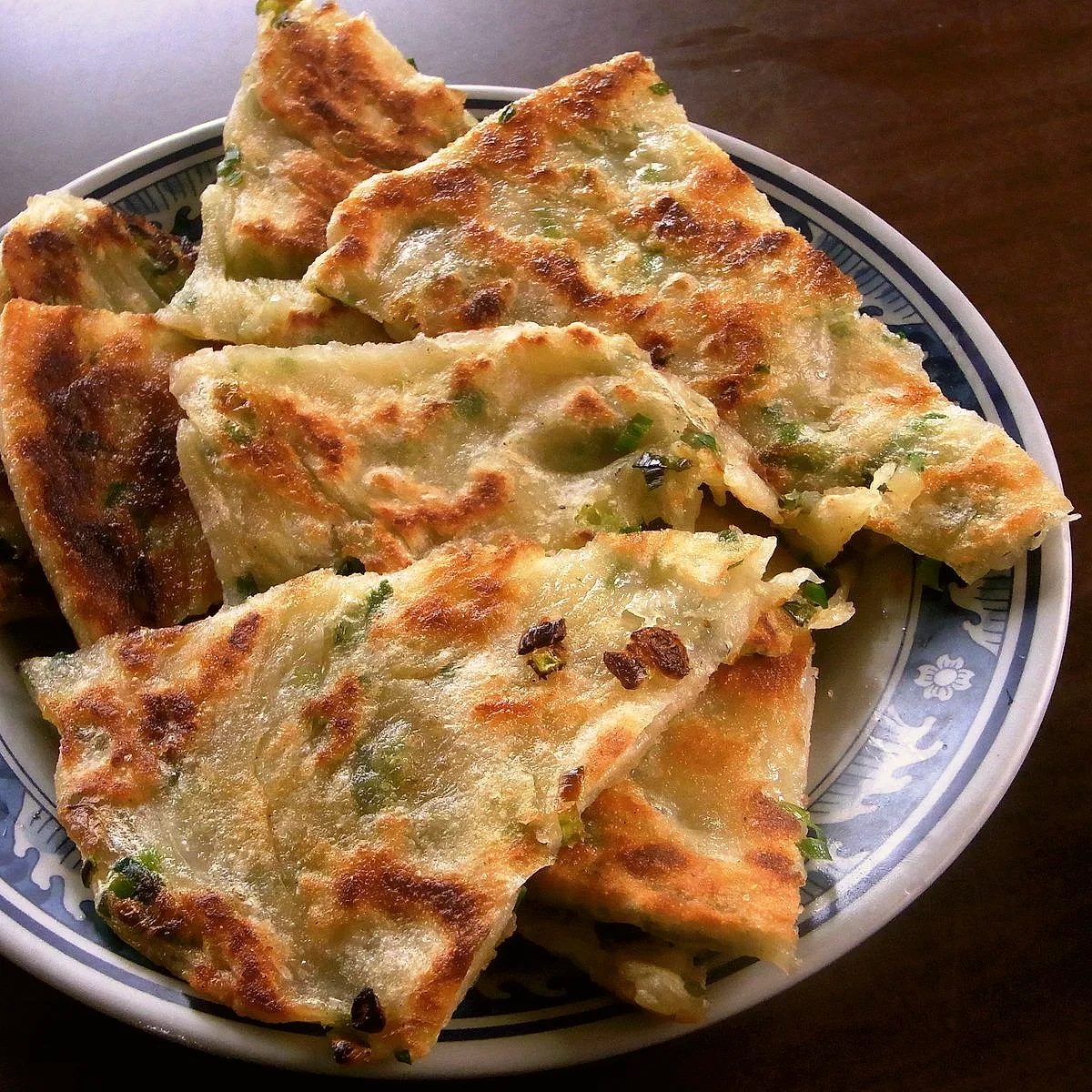

GFDL. Cropped and colour-adjusted for this site.
Method
Pour the 100 ml water into the 300 g plain flour and stir quickly with chopsticks, then add the 60 ml water and 4 g fine sea salt and bring together into a soft dough, taking 10m.
Bringing part of the flour together with boiling water before the cold water goes in partly cooks the starch, giving a softer, more pliable dough than cold water alone would, which is what lets it roll out thin without tearing.
Cover the dough and rest it for 30m.
Roll the dough out into a large, thin rectangle. Mix the 40 ml toasted sesame oil with the 20 g plain flour into a paste and spread it evenly over the surface, then scatter with the 5 ½ spring onions (80 g). Roll up tightly from one long edge into a log, then coil the log into a flat spiral and roll it out gently into a disc, taking 20m in total.
Common pitfallRolling the coiled dough out too firmly presses the layers back together into one dense sheet. A light touch keeps the spiral of oil and spring onion distinct, which is what gives the cooked pancake its flaky layers.
Rest the shaped disc for 15m.
Heat the 40 ml vegetable oil in a wide pan over medium heat and fry the pancake for 12m in total, turning occasionally, until deep golden and crisp on both sides. Drain briefly before cutting into wedges.
Scallion pancake belongs to bing, a broad Chinese category covering almost any food built from a worked wheat dough: flatbreads, layered pastries, even some noodles fall inside it. The category is old, and its earliest documented member was not even originally Chinese: hubing, a flatbread whose name literally marks it "foreign bing," is recorded as early as the second century BCE, carried into China along the same Silk Road trade routes that also brought new crops and new milling technology from Central Asia [1]. Wheat itself only reached China from further west in the first place, so the entire family of flatbreads scallion pancake belongs to depends, at its root, on an imported grain worked with imported techniques.
The scallion pancake itself is a much later and more specific development within that broad family, defined less by any single documented inventor than by its particular method: an unleavened dough rolled thin, brushed with oil and scattered with sliced spring onion, then rolled up and coiled before being flattened and fried, so that what looks like a single disc of dough is actually many oiled layers pressed together, the same layering principle that runs through the wider bing family of flatbreads and pastries [2] [1]. That layering is what gives the finished pancake its particular texture: crisp outside, distinctly layered and chewy within.
Sources
- History of Chinese Flatbreads Reflects How Food Has Echoes of Faraway Places, South China Morning PostOn hubing, recorded as early as the second century BC, and the "hu" prefix marking it as a foreign import carried in along Silk Road trade.
- Cong you bing, WikipediaOn the layered, unleavened technique and the pancake's regional variants across East Asia.