American · Dessert · Snack
Chocolate Chip Cookies
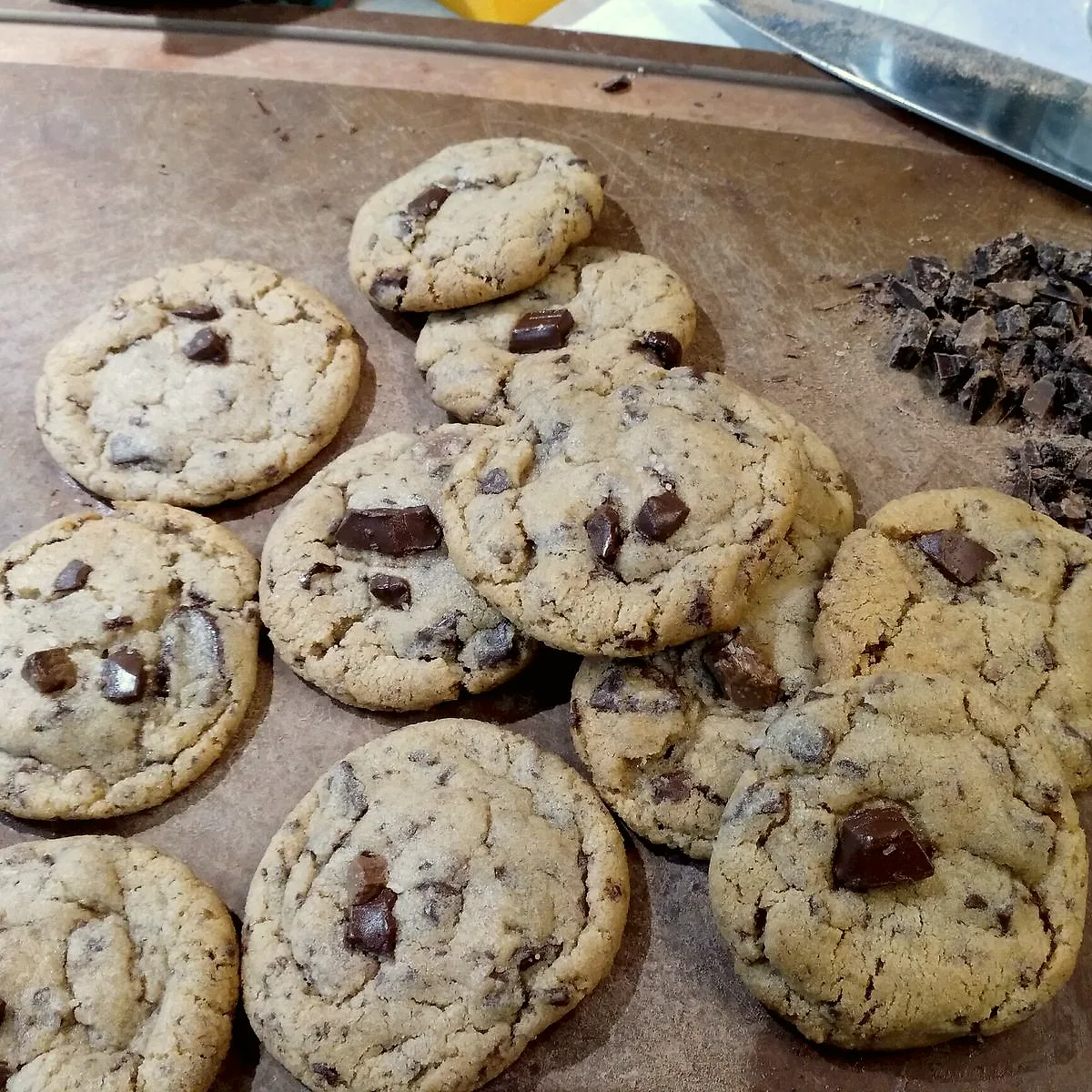
A creamed butter dough rested cold and baked with chopped chocolate, pulled from the oven while the middle still looks unfinished.
Also known asToll House cookie · United States

CC0. Cropped and colour-adjusted for this site.
Method
Beat the 170 g unsalted butter with the 150 g light brown sugar and the 100 g caster sugar for 5m, until the mixture has gone visibly paler and grown in volume, and no grittiness is left when a little is rubbed between finger and thumb.
Creaming is aeration, not mixing. Beating sugar crystals through soft butter cuts air pockets into the fat, and those pockets are what the dough rises on; there is no other leavening here doing that job.
Beat in the 2 eggs (100 g) a little at a time, letting each addition disappear completely before the next goes in, then the 8 ml vanilla extract. Take 3m over it; adding the egg too fast splits the mixture and it will not come back.
Sift the 280 g plain flour together with the 5 g bicarbonate of soda and the 5 g fine sea salt and fold them in with a spatula over 4m, stopping the instant no dry flour is visible. Fold the 190 g dark chocolate through with the last few turns.
Cover the bowl and leave it in the fridge for 1h. The dough should be firm enough to roll without sticking.
Cold dough spreads less, so the cookie bakes upwards rather than outwards. The rest also lets the flour hydrate fully, which darkens both the colour and the flavour of the finished cookie.
Meanwhile heat the oven to 180 °C and give it 20m to come up properly: an oven that has only just reached the dial is not the same as one that has settled there. Line the flattest baking trays in the house.
Roll the dough into balls a little larger than a walnut and set them far apart, since they spread to roughly 9 cm across. Press the 30 g dark chocolate onto the tops. Bake for 12m, until the edges have set and coloured and the centres are still pale and slightly domed.
Common pitfallThey come out looking underdone, and that is the point; the centres are still soft and slightly domed when the tray leaves the oven. A cookie baked until the middle looks cooked has been baked until it is dry.
Leave them on the hot tray for 10m before moving them. They go on cooking on the metal and are too fragile to lift until the middles have set and sunk into the dense, ridged centre that is the whole object.
The chocolate chip cookie has what almost no famous dish has: a named author, an address and a date. Ruth Graves Wakefield trained in household arts and worked as a dietitian before she and her husband Kenneth bought a former toll house at Whitman, Massachusetts, in 1930 and turned it into the Toll House Inn [2]. The recipe reached print as Toll House Chocolate Crunch Cookies in the 1938 edition of her Toll House Tried and True Recipes [1].
The part everybody repeats is the accident: short of an ingredient, she chopped up a Nestlé bar and stirred it in expecting it to melt into the dough, and it refused [2]. Wakefield's own accounts do not describe an accident. Asked about it in the 1970s she said she had been serving a thin butterscotch nut cookie with ice cream and set out to come up with something else, and described breaking a semi-sweet bar apart with an ice pick alongside her pastry chef Sue Brides [1]. Food writers have noted the obvious difficulty with the legend, which is that she was a trained home economist running a professional kitchen [1].
The claim to invention is disputed on wider grounds too. Stella Parks, researching BraveTart, found a chocolate jumbles recipe with much the same dough proportions and grated chocolate through it, syndicated across American newspapers in 1877, and bakers already selling something they called chocolate chip cookies in the 1920s [3].
What followed is not in dispute and is the more consequential half of the story. Nestlé arranged to print the recipe on its wrappers; Wakefield said she was promised a dollar, and the retellings add a lifetime supply of chocolate [1]. By the end of 1939 the company was scoring its bars into segments to be snapped off, and soon after began selling small teardrops of chocolate it called morsels [1]. The chocolate chip, in other words, was invented to fit the cookie rather than the other way round.
Sources
- Chocolate chip cookie, WikipediaOn the 1938 publication, Wakefield's own account given in the 1970s, the doubts raised about the accident story, the Nestlé arrangement and the introduction of morsels.
- Ruth Wakefield, Lemelson-MIT Program, Massachusetts Institute of TechnologyBiographical record (her training, the purchase of the Toll House in 1930) and a straightforward telling of the accidental version of the invention.
- Nearly Everything We Think We Know About Chocolate Chips Is A Lie, The TakeoutReports Stella Parks's research for *BraveTart*: the 1877 chocolate jumbles recipe and bakers selling chocolate chip cookies in the 1920s.