Italian · Main Course
Spaghetti alla Carbonara
Cured pork, sheep's cheese and egg, brought together by nothing but the heat of the pasta and a little of its water.
Also known asPasta alla carbonara · Italy
Not the same asPasta alla gricia (The same guanciale and Pecorino without the egg. Carbonara is, in effect, gricia with egg added.)Cacio e pepe (Cheese and pepper only, with no pork and no egg; the creaminess comes from cheese and pasta water alone.)
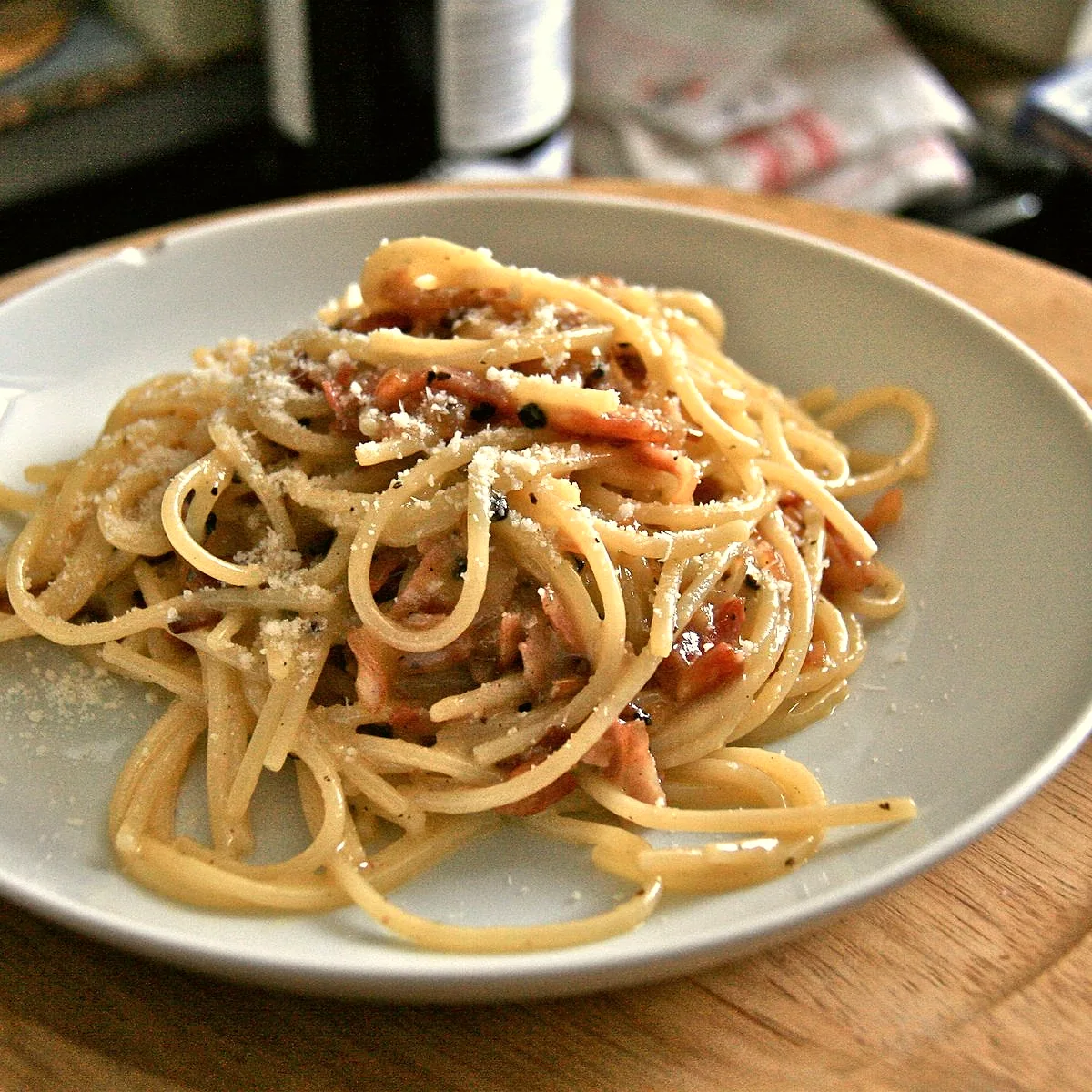
.JPG)
CC BY-SA 3.0. Cropped and colour-adjusted for this site.
Method
Bring the 2 L water to a rolling boil in the widest pan you have, then add the 20 g fine sea salt and let it dissolve.
Add the 180 g dried spaghetti and cook for 9m, or two minutes short of whatever the packet claims. Before draining, lift out a mugful of the cooking water: the starch it carries is what will let the sauce bind. Drain the pasta while the centre still resists a bite.
While the water heats, put the 120 g guanciale into a cold, dry pan and set it over a low flame. Let it render for 9m, until the fat has run clear and the edges have gone glassy and crisp. Take the pan off the heat and leave the fat in it.
Common pitfallStarting the guanciale in a hot pan seizes the outside before the fat has run. It goes into a cold, dry pan and comes up to temperature with it.
Beat the 3 ½ egg yolks (60 g) and the 1 egg (50 g) together with the 45 g Pecorino Romano and most of the 3 g ground black pepper until the mixture is thick and pale and holds a ribbon.
Tip the drained pasta into the pan with the guanciale and toss it through the warm fat. Wait half a minute for the pan to drop below 70 °C, then add the egg mixture along with a splash of the reserved cooking water, tossing hard and continuously for 3m. It will look loose at first and then turn glossy. Serve at once, with the 15 g Pecorino Romano and the rest of the pepper over the top.
The pan comes off the heat before the egg goes anywhere near it. The sauce is set by residual warmth and the starch in the pasta water; direct heat scrambles it instead.
Carbonara is a Roman dish and a young one. For a recipe so often described as traditional, the striking thing about the record is how thin it is before the Second World War: no cookbook, menu or newspaper appears to mention it at all [1].
The dish surfaces immediately after. In 1950 the Turin newspaper La Stampa reported that American officers had spent years hunting for spaghetti alla carbonara in the restaurants of Trastevere, without troubling to say what it was [1]. The earliest recipe anyone has produced was printed two years later, and not in Italy: it appears in Vittles and Vice, a 1952 Chicago cookbook by Patricia Bronté [1]. Italy's own first published version followed in La Cucina Italiana in 1954, and it is not the dish as it is now made; that one used pancetta, garlic and Gruyère [1].
The most repeated explanation ties it to Allied rations. American troops in Italy had bacon and powdered egg, and one account credits a young Italian cook, Renato Gualandi, with improvising something along these lines for an army dinner in 1944 [1]. The food historian Luca Cesari places its birth in Rome around the same period and for much the same reason [2]. None of this is settled, and the name itself (from carbonaro, a charcoal burner) has attracted its own set of unevidenced stories.
What the record does establish is that today's austerity is a recent achievement rather than an ancient rule. Cream was ordinary in carbonara recipes for decades and only fell out of favour in the 1990s [1]. The version now defended as the authentic one (guanciale not pancetta, Pecorino not Parmigiano, no cream, no garlic) is better understood as a position the dish arrived at than as the place it started.
Sources
- Carbonara, WikipediaCollates the documentary record: the 1950 La Stampa mention, the 1952 Bronté recipe, the 1954 La Cucina Italiana version and the Gualandi account.
- The Origins of Carbonara, Great British ChefsSummarises the competing origin accounts, including food historian Luca Cesari's reading.