American · Bread · Side · Breakfast
Buttermilk Biscuits
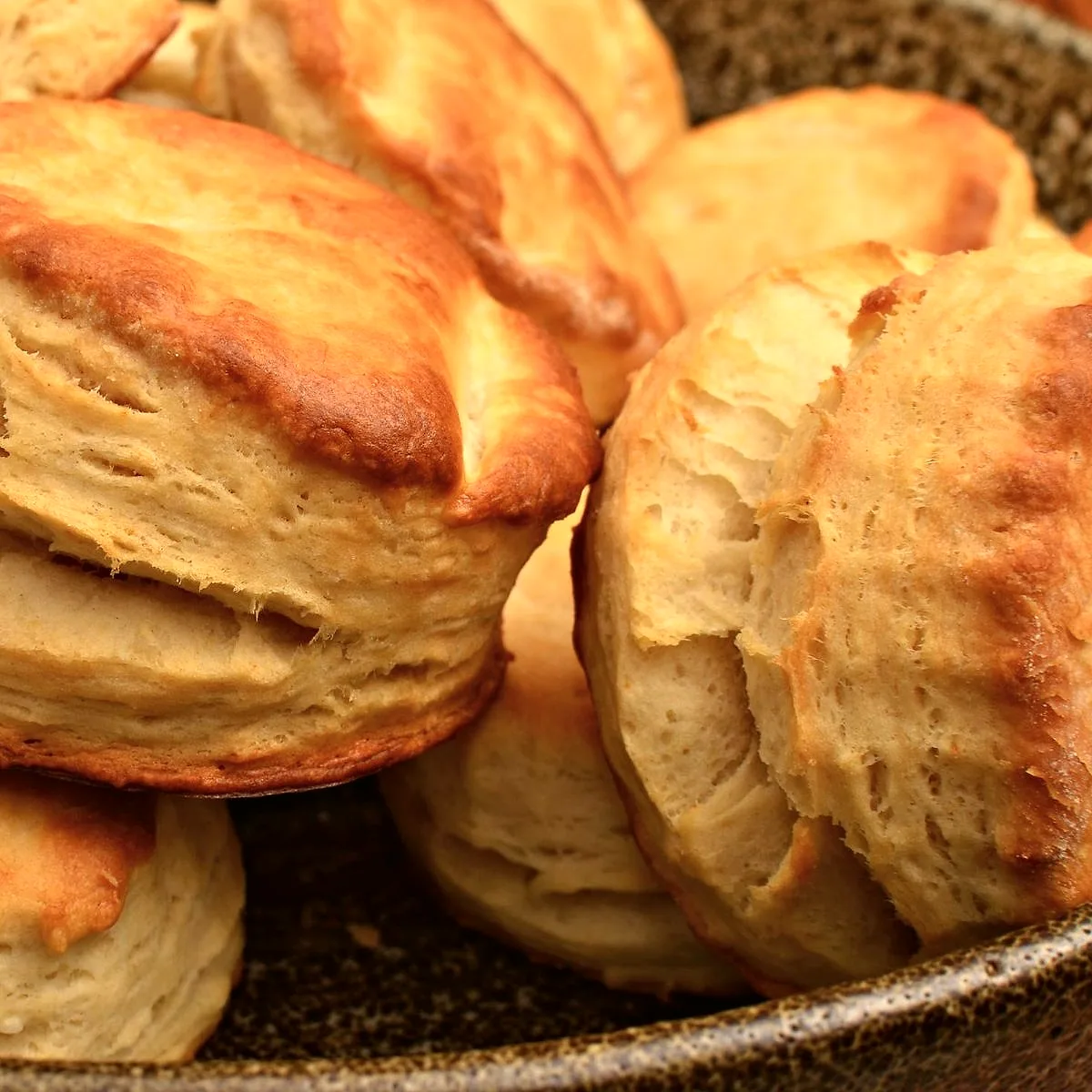
A quick bread leavened by baking powder and soda rather than yeast, laminated cold so it bakes into visible, flaky layers.
.jpg)
CC BY 2.0. Cropped and colour-adjusted for this site.
Method
Whisk the 300 g plain flour, 12 g baking powder, 3 g bicarbonate of soda and 6 g fine sea salt together in a wide bowl.
Rub or cut the 85 g unsalted butter into the flour for 5m, until the largest pieces are the size of small peas. Keep the mixture cold throughout.
Common pitfallButter that softens before it reaches the oven melts into the dough instead of staying as distinct flecks, and the biscuit rises far less for it. Keep it cold at every stage, including a short rest before baking if the kitchen is warm.
Pour in the 210 ml cultured buttermilk and bring the dough together with a few strokes, stopping while it still looks shaggy. Turn it onto a floured surface and pat it into a rectangle, then fold it into thirds like a letter. Repeat this fold twice more over 6m, patting the dough back out each time, before patting it to its final thickness.
Folding the dough over itself rather than kneading it builds thin sheets of butter between thin sheets of dough, and it is those sheets, not the raising agents alone, that give the baked biscuit its visible layers.
Cut rounds straight down without twisting the cutter, which would seal the cut edge and blunt the rise. Gather the scraps, pat them back together once, and cut the rest. Set the rounds close together on a lined tray, touching at the edges, over 4m.
Bake at 220 °C for 16m, until well risen and golden on top. Brush the tops with the 15 g unsalted butter as soon as they come out of the oven.
The Southern buttermilk biscuit descends from British quick breads brought over by English and Scottish settlers, but it is not a straightforward transplant [1]. Wheat flour was scarce and expensive in the early colonies, and it was successful wheat harvests in the Southern colonies, alongside a ready supply of buttermilk and lard from dairy cows and hogs, that gave cooks the ingredients to make something recognisably like a biscuit at all [2].
What made it the biscuit eaten today came later, and it came from chemistry rather than wheat. Baking soda and then baking powder reached American kitchens in the nineteenth century, and it was these leaveners (not yeast, and not the long fermentation a British scone might get) that let the dough rise quickly and lightly in a hot oven [1]. Buttermilk, left over from churning butter on a farm, supplied both the tang and the acid the soda needed to react against, and the two arrived in Southern pantries at roughly the same moment.
The biscuit's association with poverty is as real as its association with comfort: flour, fat and soured milk were what a farm kitchen already had, and biscuits and gravy became a cheap, dense meal for field hands and loggers before they became a Sunday-morning indulgence [2]. The lamination that gives a good biscuit its visible layers (folding the dough over cold fat rather than simply mixing it in) is a technique refined well after the ingredients themselves had settled into place.
Sources
- The rise: a history of American biscuits, King Arthur BakingTraces the biscuit from British scone-like breads to the Southern buttermilk biscuit.
- Baking History: How a savory Southern accompaniment got its start, WNC MagazineRegional account of the biscuit's development in Southern Appalachian kitchens.