American · Snack
Buffalo Wings
Chicken wings deep-fried unbreaded until crisp, then tossed in a hot cayenne pepper sauce and butter.
Also known asHot wings · United States
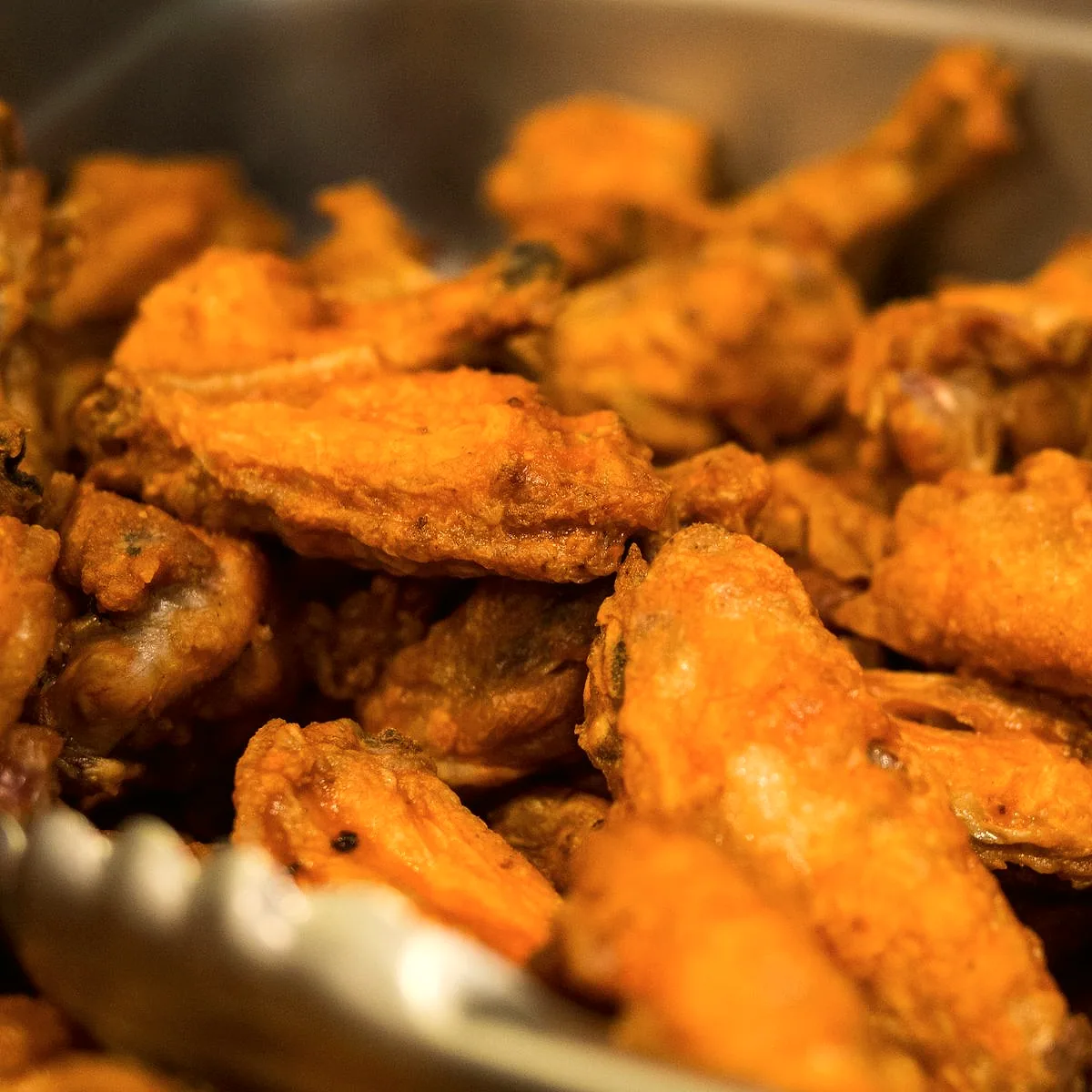
.jpg)
CC BY 2.0. Cropped and colour-adjusted for this site.
Method
Pat the 1 kg chicken wing completely dry with paper towels and season all over with the 5 g fine sea salt and 2 g ground black pepper.
Heat the 1.5 L peanut oil in a deep, heavy pot or a deep-fat fryer to 190 °C.
Fry the wings in batches for 12m, turning occasionally, until deep golden and cooked through. Lift out onto a wire rack to drain.
Leaving the wings unbreaded is what lets the skin itself go crisp and lets it soak up the sauce afterwards rather than shedding a separate coating.
While the wings fry, melt the 60 g unsalted butter with the 120 ml hot sauce in a small saucepan over a low heat, stirring until smooth.
Tip the hot wings into a large bowl, pour over the sauce, and toss to coat evenly. Serve at once.
Common pitfallSauced wings left to sit lose their crispness within minutes as the sauce softens the skin, so they go from fryer to sauce to table with no pause in between.
Buffalo wings are usually dated precisely: 1964, at the Anchor Bar in Buffalo, New York, made by Teressa Bellissimo. Past that point the story splits. One version has her improvising with a batch of chicken wings delivered by mistake in place of the necks she had ordered for a sauce; another, told by her own son, has her simply frying up a late-night snack for him and his friends after a night out [1]. Notably, a 1969 newspaper profile of the Anchor Bar does not mention the dish at all, which sits awkwardly with a firm 1964 invention date [2].
The credit is also not uncontested outside the family. John Young ran a Buffalo restaurant called Wings and Things around the same period, serving his own whole wings in a sauce he said was adapted from a similar dish he had seen in Washington, D.C.; he maintained that Frank Bellissimo, Teressa's husband, had eaten at his restaurant before wings turned up at the Anchor Bar. The paper trail for either claim is thin: dates are uncertain, no contemporary account corroborates one version over the other, and it remains possible that both cooks were independently adapting an idea already circulating around the city [2].
What is not in question is the shape the dish settled into and kept: wings fried unbreaded rather than battered, tossed hot in a cayenne pepper sauce loosened with butter, and served with celery and a blue cheese dip to cut the heat. That combination, whoever is responsible for it, is what travelled far beyond Buffalo and gave the city's name to a way of preparing a chicken wing rather than to one restaurant's dish.
Sources
- The Debated Origin Story Of Buffalo Wings, Tasting TableSets out the two conflicting accounts within the Bellissimo family itself.
- The Complicated And Fascinating Story Behind The Origin Of Buffalo Wings, The Daily MealLays out John Young's competing claim through his restaurant Wings and Things and assesses the evidence on both sides as unresolved.