Dutch and Belgian · Breakfast · Dessert
Belgian Waffles
A yeasted batter lightened with whipped egg white, baked into a large, rectangular waffle with deep, crisp pockets, dusted with icing sugar.
Not the same asAmerican waffles (The baking-powder batter sold in the United States as "Belgian waffles" since the 1960s, cooked in the same deep-pocketed iron but chemically leavened and made without yeast. It is a different dish from this yeasted Brussels batter.)
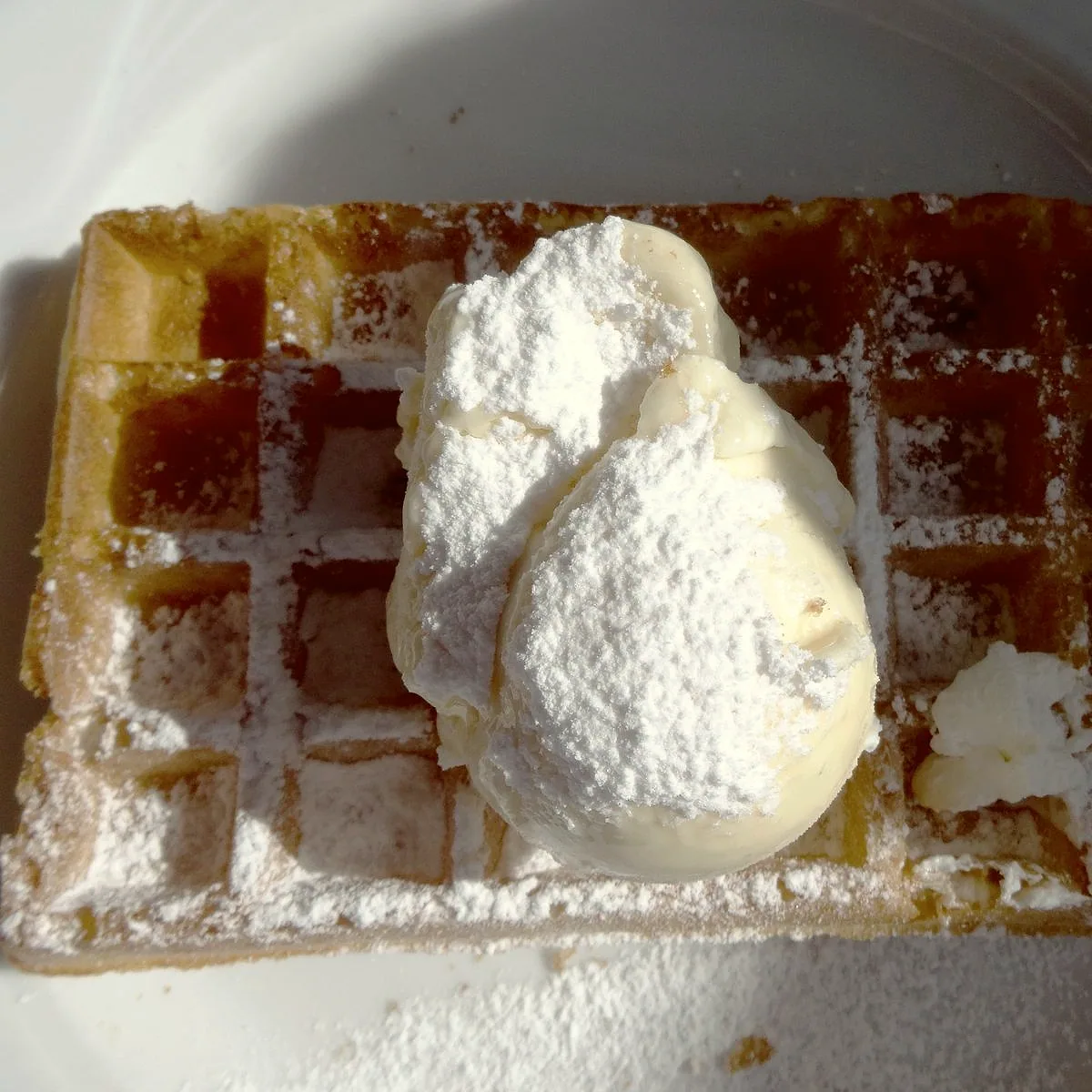

CC BY-SA 4.0. Cropped and colour-adjusted for this site.
The same dish, adapted. Every quantity, time and figure below changes with the version.
Method
Stir the 5 g dried yeast into the warm 350 ml milk and leave it for 8m, until foamy.
Whisk the 300 g plain flour, 20 g caster sugar and 3 g fine sea salt together in a large bowl. Whisk in the yeasted milk, the 2 egg yolks (34 g), the 60 g unsalted butter and the 5 ml vanilla extract until smooth. This takes 6m.
Whip the 2 egg whites (66 g) to stiff peaks, working for 5m.
Whipping the whites separately and folding them in at the end is what gives a Brussels waffle its light, almost soufflé-like crumb inside a crisp shell, rather than the denser texture of a batter mixed all at once.
Fold the whipped whites gently through the batter, cover, and leave somewhere warm to prove for 45m, until visibly puffed and bubbly.
Heat the waffle iron and brush it lightly with butter. Ladle in the batter and cook until deep golden and crisp, releasing easily from the plates. Repeat with the remaining batter, spending 20m in total. Dust with the 20 g icing sugar and serve each waffle as soon as it is done.
Method
Stir the 7 g dried yeast into the warm 60 ml milk and leave it for 8m, until foamy.
Combine the 350 g bread flour, 15 g caster sugar and 4 g fine sea salt in a large bowl. Add the yeasted milk, the 2 eggs (100 g) and the 5 ml vanilla extract, and bring together into a rough, sticky dough. This takes 8m.
Knead in the soft 150 g unsalted butter a little at a time, working the dough for 12m, until smooth, glossy and elastic.
Cover the dough and leave it to prove somewhere warm for 1h, until roughly doubled.
Knock the dough back and fold in the 150 g pearl sugar by hand, distributing it evenly. This takes 5m.
The pearl sugar is folded in only after the dough has already risen once, and only just before baking, so it stays in distinct, unmelted lumps that caramelise against the hot iron rather than dissolving fully into the dough.
Divide the dough into equal balls and let them rest, covered, for 20m.
Heat the waffle iron and brush it lightly with butter. Press a ball of dough into the iron and cook until deep golden-brown, with the pearl sugar caramelised at the surface. Repeat with the remaining dough, spending 20m in total, and serve each waffle warm.
Common pitfallEscaped pearl sugar burns quickly on a bare iron plate and turns bitter. Wipe the plates between waffles if sugar has leaked and caught.
The waffle iron is medieval. Street vendors were already pressing a flour-and-water batter between hot metal grids by the Middle Ages, and by the sixteenth century that plain batter had picked up sugar, eggs, spices and yeast, becoming recognisably the honeycombed treat sold today [1]. What "Belgian waffle" flattens into one export name are actually two distinct Belgian waffles, and only one of them looks like what most people outside Belgium picture.
The Brussels waffle is the rectangular one: a light, yeasted batter baked into deep, square pockets, mild enough in itself that it is built to carry toppings rather than stand alone [1]. It is also the one responsible for the dish's global reputation: Belgian migrants Maurice and Rose Vermersch sold it at the 1964 New York World's Fair under the invented name "Bel-Gem" waffles, and the American idea of a "Belgian waffle" descends more or less directly from that stand [1].
The Liège waffle is the older-feeling of the two, though its own origin is carried mostly as legend rather than record: an eighteenth-century Prince-Bishop of Liège is said to have asked his chef for a new kind of sweet, and the chef answered with a dense, brioche-like dough studded with lumps of pearl sugar [2][1]. Pearl sugar is the whole difference: its crystals resist melting at normal baking heat, so instead of dissolving into the batter they half-caramelise against the hot iron, leaving pockets of crunch and burnt-sugar flavour through a small, dense, irregularly rounded waffle meant to be eaten plain and warm from the hand, not dressed at a table [2][1]. Inside Belgium, the Liège waffle has in recent years become the more commonly sold of the two, even as the Brussels waffle remains the version the rest of the world learned first [2][1].
Sources
- Where to Eat the Best Belgian Waffles in Brussels, National GeographicCovers the medieval origins of the grid-iron waffle, the Brussels/Liège distinction, pearl sugar, and the 1964 New York World's Fair "Bel-Gem" stand.
- Liège waffle, WikipediaSets out the eighteenth-century Prince-Bishop legend, the brioche-dough and pearl-sugar construction, and the more recent rise of Liège waffles even within Belgium itself.