Colombian · Breakfast · Side · Bread
Arepas Colombianas
Griddled corn cakes made from precooked white corn flour, one arepa to a serving. The everyday bread of the Colombian table, in the version stuffed with cheese.
Not the same asVenezuelan arepa (Made the same way from the same precooked corn flour, but shaped noticeably thicker and typically split open and stuffed after cooking, rather than eaten flat with the filling worked into the dough or spread on top.)
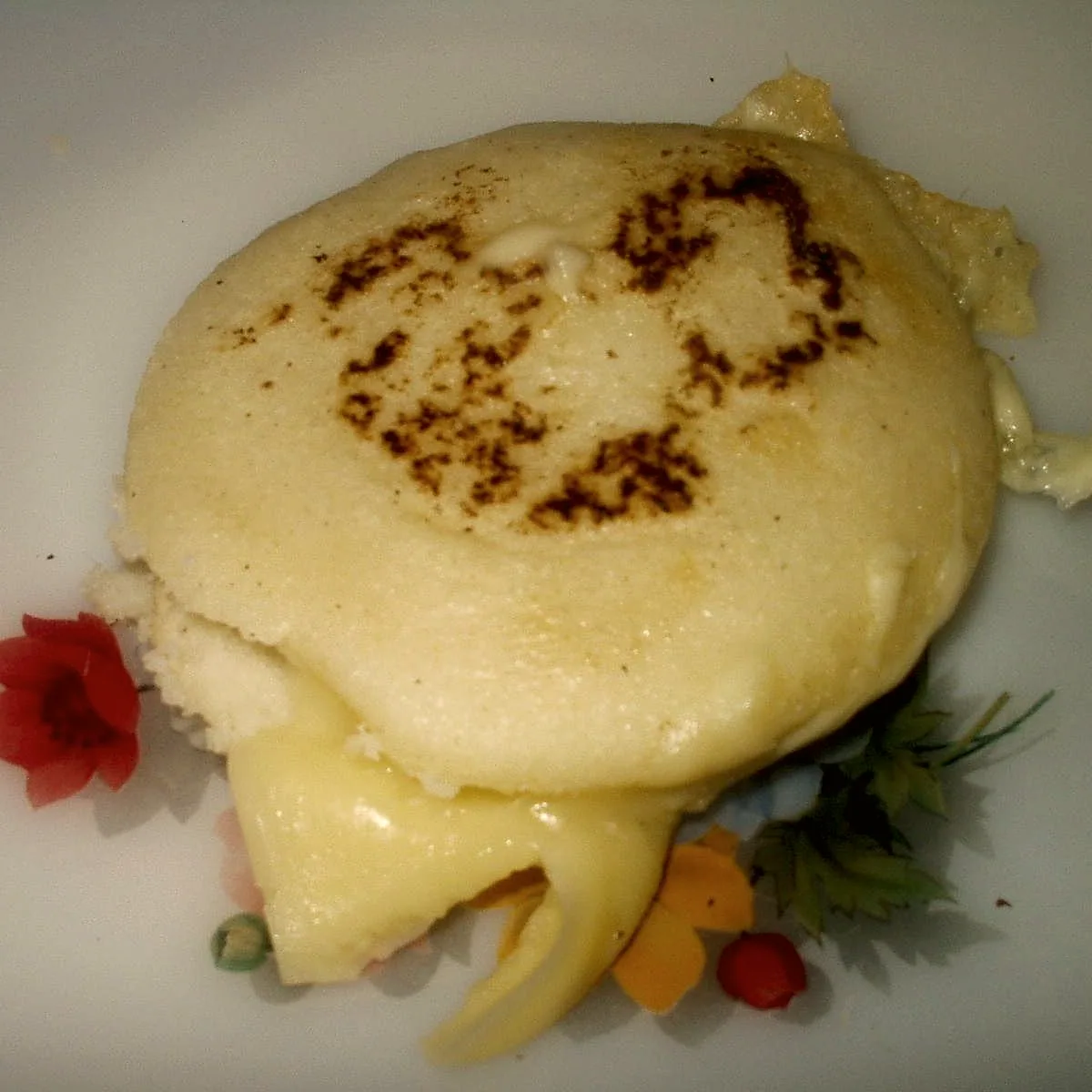

CC BY-SA 3.0. Cropped and colour-adjusted for this site.
The same dish, adapted. Every quantity, time and figure below changes with the version.
Method
Combine the 300 g precooked corn flour and 4 g fine sea salt, then work in the 350 ml water and the 150 g queso fresco to form a soft, slightly sticky dough. This takes about 10m.
Cover the dough and leave it to rest for 10m.
Common pitfallShaping the dough immediately after mixing leaves it prone to cracking at the edges once griddled; a short rest lets the flour hydrate fully first.
Divide the dough into as many equal portions as arepas are being made and pat each into a flat, even round. This takes about 8m.
Melt the 15 g unsalted butter on a griddle or in a wide pan over a medium heat and cook the arepas for 16m in total, turning once or twice, until deeply golden and cooked through to the centre.
Method
Blend the 300 g corn to a coarse, wet purée. This takes about 5m.
Stir the 100 g precooked corn flour, 20 g caster sugar, 3 g fine sea salt and 100 g queso fresco into the corn purée to make a soft, thick batter. This takes about 8m.
Divide the batter into as many equal portions as arepas are being made and pat each into a flat, even round. This takes about 8m.
Melt the 15 g unsalted butter on a griddle or in a wide pan over a medium-low heat and cook the arepas for 16m in total, turning once or twice, until golden and set through.
The arepa is old enough to predate the two nations that now argue over it. Its name comes from erepa, the word for cornbread in Cumanagoto, an indigenous language of what is now eastern Venezuela [1] [2], and the corn cake itself was already being made by indigenous peoples across the region that Colombia and Venezuela would eventually become, long before either border existed [2].
What has stayed remarkably constant is the arepa itself: ground corn, formed into a disc and cooked on a hot surface, in a form said to differ little from what pre-Columbian cooks would recognise. What has diverged is the two countries' modern versions: Colombian arepas are typically thinner and often eaten plain, split and buttered, or worked through with cheese; Venezuelan arepas are made noticeably thicker and are more often split open and stuffed after cooking. Both countries treat the dish as a matter of national pride, and scholars and food professionals on both sides of the border have taken to describing it not as a prize to be won but as a heritage the two countries share [2].
Sources
- Arepa, WikipediaStates the Cumanagoto etymology of "arepa" from erepa, "cornbread," and gives archaeological dating of roughly 3,000 years for arepas made by the Muisca in Colombia's Altiplano Cundiboyacense against roughly 2,800 years in Venezuela.
- ¿La arepa es de Venezuela o Colombia? El frenético debate de su origen, La TerceraQuotes Ocarina Castillo, an anthropologist at the Universidad Central de Venezuela, on the Cumanagoto-"erepa" etymology and on the arepa having been eaten for thousands of years before today's Colombia-Venezuela border existed, and quotes a restaurant owner describing the arepa as belonging "to the world" rather than to either nation.