Turkish · Main Course
Adana Kebabı
Hand-worked lamb mince, bound with grated onion and Maraş pepper until it clings to a broad flat skewer, then grilled hard over charcoal.
Not the same asUrfa kebab (The same shape and hand-mincing technique, but seasoned without red pepper, giving a pale, mild kebab rather than Adana's deep red, chilli-forward one.)
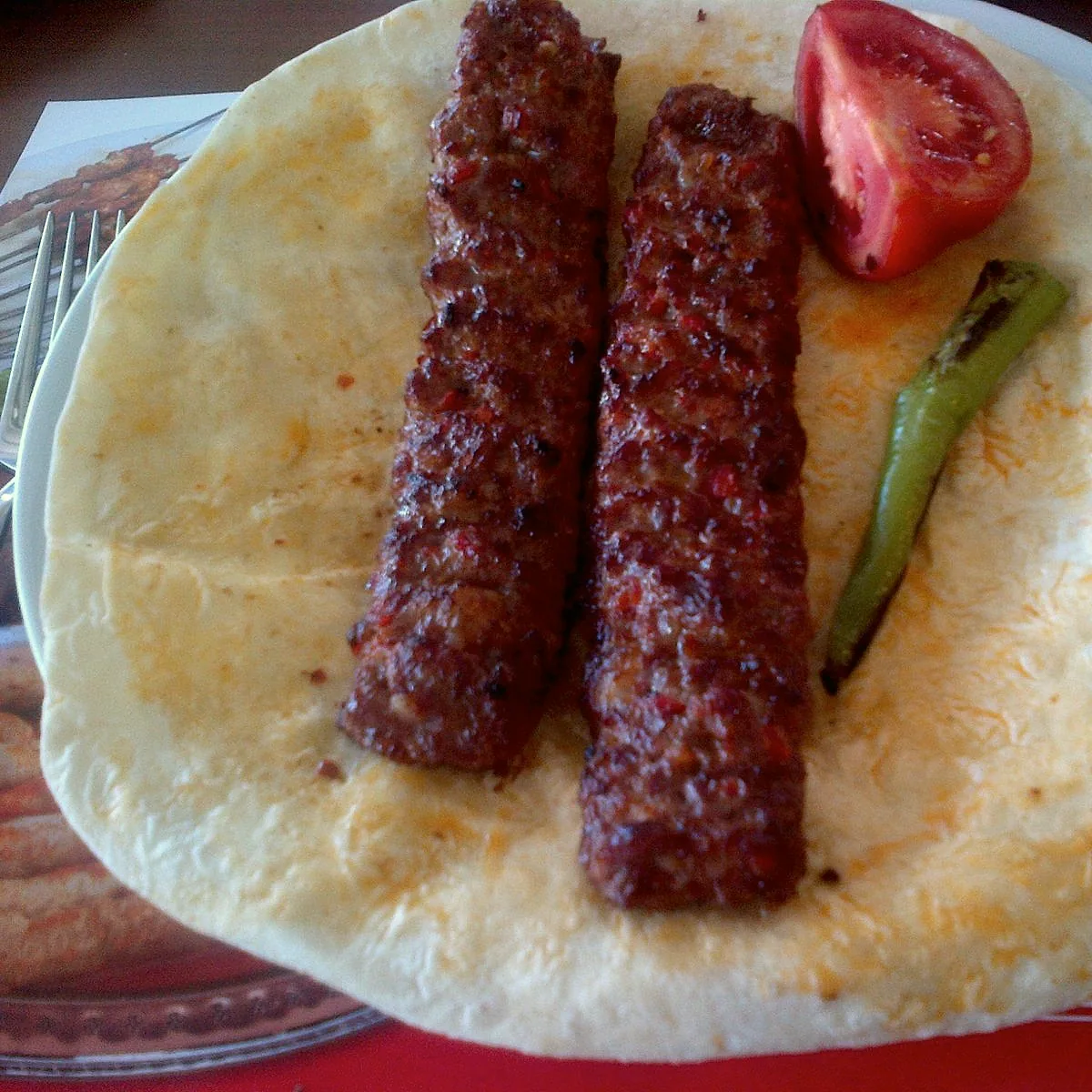

CC BY-SA 4.0. Cropped and colour-adjusted for this site.
Method
Combine the 500 g lamb mince, 50 g yellow onion, 2 garlic cloves (10 g), 6 g Maraş pepper and 7 g fine sea salt in a wide bowl. Knead and squeeze the mixture by hand for 8m, until it turns sticky and dense and holds together in a mass rather than falling apart in loose grains.
The mince is worked hard, not just mixed, until the fat binds the meat into a paste that holds its shape on the skewer without a binder such as egg or breadcrumb.
Cover the mince and chill it for 30m, so the fat firms and the mixture is easier to press onto the skewers.
Divide the mince into even portions. With wet hands, mould each portion around a broad, flat metal skewer, pressing and smoothing it into a long ribbon so it grips the blade and will not slip or spin. Work for 10m in total.
Common pitfallA skewer pressed on with cold, slack hands falls apart on the grill. Wetting the hands and pressing the meat firmly and evenly along the flat blade is what keeps it in one piece.
Grill the skewers over fierce, direct charcoal heat, turning them often, for 12m, until the outside is well charred in places and the meat is cooked through with no pink remaining at the centre.
Adana kebab takes its name from Adana, the city in southern Turkey where it is said to have taken its present form in the bazaars of the old city in the second half of the nineteenth century [1]. Before the name settled, it was known locally simply as kıyma kebabı (minced-meat kebab) and closely related versions are cooked across the belt of former Ottoman territory running from Mersin through Aleppo to Kirkuk, which points to a shared regional technique rather than a single point of invention [1]. One account traces the specific method (hand-chopped meat worked with lamb tail fat) to Birecik, once part of the Ottoman Eyalet of Aleppo, describing the kebab as a product of Turkish and Arab culinary exchange rather than a purely Turkish one [1].
The dish now carries a controlled designation of origin, granted in 2005 after a formal legal process, which sets out standards for how a kebab may be labelled Adana [1][2]. Among the standards it sets out are that the meat be chopped by hand with a two-sided cleaver, the zırh, rather than run through a machine, and that lamb tail fat make up a fixed share of the mix [2]. That designation is also the source of a detail at odds with the kebab's international reputation: the original Adana kebab was not a hot dish at all [1]. Maraş pepper gives it its colour and a background warmth rather than sharp heat, and the assumption that Adana kebab is fiery appears to be a later development as the dish spread beyond its home city: it reached Istanbul, Baghdad and Damascus from the 1950s onward, each stop free to adjust the seasoning [1].
Sources
- Adana kebabı, WikipediaCovers the Adana-Mersin regional origin, the Birecik/Aleppo fusion account, and the 2005 controlled designation of origin.
- Adana Kebab: Ultimate Digital Atlas of Turkish Kebab Art, Kebabs.com.trDescribes what the designation specifies in practice: hand-mincing with a zırh cleaver and a set proportion of lamb tail fat.