The Specialty Polymers Age (1980-1999)
Glass Transition Temperature (Tg)
Challenger tragedy
Overnight temperatures at Cape Canaveral fell to about -2°C on 27 January 1986, cold enough that the launch pad’s water lines were left running on a slow trickle so they would not freeze and burst. By morning the gantry was hung with icicles, an alien sight on a Florida launch complex built for heat. Engineers at Morton Thiokol, which built the shuttle’s solid rocket boosters, had already told NASA in writing that they did not want to launch that cold: the rubber O-rings sealing the joints between booster segments had never been qualified below about 12°C, and nobody could say with confidence how they would behave twenty degrees colder than that.
Plate I
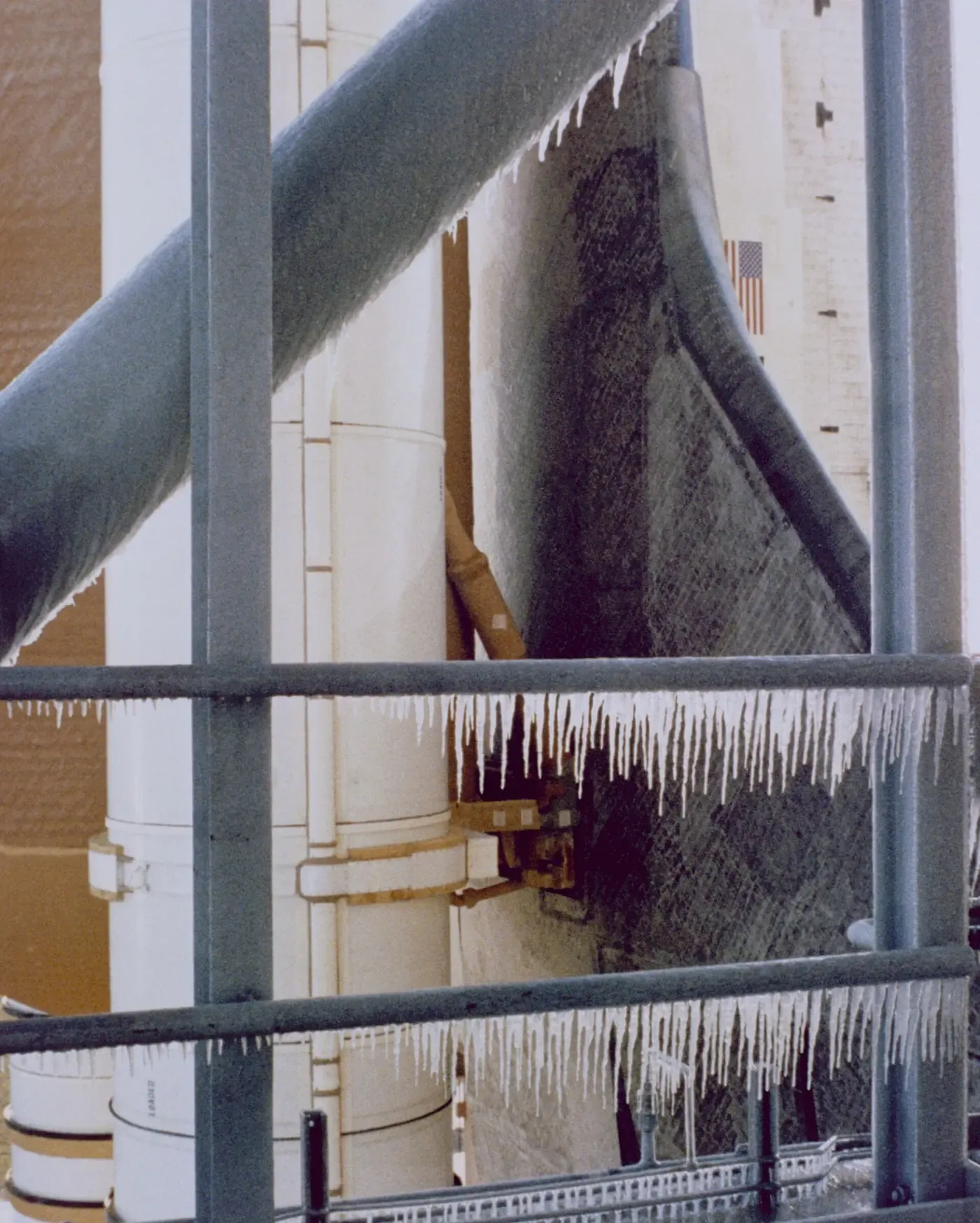

They launched anyway, at 11:38 a.m. on the 28th. Seventy-three seconds later, Space Shuttle Challenger broke apart, and all seven crew were lost, among them Christa McAuliffe, who would have been the first schoolteacher in space. The Rogers Commission investigation that followed spent months tracing the failure to a single joint on the right-hand solid rocket booster, where a rubber O-ring had not sealed properly at ignition. What the commission was really investigating, without always using the phrase, was a property every polymer chemist already had a name for: the glass transition temperature, the point below which a rubber stops behaving like rubber.
Plate II


A Property Chemists Already Had a Name For
Every amorphous polymer (one whose chains are not locked into a crystal lattice) has a temperature range across which it stops being rigid and starts being flexible, or the reverse, as it cools. Above that range the chains and chain segments have enough thermal energy to wriggle past one another; the material can flow, however slowly, and deforms rather than fractures. Below it, the same chains are frozen in place: not chemically bonded any differently, just too cold to move on any useful timescale. The material is glassy: hard, often brittle, and dimensionally stable in a way the same polymer is not a few degrees warmer. That crossover is the glass transition temperature, Tg, and unlike a melting point it is not sharp: there is no latent heat, no fixed crystal structure breaking down, just chain motion fading out gradually over a span of degrees.
Rubber and plastics technologists had been running into this behaviour, and measuring it by whatever means they had, since well before anyone gave it a settled theory. It was Thomas Fox and Paul Flory, in 1950, who first showed that Tg rises predictably as chains get longer, following a simple inverse relationship with molecular weight (the Fox-Flory equation), and a few years later Fox gave the field a companion rule for what happens when two different monomers are copolymerized, with the blend’s Tg falling between the two components’ in proportion to how much of each is present. In 1955, Malcolm Williams, Robert Landel and John Ferry published what became the field’s most quoted relationship: the WLF equation, which describes how a polymer’s mechanical response scales with temperature above Tg using only two fitted constants that turn out to be nearly universal across unrelated polymers. Both results still anchor the field. And an adjacent puzzle (why a liquid cooled fast enough to dodge crystallisation does not simply keep losing entropy until it runs out, a paradox raised by Wolfgang Kauzmann in 1948) is still argued over today; the vitrification chemists actually measure is, in a sense, matter’s way of avoiding Kauzmann’s contradiction by locking up before it arrives.
What Freezes, and What Doesn’t
Nothing about the chemistry changes at Tg: no bond breaks, no new structure forms. What changes is which kinds of motion the chains can still afford. Above Tg, whole segments of a chain (stretches ten or twenty carbons long) can rotate and slide past their neighbours on a timescale of microseconds or faster, and it is this segmental motion, not the vibration of individual bonds, that gives a rubber its flow and its give. As the temperature drops, the free volume in the material (the small gaps between chains that let segments move into new positions) shrinks, and segmental motion slows in step with it. It does not happen all at once: local motions of a few atoms persist even once the larger cooperative rearrangements a whole segment needs have essentially stopped, which is why the transition spans a range of temperatures rather than occurring at one. By the time the last of that motion has effectively stopped, on any timescale that matters to an engineer, the polymer is glassy.
This is also why Tg is not a single fixed number the way a melting point can be treated as one. Measure it by heating quickly and you get a higher apparent value than measuring slowly, because the chains have less time to relax into whatever configuration the new temperature would eventually allow. It is a kinetic transition, not a thermodynamic one in the strict sense, which is exactly what made the Challenger O-rings hard to reason about from a single quoted figure.
What a Number Alone Missed
The O-ring compound was a DuPont fluoroelastomer sold as Viton, and by most published measurements its Tg sits somewhere in the range of -10°C to -30°C, depending on the exact formulation; that is comfortably below the roughly -2°C air temperature on the pad that morning. Taken at face value, that comparison suggested the seals should still have been rubbery enough to work. It was the wrong comparison to make. A polymer’s stiffness and its resilience (how fast it springs back after being compressed, rather than whether it can spring back at all) both change continuously as a material cools toward Tg, well before it actually arrives there. An O-ring squeezed into its groove at launch has to relax back to full contact with the joint wall within a fraction of a second to keep sealing; on a morning that cold, Thiokol’s own pre-launch testing showed that relaxation had already slowed drastically, days before anyone could point to a specific temperature and call it a hard limit.
Plate III
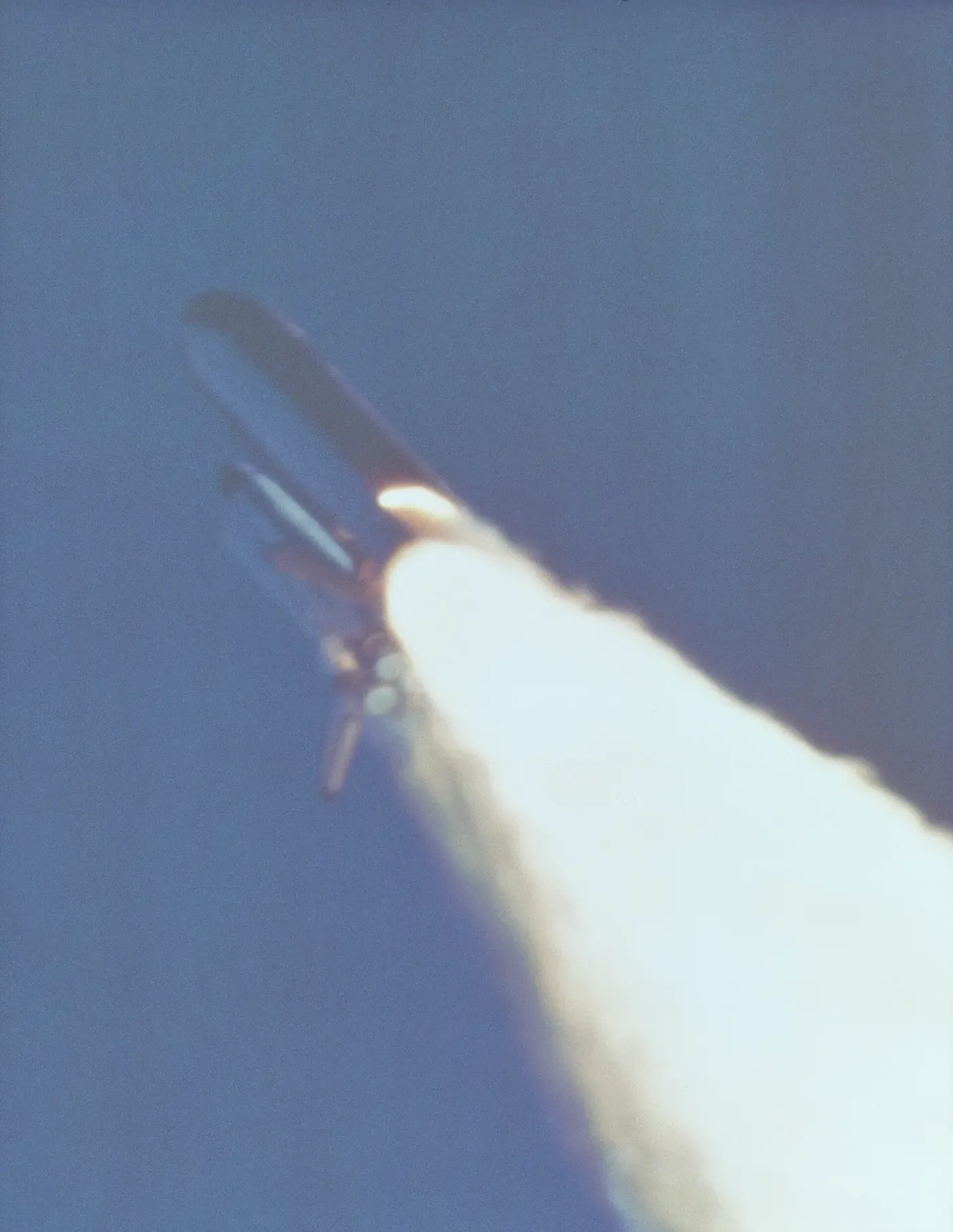

During the Rogers Commission’s televised hearings, physicist Richard Feynman made the point without a single equation. He dropped a small C-clamped sample of the O-ring material into a glass of ice water, held it there a few minutes, then released the clamp on camera: the material stayed compressed instead of springing back. It was a demonstration of exactly the phenomenon at issue: not that the rubber had turned to glass outright, but that its recovery time, which needed to be a fraction of a second, had stretched out far enough at that temperature to matter. The lesson the investigation drew was not “know your material’s Tg” so much as “know how your material behaves as it approaches Tg,” which turned out to be the harder and more useful question.
Plate IV


What Moves the Line
Tg is not fixed for a given polymer; it is a property engineers can push around by design, and the same handful of levers show up again and again.
Chain length is the most basic: short chains have more free chain ends, which move more easily than mid-chain segments, so short-chain material has a lower Tg than long-chain material of the same chemistry, following the Fox-Flory relationship above. The effect plateaus once chains get long enough that the fraction of free ends becomes negligible.
Cross-linking works in the opposite direction. Every covalent link tying one chain to its neighbour removes a degree of freedom the segment used to have, and raises Tg: a small number of cross-links can shift it noticeably, and heavy cross-linking, as in a hard thermoset, can push it far above room temperature or eliminate flow altogether. Crystallinity acts similarly on the amorphous regions of a semi-crystalline polymer: the crystallites act as physical anchor points, restricting the mobility of the disordered chain segments threaded between them, and how strongly they do so depends on how many crystallites there are and how they are distributed, which is itself set by how fast the material was cooled during processing.
Plasticizers push the other way, deliberately. A small molecule wedged between chains adds free volume and lets segments slide past each other more easily, and the effect is large: a few percent of plasticizer can drop Tg by tens of degrees. The classic case is PVC: unplasticized, its Tg sits comfortably above room temperature, which is why rigid PVC pipe is rigid, while the same polymer loaded with plasticizer becomes the flexible vinyl of medical tubing and shower curtains, its Tg pushed down below the temperatures it will ever actually see in use.
Copolymerization offers a subtler version of the same control. Blend two monomers randomly along one chain and the copolymer typically shows a single Tg between the two homopolymers’ values, weighted by how much of each is present. Arrange the same two monomers into distinct blocks instead, and the material can show two separate glass transitions, one for each block’s own domain; this is a route to materials that are rigid at the use temperature in one microphase and rubbery in the other.
Even a polymer’s processing history leaves a mark. Chains quenched quickly from the melt get frozen before they finish relaxing into their preferred packing, leaving extra free volume trapped in the glass; over months or years at room temperature that excess volume slowly works its way out, a process called physical aging, which is part of why some plastics stiffen and grow brittle simply by sitting on a shelf. Moisture behaves like an accidental plasticizer in polymers that absorb it, quietly lowering Tg in humid conditions; pressure does the reverse, raising it by squeezing out free volume mechanically.
A Property That Shows Up Everywhere Once You’re Looking
The Challenger investigation is the case that made Tg a matter of public record, but engineers had been designing around it for decades already, and go on doing so in places far from aerospace. Winter tyre compounds are formulated with a Tg well below any temperature the tyre will see on the road, so the rubber keeps its grip on ice rather than turning hard and glassy; automotive weatherstripping and gaskets are chosen the same way, for the same reason the Challenger seals were not. Pharmaceutical companies track the Tg of amorphous drug formulations because a formulation stored above its Tg can slowly recrystallize and change how the drug releases in the body, which is why storage temperature on a package insert is rarely an arbitrary number. Food scientists rely on it too: a hard candy is, physically, sugar cooled into a glass, brittle because it is stored well below its Tg, and the same reasoning explains why crackers turn stale; atmospheric moisture acts as a plasticizer, quietly dragging Tg down below room temperature and softening what used to be crisp.
Plate V
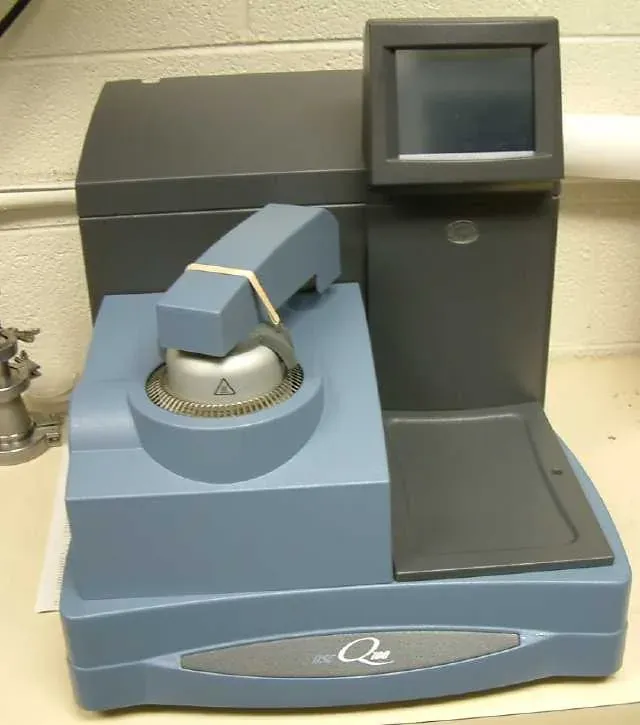

None of this required a new discovery after 1986; the science had been in place for decades. What changed was how visibly the stakes could be stated: a seal engineered without enough margin around a transition temperature nobody had bothered to characterise at the temperature that mattered killed seven people on live television, and every polymer engineer since has had a harder time treating Tg as a number to look up rather than a behaviour to test for.
The glass transition temperature (Tg) is the temperature range over which an amorphous polymer (or the amorphous regions of a semi-crystalline one) transitions between a hard, glassy state and a softer, rubbery/viscous state, as segmental chain motion becomes thermally activated. Unlike melting (Tm), Tg is not a sharp first-order phase transition; it is a kinetic, rate-dependent softening of the material, tied to the freezing-in of chain-segment mobility rather than a change in crystal structure. Tg is a defining engineering property: below it, a polymer is brittle and dimensionally stable; above it, it is flexible but loses stiffness. The Space Shuttle Challenger disaster (January 28, 1986) is the canonical real-world illustration: the solid rocket booster O-rings, made of a fluoroelastomer rubber, lost their resilience and sealing ability at the unusually cold launch-morning temperatures (in the 20s Fahrenheit) because the rubber approached or dropped below its glass transition temperature (known to only perform reliably above ~53°F). Physicist Richard Feynman famously demonstrated this at a televised press conference by dipping a compressed O-ring sample in ice water and showing it failed to spring back to shape; this was a direct, visible demonstration of glassy embrittlement. The failed O-ring seal allowed hot gas to escape a solid rocket booster, igniting the external fuel tank and destroying the vehicle 73 seconds after launch.
No governing equations recorded. This concept is treated qualitatively.
- Year of origin
- 1986
- Era
- The Specialty Polymers Age (1980-1999)
- Key figures
- Thomas G. Fox · Paul J. Flory · Malcolm L. Williams · Robert F. Landel · John D. Ferry
- Events referenced
- Space Shuttle Challenger disaster (January 28, 1986) · Rogers Commission investigation (1986)
- [1]Glass transitionWikipediaAccessed 2026-07-14https://en.wikipedia.org/wiki/Glass_transition[wiki-glass-transition]
- [2]Space Shuttle Challenger disaster: O-ring cold-temperature failure (Richard Feynman)Web search summary (History.com, Nautilus, feynman.com)Accessed 2026-07-14https://en.wikipedia.org/wiki/Space_Shuttle_Challenger_disaster[search-challenger-oring]
Illustrations
- Plate IIce on the Space Shuttle Challenger's launch tower on the morning of 28 January 1986 (the cold snap the O-ring seals had never been tested against).Wikimedia Commons
- Plate IIThe moment of the disaster, a few seconds after the failed joint let hot gas escape and ignite the external tank.Wikimedia Commons
- Plate IIICamera E-207's frame from 58.778 seconds into the flight, showing the flame breach at the failed joint (the physical evidence the Rogers Commission traced back to a seal that had lost its resilience in the cold).Wikimedia Commons
- Plate IVRichard Feynman, photographed two years before he demonstrated the O-ring's loss of resilience in ice water at a televised Rogers Commission hearing.Wikimedia Commons
- Plate VA differential scanning calorimeter, the standard instrument for measuring where a polymer's glass transition actually falls.Wikimedia Commons