
Skip to content
Markey
Theme: System (currently light)
The Mitsubishi three-diamond mark in red, next to the Mitsubishi Motors wordmark

Generation

Mitsubishi Pajero

Mitsubishi Pajero (L040/L140), 1982-1991

Produced
1982–1991
Code
L040/L140
Designer
Kiyoshi Honda
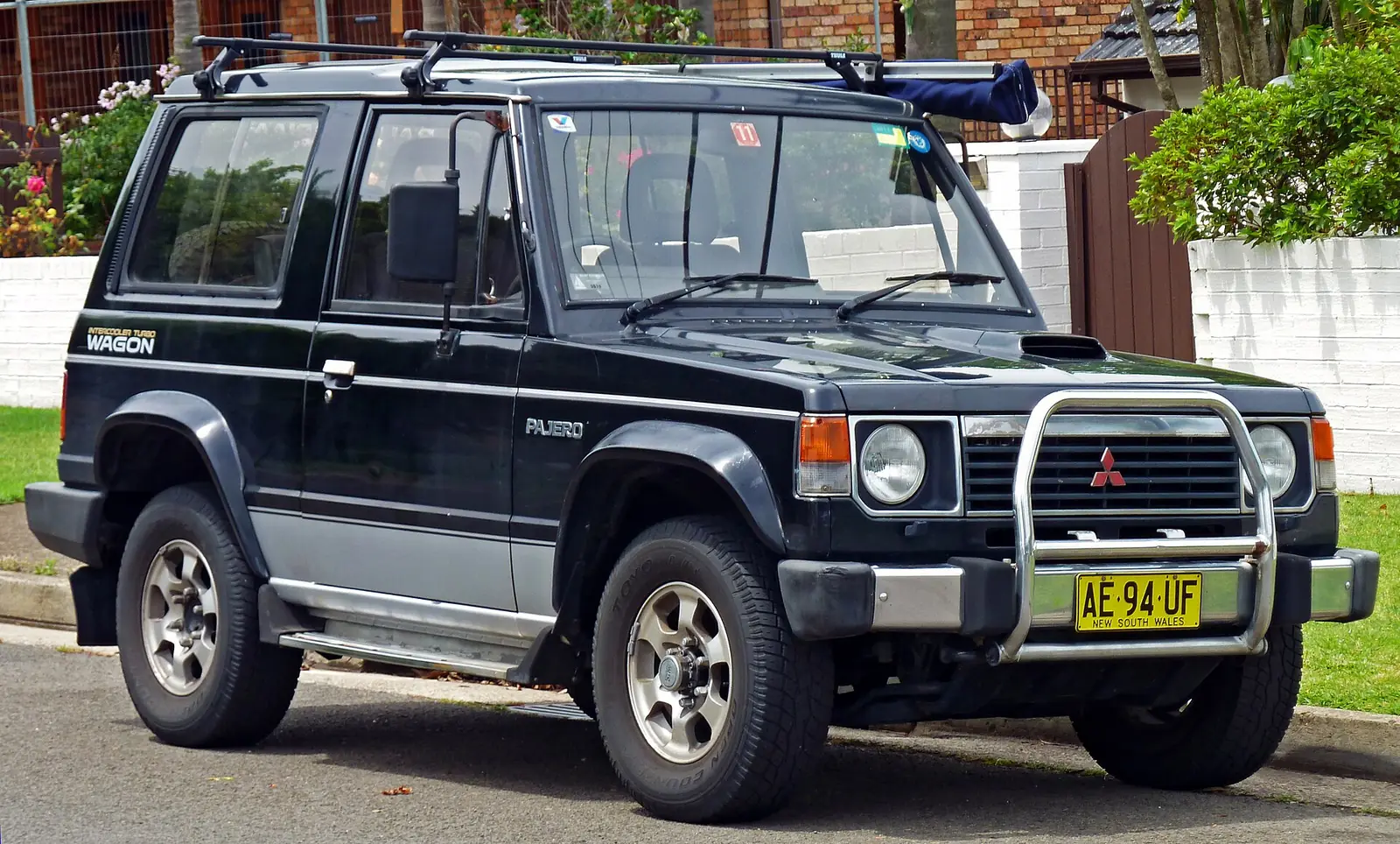
Black first-generation Mitsubishi Pajero three-door hardtop with a chrome bull bar, photographed from the front three-quarter angle on a residential street

Image credit

File
File:1989 Mitsubishi Pajero hardtop (2010-12-10) 01.jpg
Author
OSX
Licence
Public domain

Body style

Powertrain

Developed from a 1979 Tokyo Motor Show concept and launched in May 1982 as a replacement for the Mitsubishi Jeep Delivery Wagon, the first Pajero combined unusual-for-the-class features (a turbocharged diesel option, front double-wishbone suspension with torsion bar springs, and power steering) with body-on-frame simplicity.[1] It started as a short-wheelbase three-door with a choice of metal or canvas tops; a five-door long-wheelbase model followed in 1983 with seating for seven. Entering rallying within a year of launch, the Pajero went on to found a Dakar-winning reputation the nameplate never lost. Hyundai licensed the platform as the Galloper from 1991 to 2003, and Dodge briefly rebadged it as the Raider in North America.

Three trims are recorded here, from the range’s later years once the lineup had matured: the 2.6-litre four, the range-topping 3.0-litre V6, and the intercooled 2.5-litre turbodiesel (the first intercooler fitted to a production 4x4, according to the source). All three power figures are published directly in kW, so no PS conversion applies. An earlier, differently tuned European-market 2.6-litre engine is quoted elsewhere in the article at a lower output; the two are not reconciled, and the later figure is the one recorded here.

Overview

Manufacturer
Mitsubishi
Produced
1982–1991
Model code
L040/L140
Designer
Kiyoshi Honda
Segment
E-SUV (Europe) / Full-size SUV (US)
Positioning
Mainstream
Assembly
  • Sakahogi, Gifu, Japan (Pajero Manufacturing Co., Ltd)
  • Tramagal, Portugal (Tramagauto)
  • Cainta, Philippines (MMPC)
  • Zhuhai, Guangdong, China
  • Ulsan, South Korea (Hyundai Precision Products)

Dimensions

Length
4,650 mm

5-door long-wheelbase body; the 3-door short-wheelbase body is 3995 mm.

[1]

Width
1,679 mm

Published as 66.1 in and 66.6 in across body variants; converted at 1 in = 25.4 mm, the lower figure (1679 mm) is recorded here.

[1]

Height
1,890 mm

5-door body, published as 74.4 in, converted at 1 in = 25.4 mm (1890 mm). The 3-door body is lower, at 72.4-72.8 in (1839-1849 mm).

[1]

Wheelbase
2,695 mm

5-door long-wheelbase body; the 3-door short-wheelbase body is 2350 mm.

[1]

Kerb weight
Not yet available

2.6

Trim · 1988–1991 · 4G54

Power
82 kW

82 kW, published directly in kW in the source. A separate, earlier European-market tune of the same displacement is quoted elsewhere in the article at 103 PS (76 kW); the two are not reconciled, and the later, higher figure is recorded here.

[1]

Torque
Not yet available
Kerb weight
Not yet available
0–100 km/h
Not yet available
Top speed
Not yet available
Fuel economy
Not yet available
CO₂
Not yet available
Drag coefficient
Not yet available
Frontal area
Not yet available
Displacement
Not yet available
Boot volume
Not yet available
Engine
2.6 L inline-4 · 4G54
Drivetrain
Four-wheel drive

3.0 V6

Trim · 1988–1991 · 6G72

Power
104 kW

104 kW, published directly in kW in the source. The range-topping petrol engine, added in 1988.

[1]

Torque
Not yet available
Kerb weight
Not yet available
0–100 km/h
Not yet available
Top speed
Not yet available
Fuel economy
Not yet available
CO₂
Not yet available
Drag coefficient
Not yet available
Frontal area
Not yet available
Displacement
Not yet available
Boot volume
Not yet available
Engine
3.0 L V6, SOHC, EFI · 6G72
Drivetrain
Four-wheel drive

2.5 Turbodiesel (intercooled)

Trim · 1988–1991 · 4D56T

Power
70 kW

70 kW, published directly in kW in the source. This is the first intercooled engine fitted to a production 4x4, per the article. A non-intercooled version of the same engine made 62 kW and is not recorded separately here.

[1]

Torque
Not yet available
Kerb weight
Not yet available
0–100 km/h
Not yet available
Top speed
Not yet available
Fuel economy
Not yet available
CO₂
Not yet available
Drag coefficient
Not yet available
Frontal area
Not yet available
Displacement
Not yet available
Boot volume
Not yet available
Engine
2.5 L inline-4, OHC, turbocharged, intercooled · 4D56T
Drivetrain
Four-wheel drive

Sources & confidence

Every figure above carries a status. Nothing on this page is estimated without saying so, and nothing missing has been filled in with a guess.

Last verified
2026-09-24
Review status
Compiled from cited sources

Photography on this page is credited on each image. Tap theion a photograph for its author, licence and source.

References

Every sourced figure and every cited claim on this page, numbered. Wikipedia articles record the revision they were read at, because the article will have changed by the time you check it.

  1. [1]

    Mitsubishi Pajero. Wikipedia · revision 1375943829 · read 2026-09-24

    WikipediaCC BY-SA 4.0

    Single article covering all five generations by section.