Skip to content
Markey
Theme: System (currently light)
The Lamborghini wordmark, in a stylised uppercase serif typeface, with a small tagline beneath it

Generation

Lamborghini Urus

Lamborghini Urus, 2017-present

Produced
2017–present
Designer
Filippo Perini (2012 concept); Mitja Borkert (production version)
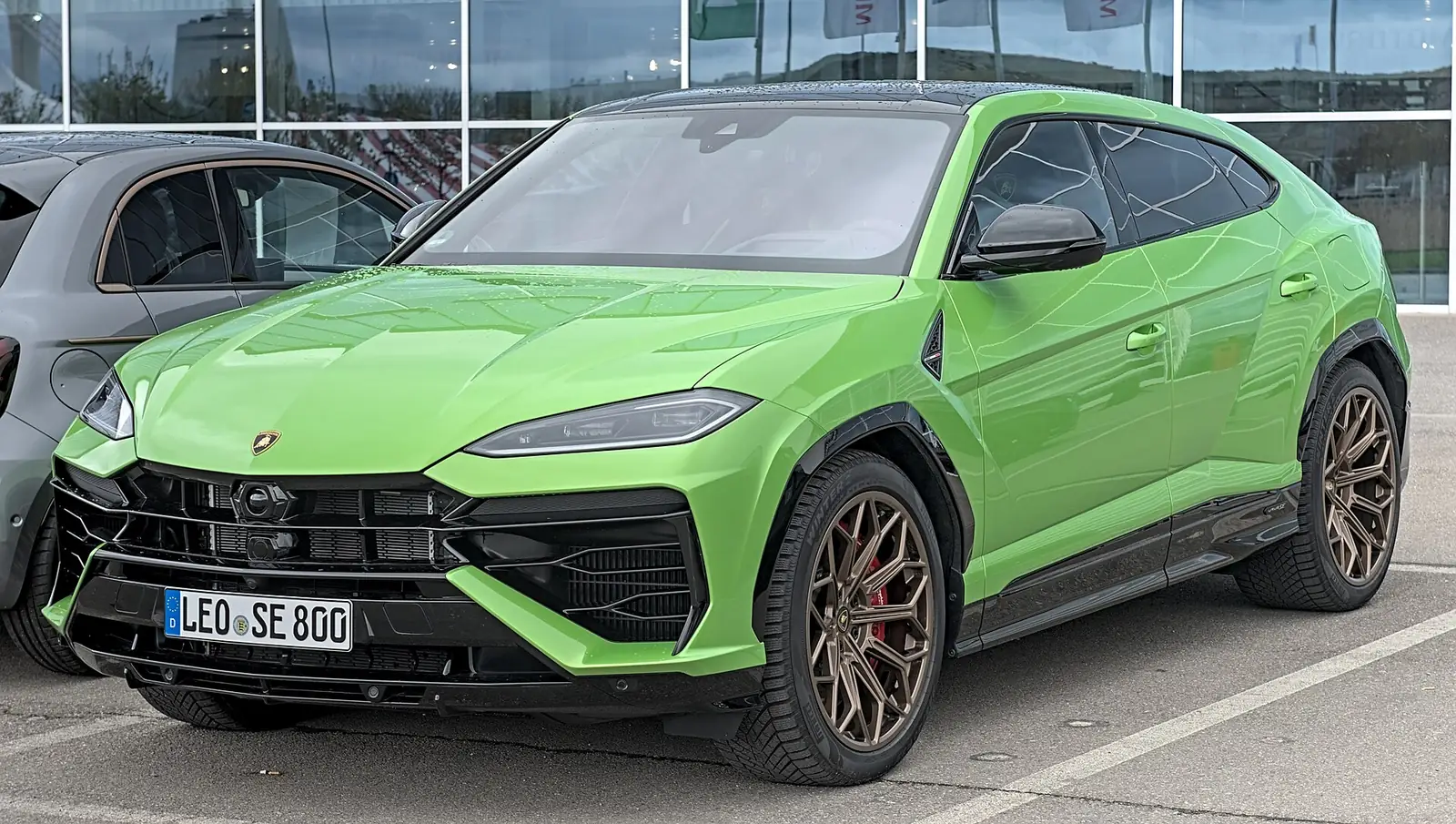
Green Lamborghini Urus SE photographed from the front three-quarter angle, showing the SUV's angular Lamborghini-styled front end

Image credit

File
File:Lamborghini Urus SE DSC 8524.jpg
Author (attribution required)
Alexander Migl

Body style

Drivetrain

The Urus has been a single, continuously updated generation since 2017: Lamborghini’s naming has moved through Urus, Urus S, Urus Performante and now Urus SE without ever calling any of them a new generation, so this entry follows that and treats the run as one, with the launch car and the current SE as its two bracketing trims.[1]

The SE’s power and torque figures are Lamborghini’s own published system totals for the plug-in hybrid V8-plus-motor combination (596 kW and 950 N⋅m), which do not equal the sum of the 462 kW/800 N⋅m engine and 141 kW/483 N⋅m motor figures also quoted in the same article, because engine and motor peak at different points and cannot be added together. Only the manufacturer’s own combined figures are recorded.

The SE’s mass is left as a gap rather than a guess. The article states it is “roughly 300 kg” heavier than the Urus S, but the Urus S’s own kerb weight is never independently given; only the original 2017 Urus’s 2,200 kg is, which NHTSA’s Canadian Vehicle Specifications register independently confirms for the 2019 model year. Adding an approximate delta to a different car’s weight would be an invented number wearing a verified label, so the SE’s mass is recorded as a placeholder instead.
Overview

Manufacturer
Lamborghini
Produced
2017–present
Designer
Filippo Perini (2012 concept); Mitja Borkert (production version)
Segment
E-SUV (Europe) / Full-size SUV (US)
Positioning
Ultra-luxury & exotic
Assembly
Sant'Agata Bolognese, Italy

Dimensions

Length
5,113 mm

[1]

Width
2,017 mm

[1]

Height
1,638 mm

[1]

Wheelbase
3,002 mm

[1]

Kerb weight
2,200 kg

Base Urus. Confirmed independently by NHTSA's Canadian Vehicle Specifications for the 2019 model year, which records the identical 2,200 kg curb weight.

[1]

Urus

Trim · 2017–2022

Power
478 kW

At 6,000 rpm.

[1]

Torque
850 N⋅m

At 2,250-4,500 rpm.

[1]

Kerb weight
2,200 kg

Confirmed by NHTSA's Canadian Vehicle Specifications for the 2019 model year.

[1]

0–100 km/h
3.6 s

[1]

Top speed
305 km/h

[1]

Fuel economy
Not yet available
CO₂
Not yet available
Drag coefficient
Not yet available
Frontal area
Not yet available
Displacement
3,996 ccEstimated

The article states the engine as "4.0-litre", based on the Audi 4.0 TFSI V8; 3,996 cc is that engine family's well-documented displacement, not a figure stated directly in this article.

Boot volume
Not yet available
Seats
5
Engine
V8, twin-turbo
Drivetrain
All-wheel drive

Urus SE

Trim · 2024–present

Power
596 kW

Published combined system output. The engine alone makes 462 kW and the electric motor alone 141 kW; those do not add to 596 kW because they peak at different points, so only the manufacturer's own combined figure is used.

[1]

Torque
950 N⋅m

Published combined system torque. The engine alone makes 800 N-m and the motor alone 483 N-m; motor and engine torque cannot be meaningfully summed at the crankshaft, so only the manufacturer's own combined figure is used.

[1]

Kerb weight
Not yet available

The article states only that the SE is "roughly 300 kg" heavier than the Urus S due to its 25.9 kWh battery pack, and the Urus S's own kerb weight is not independently stated in this article, only the original Urus's 2,200 kg. Adding 300 kg to a different trim's weight would be exactly the kind of invented arithmetic this site avoids, so the field is left as a placeholder instead.

0–100 km/h
3.4 s

[1]

Top speed
312 km/h

Lamborghini's own claim: the fastest production SUV in the world at launch.

[1]

Fuel economy
Not yet available
Electric consumption
Not yet available
Battery capacity
25.9 kWh

Total pack capacity; the article does not separately state a usable figure.

[1]

Electric range
Not yet available
CO₂
Not yet available
Drag coefficient
Not yet available
Frontal area
Not yet available
Displacement
3,996 ccEstimated

Reworked version of the same Audi-derived 4.0-litre V8; the article does not give an exact cc figure for the SE's engine, so this carries the same estimate as the base Urus.

Boot volume
Not yet available
Seats
5
Engine
V8, twin-turbo, plug-in hybrid with permanent-magnet electric motor
Drivetrain
All-wheel drive

Sources & confidence

Every figure above carries a status. Nothing on this page is estimated without saying so, and nothing missing has been filled in with a guess.

Last verified
2026-09-08
Review status
Compiled from cited sources

Photography on this page is credited on each image. Tap theion a photograph for its author, licence and source.

References

Every sourced figure and every cited claim on this page, numbered. Wikipedia articles record the revision they were read at, because the article will have changed by the time you check it.

  1. [1]

    Lamborghini Urus. Wikipedia · revision 1369265590 · read 2026-09-08

    WikipediaCC BY-SA 4.0

  2. [2]

    NHTSA Canadian Vehicle Specifications — 2019 Lamborghini Urus. NHTSA · read 2026-09-08

    DatasetPublic domain (US government work)Cited by the specifications