
Skip to content
Markey
Theme: System (currently light)
Hyundai badge: a stylised, slanted letter H inside an oval

Generation

Hyundai Accent (X3)

Hyundai Accent (X3), 1994-1999

Produced
1994–1999
Code
X3
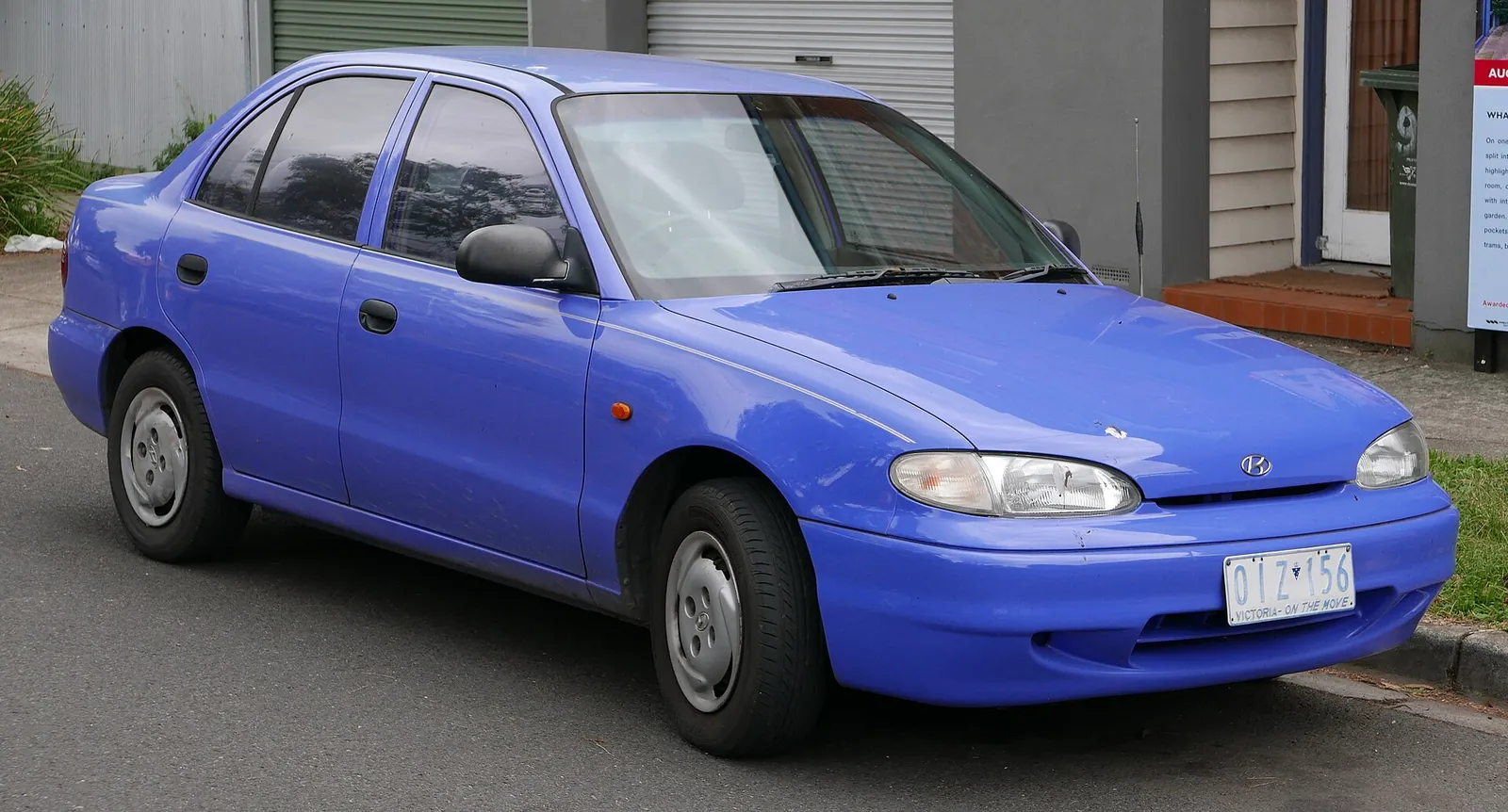
Blue Hyundai Excel/Accent X3 four-door sedan photographed from the front three-quarter angle, parked on a residential street

Image credit

File
File:1996 Hyundai Excel (X3) GLX sedan (2015-06-25) 01 (cropped).jpg
Author
OSX
Licence
Public domain

Released into the public domain by the photographer.

Body style

Powertrain

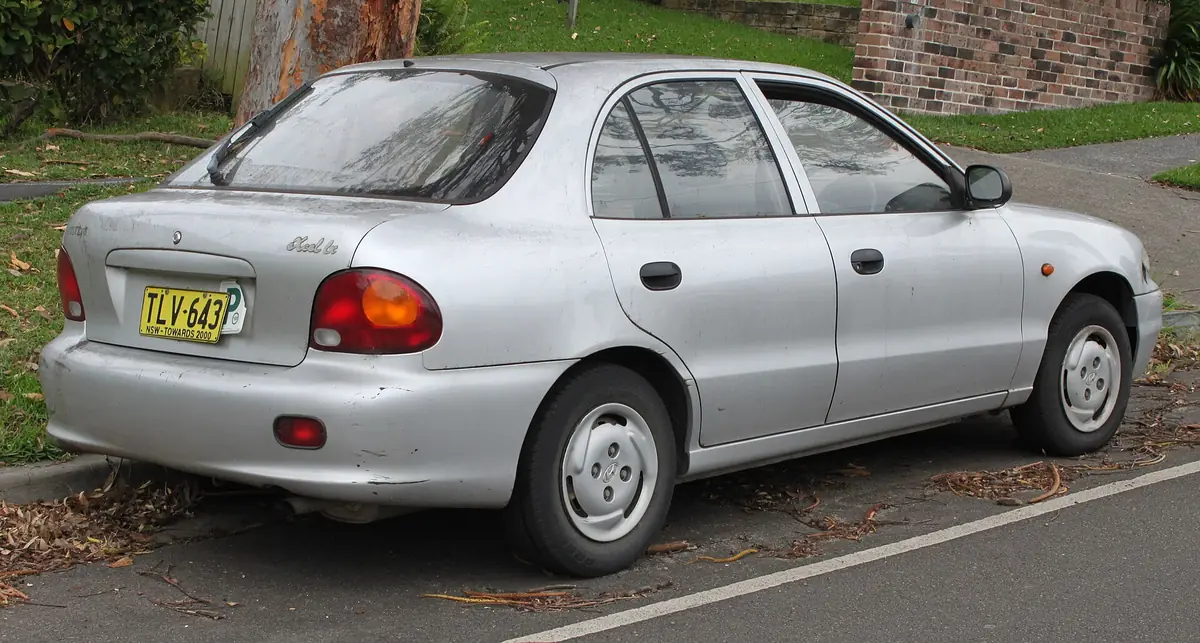
Hyundai’s first Accent, launched in 1994 to replace the Excel and, in several markets including Australia and the Netherlands, sold under the Excel name itself rather than a new one.[1] It was built and rebadged even more widely than that: as the Hyundai Pony in France, the Bimantara Cakra in Indonesia and the Kia Qianlima in China, sharing sheet metal across brands and continents from a single Ulsan design.

The car’s own sourcing is a small lesson in how numbers are dated. Its weight is published as a range across the run (2,101-2,150 lb, or roughly 953-975 kg); the specific figure recorded here, 953 kg, comes from a Canadian government record of the two-door hatchback and sits at the low end of that range, so it describes one particular body style, not the whole model. Two engine states of tune are recorded, an early single-cam and a 1997 twin-cam facelift, and they are kept apart deliberately: Hyundai also sold a higher-output “GT” tune of the same twin-cam engine in the US, which made a different power figure and is not the trim recorded here.
Overview

Manufacturer
Hyundai
Produced
1994–1999
Model code
X3
Segment
B-segment (Europe) / Subcompact (US)
Positioning
Economy
Assembly
  • Ulsan, South Korea (Hyundai)
  • İzmit, Kocaeli Province, Turkey (Hyundai Assan Otomotiv)
  • Cairo, Egypt (Ghabbour Group)

Dimensions

Length
4,100 mm

Liftback length; the sedan is published as 162.1 in (4118 mm).

[1]

Width
1,620 mm

[1]

Height
1,395 mm

1395 mm for the Hyundai-badged car; the Kia Qianlima sibling built in China is 1410 mm.

[1]

Wheelbase
2,400 mm

[1]

Kerb weight
953 kg

Canadian-market curb weight for the 2-door hatchback (model year 95), matching the low end of Wikipedia's published 2,101-2,150 lb kerb weight range (953-975 kg).

[2]

1.5 SOHC

Trim · 1994–1999 · G4EK

Power
68 kW

91 hp at the 1997 Australian facelift, converted at 1 hp = 0.745699872 kW (67.9 kW, rounded to 68).

[1]

Torque
Not yet available
Kerb weight
953 kg

Canadian-market curb weight for the 2-door hatchback, model year 95.

[2]

0–100 km/h
Not yet available
Top speed
Not yet available
Fuel economy
8.4 L/100 km

EPA combined 28 mpg (US) for the 1996 US-market 1.5 L 5-speed manual, converted at 235.215 L-mi/100km-gal. This is the current EPA estimate; the methodology changed in 2008 and earlier cars were recalculated, so it is not the figure on the 1996 window sticker.

[3]

CO₂
197 g/km

EPA tailpipe CO2, 317.4 g/mi, converted at 1.609344 km/mi (US cycle).

[3]

Drag coefficient
Not yet available
Frontal area
Not yet available
Displacement
Not yet available
Boot volume
311 L

EPA luggage volume, 11 cu ft, converted at 28.3168 L/cu ft. EPA's method is not comparable with a European VDA boot figure.

[3]

Engine
inline-4 SOHC 12V · G4EK
Drivetrain
Front-wheel drive

1.5 DOHC Twin Cam

Trim · 1997–1999 · G4FK

Power
74 kW

74 kW (99 hp) at 6,000 rpm, as published directly in kW. The US-market Accent GT used the same DOHC engine tuned to a different, higher figure (105 hp / 78.3 kW) and is not this trim.

[1]

Torque
134 N⋅m

134 N-m at 4,000 rpm, from the 1997 Australian facelift ('Twin Cam') introduction.

[1]

Kerb weight
Not yet available
0–100 km/h
Not yet available
Top speed
Not yet available
Fuel economy
Not yet available
CO₂
Not yet available
Drag coefficient
Not yet available
Frontal area
Not yet available
Displacement
Not yet available
Boot volume
Not yet available
Engine
inline-4 DOHC 16V · G4FK
Drivetrain
Front-wheel drive

Sources & confidence

Every figure above carries a status. Nothing on this page is estimated without saying so, and nothing missing has been filled in with a guess.

Last verified
2026-09-24
Review status
Compiled from cited sources

Photography on this page is credited on each image. Tap theion a photograph for its author, licence and source.

References

Every sourced figure and every cited claim on this page, numbered. Wikipedia articles record the revision they were read at, because the article will have changed by the time you check it.

  1. [1]

    Hyundai Accent. Wikipedia · revision 1372150513 · read 2026-09-08

    WikipediaCC BY-SA 4.0

    Single article covering all generations (X3, LC, MC, RB, HC, BN7) by section.

  2. [2]

    1996 Hyundai Accent 2DR Hatchback L/GL/GT (model year 95) — NHTSA Canadian Vehicle Specifications. US National Highway Traffic Safety Administration · read 2026-09-24

    DatasetPublic domain (US Government work)Cited by the specifications

    Canadian-market curb weight 953 kg and 63/37 front/rear weight distribution for the 2-door hatchback, model year 95 (X3).

  3. [3]

    1996 Hyundai Accent (Man 5-spd, 1.5 L) — EPA fuel economy. US Environmental Protection Agency · read 2026-09-08

    DatasetPublic domain (US Government work)Cited by the specifications