
Skip to content
Markey
Theme: System (currently light)
The Ferrari wordmark in a stylised script typeface

Generation

Ferrari F40

Ferrari F40, 1987-1992

Produced
1987–1992
Designer
Pietro Camardella under Aldo Brovarone at Pininfarina; Nicola Materazzi (chief engineer)
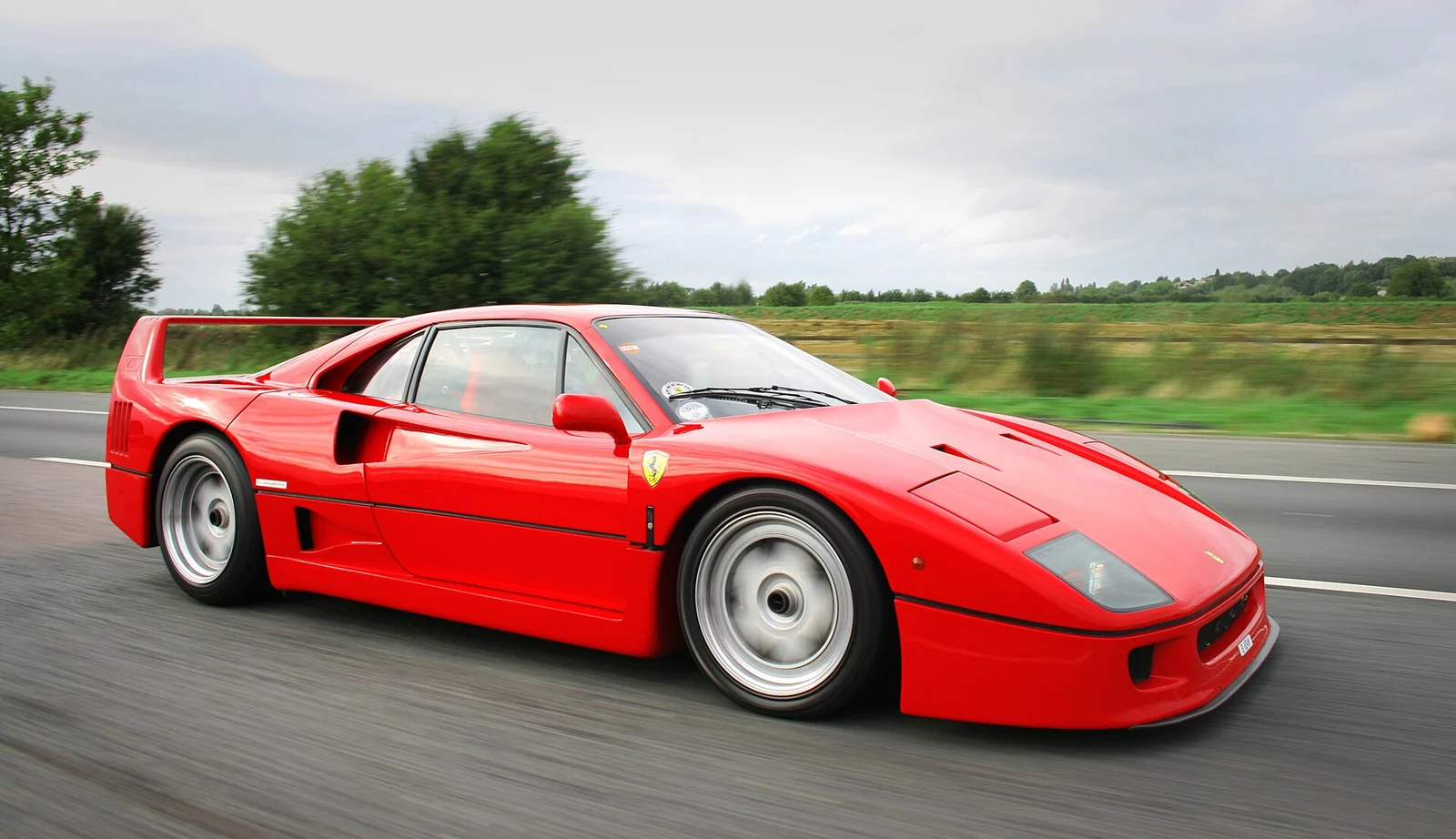
Red Ferrari F40 photographed in motion from the front three-quarter angle, showing its large rear wing and pop-up headlights

Image credit

File
File:F40 Ferrari 20090509.jpg
Author (attribution required)
Will ainsworth

Body style

Powertrain

Test Drive this car

Developed in eleven months from June 1986 by chief engineer Nicola Materazzi, who had proposed the underlying idea to Enzo Ferrari two years earlier as a road-legal evolution of the 288 GTO built for a Group B category that never happened.[1] It launched with a planned run of 400 cars and a US retail price around $400,000, roughly five times the 288 GTO’s; demand ran well past that figure, and Ferrari eventually built 1,311.

Ferrari’s own claimed top speed was never matched in an independent test. Different outlets recorded different numbers on different cars (321 km/h at Nardo, 315 km/h by Road & Track, 317 km/h by Car and Driver), a spread this entry treats as ordinary test-to-test variation on a hand-built 1980s car, not a genuine conflict between sources, and records the most widely repeated of the three rather than averaging or picking the highest.
Overview

Manufacturer
Ferrari
Produced
1987–1992
Designer
Pietro Camardella under Aldo Brovarone at Pininfarina; Nicola Materazzi (chief engineer)
Segment
S-segment (Europe) / Sports car (US)
Positioning
Ultra-luxury & exotic
Assembly
Maranello, Italy

Dimensions

Length
4,430 mm

[1]

Width
1,970 mm

[1]

Height
1,124 mm

[1]

Wheelbase
2,450 mm

[1]

Kerb weight
1,254 kg

Europe-market figure; the US-market car is heavier at 1,369 kg, largely due to emissions and impact-safety equipment.

[1]

F40

Trim · 1987–1992 · Tipo F120A

Power
352 kW

Manufacturer-stated, 478 PS at 7,000 rpm, converted at 1 PS = 0.73549875 kW. Wikipedia notes that gearing, torque curves and actual power output differed among individual cars.

[1]

Torque
577 N⋅m

Manufacturer-stated, at 4,000 rpm.

[1]

Kerb weight
1,254 kg

Europe-market figure.

[1]

0–100 km/h
4.7 s

First independent measurement, published on the cover of Sport Auto, September 1988.

[1]

Top speed
321 km/h

Measured by Auto, Motor und Sport at Nardo (1988) and matched by Sport Auto's own test the same year; Road & Track later measured 196 mph (315.4 km/h) and Car and Driver 197 mph (317.0 km/h) on different cars. Ferrari's own claimed top speed was never independently matched by any published test.

[1]

Fuel economy
Not yet available
CO₂
Not yet available
Drag coefficient
0.34

[1]

Frontal area
Not yet available
Displacement
2,936 cc

[1]

Boot volume
Not yet available
Seats
2
Engine
V8, 90 degrees, twin-turbocharged, intercooled · Tipo F120A
Drivetrain
Rear-wheel drive

Sources & confidence

Every figure above carries a status. Nothing on this page is estimated without saying so, and nothing missing has been filled in with a guess.

Last verified
2026-09-04
Review status
Compiled from cited sources

Photography on this page is credited on each image. Tap theion a photograph for its author, licence and source.

References

Every sourced figure and every cited claim on this page, numbered. Wikipedia articles record the revision they were read at, because the article will have changed by the time you check it.

  1. [1]

    Ferrari F40. Wikipedia · revision 1372984438 · read 2026-09-04

    WikipediaCC BY-SA 4.0