
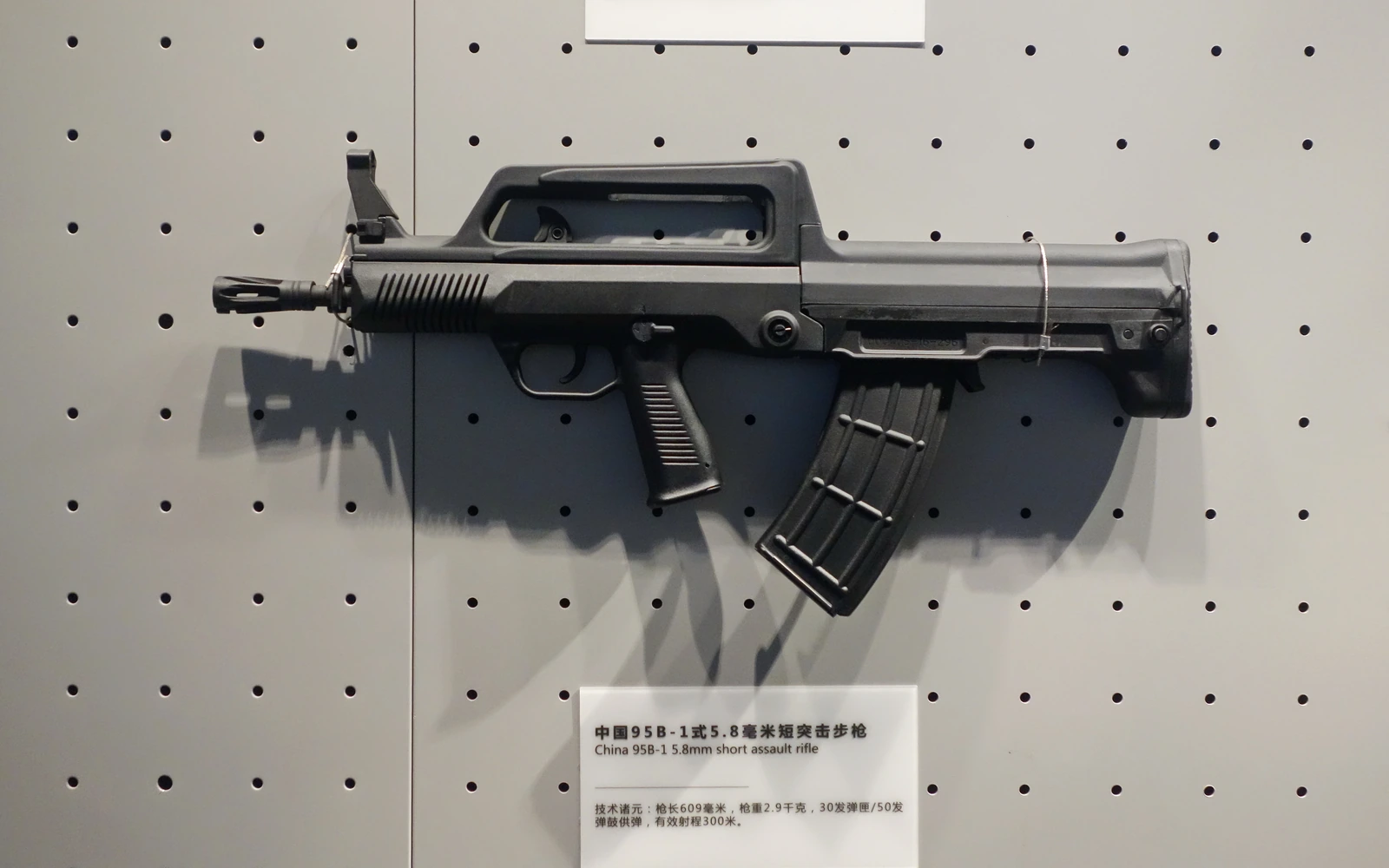
Image credit
- Title
- File:95B-1 short assault rifle 20220203.jpg
- Author
- Tyg728(attribution required)
- Licence
- CC BY-SA 4.0
- Source
- https://commons.wikimedia.org/wiki/File:95B-1_short_assault_rifle_20220203.jpg

How Muzzle energy is calculated
E = ½ · m · v²
Inputs
- m4.15 g64.04 grverifiedsourceBallistics table of the cited article, which publishes bullet mass in grams.
- v930 m/s3,051 fpsverifiedMeasured with a 557 mm barrel, not this arm's 463 mm. Velocity outside the sourced range is not projected.
1 of 2 inputs link to their source.
How Muzzle velocity is calculated
nearest sourced barrel length, no extrapolation
Inputs
- v at 557 mm930 m/s3,051 fpsverifiedsourceBallistics table of the cited article.
Assumptions
- This figure belongs to a 557 mm barrel. It is shown because it is the closest measurement that exists, not because it applies here.
1 of 1 inputs link to their source.
How Loaded mass is calculated
m_loaded = m_empty + m_magazine + n · m_cartridge
Not calculated: m_magazine has no sourced figure yet. Nothing is substituted for a missing input.
Assumptions
- One magazine, filled to the stated capacity. Spare magazines, optics, slings and lights are the owner’s, not the arm’s.
2 of 4 inputs link to their source.
How Free recoil is calculated
E_recoil = ½ · m_firearm · v_recoil²
Inputs
- m_firearm3.4 kg7.496 lbverifiedsource
- v_recoil1.135 m/s3.724 fpsestimated
Assumptions
- Propellant gas momentum is excluded: ARMAG does not record charge weights. This is therefore a lower bound on the real free recoil, consistent between entries but smaller than a figure that includes the gas term.
- Free recoil: the arm is unrestrained. Stock design, muzzle devices, stance and shooter mass are not modelled, because none of them is a property of the arm.
1 of 2 inputs link to their source.
How Capacity is calculated
as published for the primary chambering
Inputs
- capacity30verifiedsourceDetachable box magazine; a 75-round drum is also issued.
1 of 1 inputs link to their source.
Derived figures
Computed from the sourced values above. Open ƒ on any figure for the formula, its inputs, and the assumptions it makes.
How Momentum is calculated
p = m · v
Inputs
- m4.15 g64.04 grverifiedsourceBallistics table of the cited article, which publishes bullet mass in grams.
- v930 m/s3,051 fpsverifiedMeasured with a 557 mm barrel, not this arm's 463 mm. Velocity outside the sourced range is not projected.
1 of 2 inputs link to their source.
How Sectional density is calculated
SD = mass(gr) / (7000 · diameter(in)²)
Inputs
- mass4.15 g64.04 grverifiedsourceBallistics table of the cited article, which publishes bullet mass in grams.
- diameter5.8 mm0.2283 inestimatedsourceNo standards body publishes this cartridge: C.I.P. does not list it and the Chinese GJB standard is not free. This is the uncited infobox figure of the article named, and it is a lead rather than a standard.
Assumptions
- Reported in the conventional lb/in² so it is directly comparable with published figures.
2 of 2 inputs link to their source.
How Power factor is calculated
PF = mass(gr) · velocity(fps) / 1000
Inputs
- mass4.15 g64.04 grverifiedsourceBallistics table of the cited article, which publishes bullet mass in grams.
- velocity930 m/s3,051 fpsverifiedMeasured with a 557 mm barrel, not this arm's 463 mm. Velocity outside the sourced range is not projected.
Assumptions
- A competition classification defined by the IPSC and USPSA rulebooks, stated in their units. It describes a scoring category, not an effect.
1 of 2 inputs link to their source.
How Magazine dump is calculated
t = (n − 1) / (rpm / 60)
Inputs
Assumptions
- Cyclic rate held for the whole magazine, no stoppages, trigger held down. A theoretical figure for comparing mechanisms, not a measured one.
2 of 2 inputs link to their source.
How Sight error at 1 mm is calculated
θ = atan(misalignment / sight radius)
Not calculated: sight radius has no sourced figure yet. Nothing is substituted for a missing input.
Assumptions
- Shows what a stated aiming error costs. The misalignment is the reader’s figure; the site does not claim how well anyone aims.
No input on this calculation carries a clickable source yet.
Specifications
Every row here is generated from the schema, so a figure recorded on this entry cannot be missing from the table, and the same rows, read the same way, are what the comparison shows.
Identity
- Type
- Rifle
- Action
- Self-loading
- Fire modes
- Semi-automatic
- Fully automatic
- Operating system
- Gas, short-stroke piston
- Designed in
- China
- Produced in
- Introduced
- 1997
- Production
- 1995–present
Dimensions and mass
Sights and rifling
- Sight radius
- not recorded
- Sight height over bore
- not recorded
- Rifling twist
- not recorded
- Twist direction
- not recorded
- Grooves
- not recorded
- Sight graduation
- not recorded
Chamberings
- 5.8×42mmprimary30 rounds
Scale
A to-scale outline against family siblings. The dimensions are sourced; the shape is a representative outline for the type, and says so.
- QBZ-95760 mm29.92 inheight not recorded
Representative outline: the dimensions are sourced, the shape is not. Overall length, and barrel length where recorded, are drawn from this entry's own figures; the profile is a generic one for the firearm type and says nothing about this arm's actual contours. QBZ-95 records no height, so its outline is drawn at the type's proportion. That height is part of the shape, not a measurement.
Detail
China is the only major power to have introduced an entirely new service cartridge since the 1970s, and this is the rifle built for it. The 5.8×42mm round was specified to outperform both the 5.56×45mm and the 5.45×39mm at range, and adopting it meant that nothing about the QBZ-95 could be borrowed from anyone.
The layout is a bullpup: the magazine sits behind the trigger, so a 463 mm barrel fits inside a 760 mm weapon. The usual bullpup objections apply (the trigger linkage is long, the ejection port is beside the firer’s face, and left-handed use is awkward), and the 2010 QBZ-95-1 revision addressed several of them without changing the layout.
It is one of the most numerous service rifles in the world and one of the least documented in English. Its figures here come from a single encyclopedia article, no manufacturer publishes a specification sheet, and the 5.8×42mm cartridge itself is not covered by any free standards body.
References
This entry's own bibliography. Every citation key on this page resolves into this list.
- QBZ-95 · Wikipedia · 1356442512 · read 2026-08-31 · CC BY-SA 4.0
Last verified 2026-08-31 · review status: agent-populated