
Barrett M82
Barrett Firearms Manufacturing1982–presentLate Cold War
Also known as M107, Light Fifty
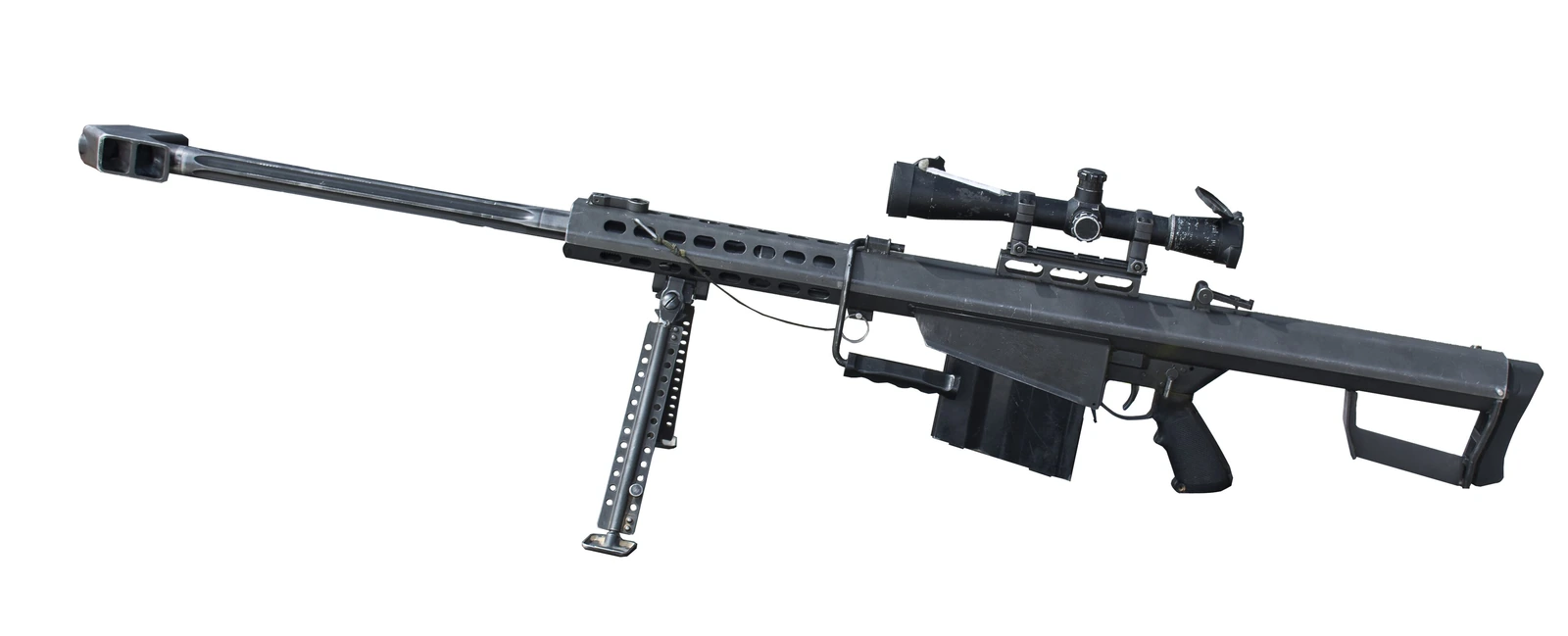
Image credit
- Title
- File:Barrett-M82A1-Independence-Day-2017-IZE-048-white.jpg
- Author
- MathKnight and Zachi Evenor(attribution required)
- Licence
- CC BY 4.0
- Source
- https://commons.wikimedia.org/wiki/File:Barrett-M82A1-Independence-Day-2017-IZE-048-white.jpg

How Muzzle energy is calculated
E = ½ · m · v²
Not calculated: m has no sourced figure yet. Nothing is substituted for a missing input.
No input on this calculation carries a clickable source yet.
How Muzzle velocity is calculated
no sourced velocity for this pairing
Not calculated: muzzle velocity has no sourced figure yet. Nothing is substituted for a missing input.
No input on this calculation carries a clickable source yet.
How Loaded mass is calculated
m_loaded = m_empty + m_magazine + n · m_cartridge
Not calculated: m_magazine has no sourced figure yet. Nothing is substituted for a missing input.
Assumptions
- One magazine, filled to the stated capacity. Spare magazines, optics, slings and lights are the owner’s, not the arm’s.
2 of 4 inputs link to their source.
How Free recoil is calculated
E_recoil = ½ · m_firearm · v_recoil²
Not calculated: v_recoil has no sourced figure yet. Nothing is substituted for a missing input.
Assumptions
- Propellant gas momentum is excluded: ARMAG does not record charge weights. This is therefore a lower bound on the real free recoil, consistent between entries but smaller than a figure that includes the gas term.
- Free recoil: the arm is unrestrained. Stock design, muzzle devices, stance and shooter mass are not modelled, because none of them is a property of the arm.
1 of 2 inputs link to their source.
How Capacity is calculated
as published for the primary chambering
Inputs
- capacity10verifiedsourceDetachable box magazines of 5 and 10 rounds.
1 of 1 inputs link to their source.
Derived figures
Computed from the sourced values above. Open ƒ on any figure for the formula, its inputs, and the assumptions it makes.
How Momentum is calculated
p = m · v
Not calculated: m has no sourced figure yet. Nothing is substituted for a missing input.
No input on this calculation carries a clickable source yet.
How Sectional density is calculated
SD = mass(gr) / (7000 · diameter(in)²)
Not calculated: mass has no sourced figure yet. Nothing is substituted for a missing input.
Assumptions
- Reported in the conventional lb/in² so it is directly comparable with published figures.
1 of 2 inputs link to their source.
How Power factor is calculated
PF = mass(gr) · velocity(fps) / 1000
Not calculated: mass has no sourced figure yet. Nothing is substituted for a missing input.
Assumptions
- A competition classification defined by the IPSC and USPSA rulebooks, stated in their units. It describes a scoring category, not an effect.
No input on this calculation carries a clickable source yet.
How Magazine dump is calculated
t = (n − 1) / (rpm / 60)
Not calculated: rpm has no sourced figure yet. Nothing is substituted for a missing input.
Assumptions
- Cyclic rate held for the whole magazine, no stoppages, trigger held down. A theoretical figure for comparing mechanisms, not a measured one.
1 of 2 inputs link to their source.
How Sight error at 1 mm is calculated
θ = atan(misalignment / sight radius)
Not calculated: sight radius has no sourced figure yet. Nothing is substituted for a missing input.
Assumptions
- Shows what a stated aiming error costs. The misalignment is the reader’s figure; the site does not claim how well anyone aims.
No input on this calculation carries a clickable source yet.
Specifications
Every row here is generated from the schema, so a figure recorded on this entry cannot be missing from the table, and the same rows, read the same way, are what the comparison shows.
Identity
- Type
- Rifle
- Action
- Self-loading
- Fire modes
- Semi-automatic
- Operating system
- Short recoil
- Roles
- Designed in
- United States
- Produced in
- Introduced
- 1989
- Production
- 1982–present
Dimensions and mass
- Mass, empty
- 13.47 kg29.70 lbsource
Published as 29.7 lb; 1 lb = 0.45359237 kg exactly. The article publishes 29.7–32.7 lb across configurations; the lower figure is recorded.
- Magazine, empty
- not recorded
- Length
- 1,219 mm48.00 insource
Published as 48 in; 1 in = 25.4 mm exactly. With the 20-inch barrel; 57 in with the 29-inch.
- Length, folded
- not recorded
- Width
- not recorded
- Height
- not recorded
- Barrel length
- 508 mm20.00 insource
Published as 20 in; 1 in = 25.4 mm exactly. The short barrel; a 29-inch barrel is also offered.
Sights and rifling
- Sight radius
- not recorded
- Sight height over bore
- not recorded
- Rifling twist
- not recorded
- Twist direction
- not recorded
- Grooves
- not recorded
- Sight graduation
- not recorded
Operation
- Cyclic rate
- not recorded
- Trigger pull
- not recorded
- Effective range
- 1,800 m1,969 ydsource
- Units produced
- not recorded
- Launch price
- not recorded
Chamberings
- .50 BMGprimary10 rounds
Scale
A to-scale outline against family siblings. The dimensions are sourced; the shape is a representative outline for the type, and says so.
- Barrett M821,219 mm48.00 inheight not recorded
Representative outline: the dimensions are sourced, the shape is not. Overall length, and barrel length where recorded, are drawn from this entry's own figures; the profile is a generic one for the firearm type and says nothing about this arm's actual contours. Barrett M82 records no height, so its outline is drawn at the type's proportion. That height is part of the shape, not a measurement.
Detail
Almost every other arm on this site was designed against a requirement somebody wrote down. This one was not: Ronnie Barrett wanted a shoulder-fired rifle for the .50 Browning machine gun cartridge, no manufacturer or army had asked for one, and he built it in a garage.
The mechanism is what makes it possible. The barrel and bolt recoil locked together for about 25 mm, the barrel then stops against a spring while the accelerator throws the bolt carrier rearwards, and a large muzzle brake bleeds off a substantial part of what is left. The result is a weapon firing a cartridge with roughly ten times a rifle round’s energy that a person can fire from the shoulder without injury, though at thirteen and a half kilograms, not for long, and not far from where it was set down.
Its role took its name from the weapon rather than the other way round. An anti-materiel rifle is used against equipment (radar, aircraft on the ground, vehicles, unexploded ordnance) at ranges where a smaller cartridge has nothing left, and the M82 created the category as a procurement line item after Desert Storm.
No width, height, sight radius or unloaded-with-magazine weight is published in the cited article.
References
This entry's own bibliography. Every citation key on this page resolves into this list.
- Barrett M82 · Wikipedia · 1370245669 · read 2026-08-31 · CC BY-SA 4.0
Last verified 2026-08-31 · review status: agent-populated