
8×50mmR Lebel
Introduced 1886Nicolas Lebel (Balle M); Georges Desaleux, Atelier de Puteaux (Balle D)CIP standard
Also known as 8mm Lebel, 8 x 51 R Lebel: the same cartridge under different names, all of which find this page.
Dimensions and pressure
Generated from the schema, like every specification table on this site, so a figure recorded on this entry cannot be missing from the table.
Identity
- Designed by
- Nicolas Lebel (Balle M); Georges Desaleux, Atelier de Puteaux (Balle D)
- Introduced
- 1886
- Production
- 1887–1945
- Standards body
- C.I.P.
- Case type
- Rimmed
- Case shape
- Bottleneck
Dimensions
- Bullet diameter
- 8.3 mm0.3268 insource
C.I.P. TDCC table II datasheet, field G1
- Bore diameter
- not recorded
- Case length
- 50.5 mm1.988 insource
C.I.P. TDCC table II datasheet, field L3
- Overall length
- 75 mm2.953 insource
C.I.P. TDCC table II datasheet, field L6
- Rim diameter
- 16 mm0.6299 insource
C.I.P. TDCC table II datasheet, field R1
- Neck diameter
- 8.85 mm0.3484 insource
C.I.P. TDCC table II datasheet, field H2
- Base diameter
- 13.77 mm0.5421 insource
C.I.P. TDCC table II datasheet, field P1
Pressure
- Maximum pressure
- 320 MPa46,412 psisource
C.I.P. TDCC table II datasheet, Pmax 3200 bar
- Pressure standard
- C.I.P.
SAAMI and C.I.P. measure pressure differently and their figures are not interchangeable, which is why the body is always named beside the figure.
Loads
Velocity is recorded per barrel length as published. A gun page interpolates between these points and never projects beyond them.
Balle D
- Bullet mass
- 12.8 g197.5 grestimated
Wikipedia's running text on the Balle D bronze mono-metal bullet, uncited on Wikipedia itself; no barrel-length-stated velocity exists for this load, so no velocity point is recorded
- Cartridge mass
- not recorded
- Bullet type
- solid 90/10 bronze, spitzer boat-tail
- G1 BC
- not recorded
- G7 BC
- not recorded
Balle N
- Bullet mass
- 15 g231.5 grestimated
Wikipedia's running text on the Balle N bullet, uncited on Wikipedia itself; no barrel-length-stated velocity exists for this load, so no velocity point is recorded
- Cartridge mass
- not recorded
- Bullet type
- lead-cored, cupro-nickel-over-steel-jacketed FMJ, spitzer boat-tail
- G1 BC
- not recorded
- G7 BC
- not recorded
Chambered in
Computed from every entry that lists this cartridge. Nothing here is hand-maintained.
No entry on the site is chambered in it yet.
Gallery
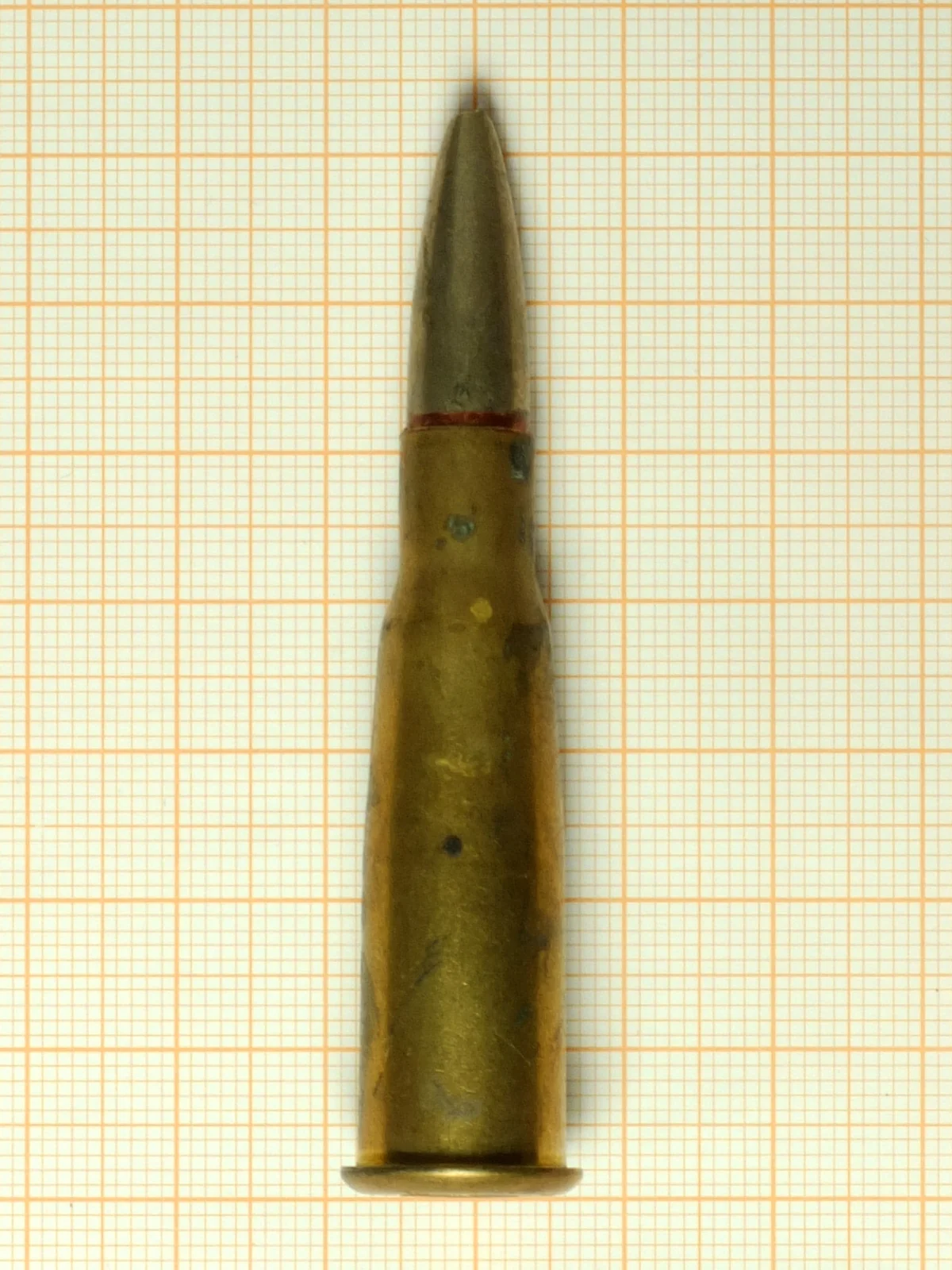
Image credit
- Title
- File:Cartridge 8mm Lebel CC BY-SA 4.0 by Grasyl.jpg
- Author
- Grasyl(attribution required)
- Licence
- CC BY-SA 4.0
- Source
- https://commons.wikimedia.org/wiki/File:Cartridge_8mm_Lebel_CC_BY-SA_4.0_by_Grasyl.jpg

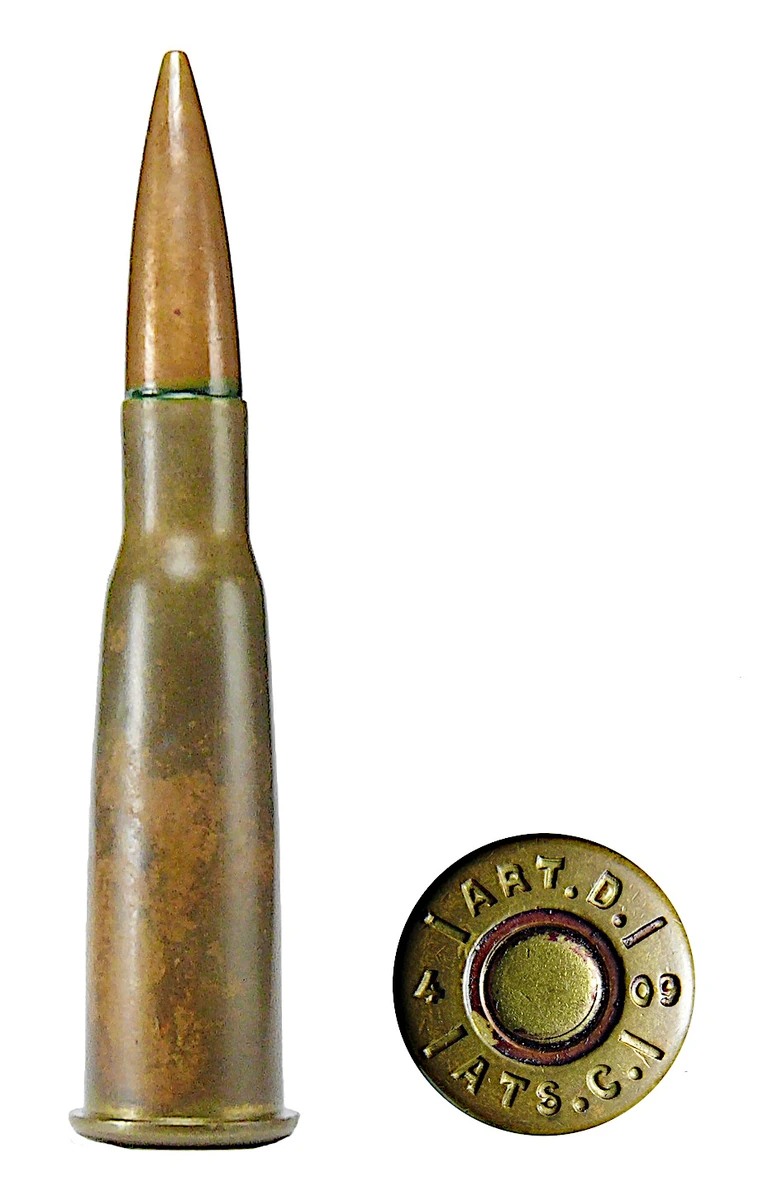
Image credit
- Title
- File:8mm Lebel Tarbes-01.jpg
- Author
- Jim Miles(attribution required)
- Licence
- CC BY-SA 4.0
- Source
- https://commons.wikimedia.org/wiki/File:8mm_Lebel_Tarbes-01.jpg

Detail
The 8×50mmR Lebel was the first smokeless-powder cartridge adopted by any army, entering French service in 1886 as the round for the tube-magazine Lebel Model 1886 rifle. It was made by necking down the earlier 11×59mmR Gras black-powder case to 8 mm, which is why its body carries an unusually sharp double taper and a thick rim rather than the cleaner bottleneck of the smaller-calibre cartridges it inspired abroad.
Its rifle’s tube magazine, rather than the cartridge’s ballistics, drove most of what makes the round distinctive. A flat-nosed bullet (balle M) was mandatory at first so a pointed tip could not set off the primer of the round in front of it; a circular groove machined around the primer cup, adopted alongside the pointed, boat-tailed balle D in 1898, later solved that problem and let France field the world’s first spitzer boat-tail military bullet. The balle D was replaced in the early 1930s by the heavier, steel-jacketed balle N, built for the Hotchkiss machine guns then in French service; rifles rechambered for it were stamped N on the barrel. The case’s taper, well suited to a tube magazine, fed poorly from the box magazines of later rifles such as the Berthier, and is the reason those magazines were built with a visible curve.
The cartridge remained in first-line French service through both world wars before being declared obsolete and replaced by the rimless 7.5×54mm French after 1945.
This entry’s dimensions and maximum pressure are transcribed from the C.I.P.’s own TDCC datasheet for the round, filed under its C.I.P. designation “8 x 51 R Lebel”. No barrel length is published alongside either historical bullet’s velocity, on Wikipedia or elsewhere freely available, so no muzzle velocity is recorded for the Balle D or Balle N loads, only their bullet masses, which are themselves uncited on Wikipedia and are carried here as estimated rather than verified. No ballistic coefficient for either bullet was found.
References
- 8×50mmR Lebel · 1370035236 · read 2026-09-01
- C.I.P. TDCC datasheet — 8 x 51 R Lebel (table II) · 2015-05-19 · read 2026-09-01
Last verified 2026-09-01 · review status: draft