
7.62×38mmR
Introduced 1895Léon NagantCIP standard
Also known as 7.62mm Nagant, 7.62 Nagant: the same cartridge under different names, all of which find this page.
Dimensions and pressure
Generated from the schema, like every specification table on this site, so a figure recorded on this entry cannot be missing from the table.
Identity
- Designed by
- Léon Nagant
- Introduced
- 1895
- Production
- 1895–present
- Standards body
- C.I.P.
- Case type
- Rimmed
- Case shape
- Straight
Dimensions
- Bullet diameter
- 7.82 mm0.3079 insource
C.I.P. TDCC table 4 datasheet, field G1
- Bore diameter
- not recorded
- Case length
- 38.8 mm1.528 insource
C.I.P. TDCC table 4 datasheet, field L3
- Overall length
- 37.3 mm1.469 insource
C.I.P. TDCC table 4 datasheet, field L6, shorter than the case length itself, because the bullet is seated flush inside the case mouth
- Rim diameter
- 10.3 mm0.4055 insource
C.I.P. TDCC table 4 datasheet, field R1
- Neck diameter
- 8.42 mm0.3315 insource
C.I.P. TDCC table 4 datasheet, field H2
- Base diameter
- 9.06 mm0.3567 insource
C.I.P. TDCC table 4 datasheet, field P1
Pressure
- Maximum pressure
- 77 MPa11,168 psisource
C.I.P. TDCC table 4 datasheet, Pmax 770 bar
- Pressure standard
- C.I.P.
SAAMI and C.I.P. measure pressure differently and their figures are not interchangeable, which is why the body is always named beside the figure.
Loads
Velocity is recorded per barrel length as published. A gun page interpolates between these points and never projects beyond them.
FMJ 7 g
- Bullet mass
- 7 g108.0 grestimated
Wikipedia infobox, uncited on Wikipedia itself; the m/s reading reproduces the article's own published energy to 0.2% via ½mv²
- Cartridge mass
- not recorded
- Bullet type
- FMJ
- G1 BC
- not recorded
- G7 BC
- not recorded
| Barrel | Velocity |
|---|---|
| 114 mm4.488 in | 305 m/s1,001 fps |
FMJ 6.35 g
- Bullet mass
- 6.35 g98.00 grestimated
Wikipedia infobox, uncited on Wikipedia itself; the m/s reading reproduces the article's own published energy to 0.5% via ½mv²
- Cartridge mass
- not recorded
- Bullet type
- FMJ
- G1 BC
- not recorded
- G7 BC
- not recorded
| Barrel | Velocity |
|---|---|
| 114 mm4.488 in | 225 m/s738.2 fps |
Chambered in
Computed from every entry that lists this cartridge. Nothing here is hand-maintained.
- Nagant M1895
Fabrique d'armes Émile et Léon Nagant
Gallery
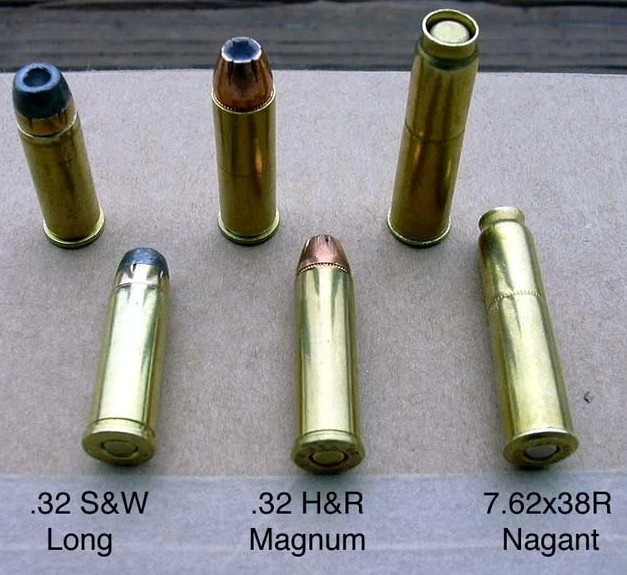
Image credit
- Title
- File:76238comparison.jpg
- Author
- Drake00(attribution required)
- Licence
- CC BY 3.0
- Source
- https://commons.wikimedia.org/wiki/File:76238comparison.jpg

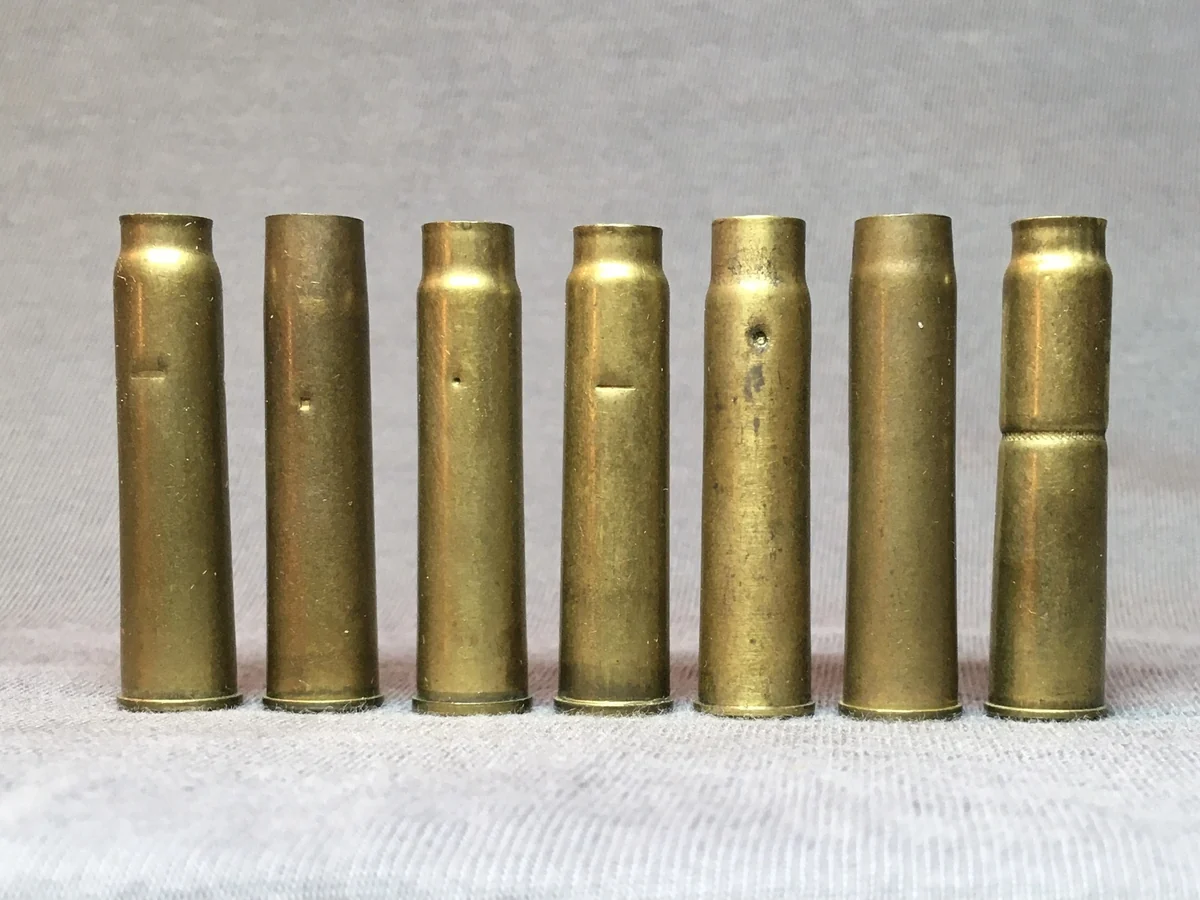
Image credit
- Title
- File:7,62 mm Nagant revolver cartridges with different case mouth crimps.jpg
- Author
- Costas-1963(attribution required)
- Licence
- CC BY-SA 4.0
- Source
- https://commons.wikimedia.org/wiki/File:7,62_mm_Nagant_revolver_cartridges_with_different_case_mouth_crimps.jpg

Detail
The 7.62×38mmR is the revolver cartridge Léon Nagant designed in 1895 for the Imperial Russian gas-seal revolver that carries his name, and it remained standard Russian and Soviet service ammunition into the Cold War. Its defining feature is not calibre or power but geometry: the bullet is seated entirely inside the case and the mouth is crimped shut over it, so the cartridge’s overall length is shorter than its own case length; a reader can see the case mouth closed over the bullet in a way no ordinary revolver round shows.
That shape exists for one mechanical reason. The Nagant M1895 revolver seals its cylinder-to-barrel gap by camming the cylinder forward on firing, and the case mouth rides into the forcing cone and expands to close the gap. A conventional cartridge with an exposed bullet nose cannot do that; the fully enclosed case mouth is what lets the cylinder gap seal at all, at the cost of a low-pressure, low-velocity round by the standards of its era.
This entry’s dimensions and maximum pressure come directly from the C.I.P.’s English-language TDCC datasheet for “7,62 Nagant”. The two load masses and velocities in the Wikipedia infobox carry no citation on Wikipedia itself and no test barrel is stated in a way that is verifiable independently of that infobox, so both loads are recorded here as estimated rather than verified; the ½mv² check does at least confirm the m/s and joule readings are self-consistent. No ballistic coefficient for either bullet was found.
References
- 7.62×38mmR · 1316173032 · read 2026-09-01
- C.I.P. TDCC datasheet — 7,62 Nagant (table 4) · 2000-06-07 · read 2026-09-01
Last verified 2026-09-01 · review status: draft