
.50-70 Government
Introduced 1866CIP standard
Also known as .50-70 Musket: the same cartridge under different names, all of which find this page.
Dimensions and pressure
Generated from the schema, like every specification table on this site, so a figure recorded on this entry cannot be missing from the table.
Identity
- Designed by
- not recorded
- Introduced
- 1866
- Production
- not recorded
- Standards body
- C.I.P.
- Case type
- Rimmed
- Case shape
- Straight
Dimensions
- Bullet diameter
- 13.08 mm0.5150 insource
Dimension G1.
- Bore diameter
- not recorded
- Case length
- 45.01 mm1.772 insource
Cartridge maximum, dimension L3.
- Overall length
- 57.15 mm2.250 insource
Dimension L6.
- Rim diameter
- 16.92 mm0.6661 insource
Dimension R1.
- Neck diameter
- not recorded
- Base diameter
- 14.48 mm0.5701 insource
Dimension P1.
Pressure
- Maximum pressure
- 210 MPa30,458 psisource
Pmax 2100 bar, C.I.P. method.
- Pressure standard
- C.I.P.
SAAMI and C.I.P. measure pressure differently and their figures are not interchangeable, which is why the body is always named beside the figure.
Loads
Velocity is recorded per barrel length as published. A gun page interpolates between these points and never projects beyond them.
425 gr Lead SP
- Bullet mass
- 27.54 g425.0 grestimated
425 gr bullet, from a handloading data page (Accurate Powder), via the Wikipedia infobox. The published velocity on that page is a maximum-handload result tied to a specific powder charge, not a factory-ammunition figure, so it is not recorded.
- Cartridge mass
- not recorded
- Bullet type
- Lead SP
- G1 BC
- not recorded
- G7 BC
- not recorded
550 gr Lead FN
- Bullet mass
- 35.64 g550.0 grestimated
550 gr bullet, from the same handloading data page, via the Wikipedia infobox. Velocity not recorded for the same reason.
- Cartridge mass
- not recorded
- Bullet type
- Lead FN
- G1 BC
- not recorded
- G7 BC
- not recorded
400 gr SP
- Bullet mass
- 25.92 g400.0 grestimated
400 gr bullet, from the same handloading data page, via the Wikipedia infobox. Velocity not recorded for the same reason.
- Cartridge mass
- not recorded
- Bullet type
- SP
- G1 BC
- not recorded
- G7 BC
- not recorded
Chambered in
Computed from every entry that lists this cartridge. Nothing here is hand-maintained.
No entry on the site is chambered in it yet.
Gallery
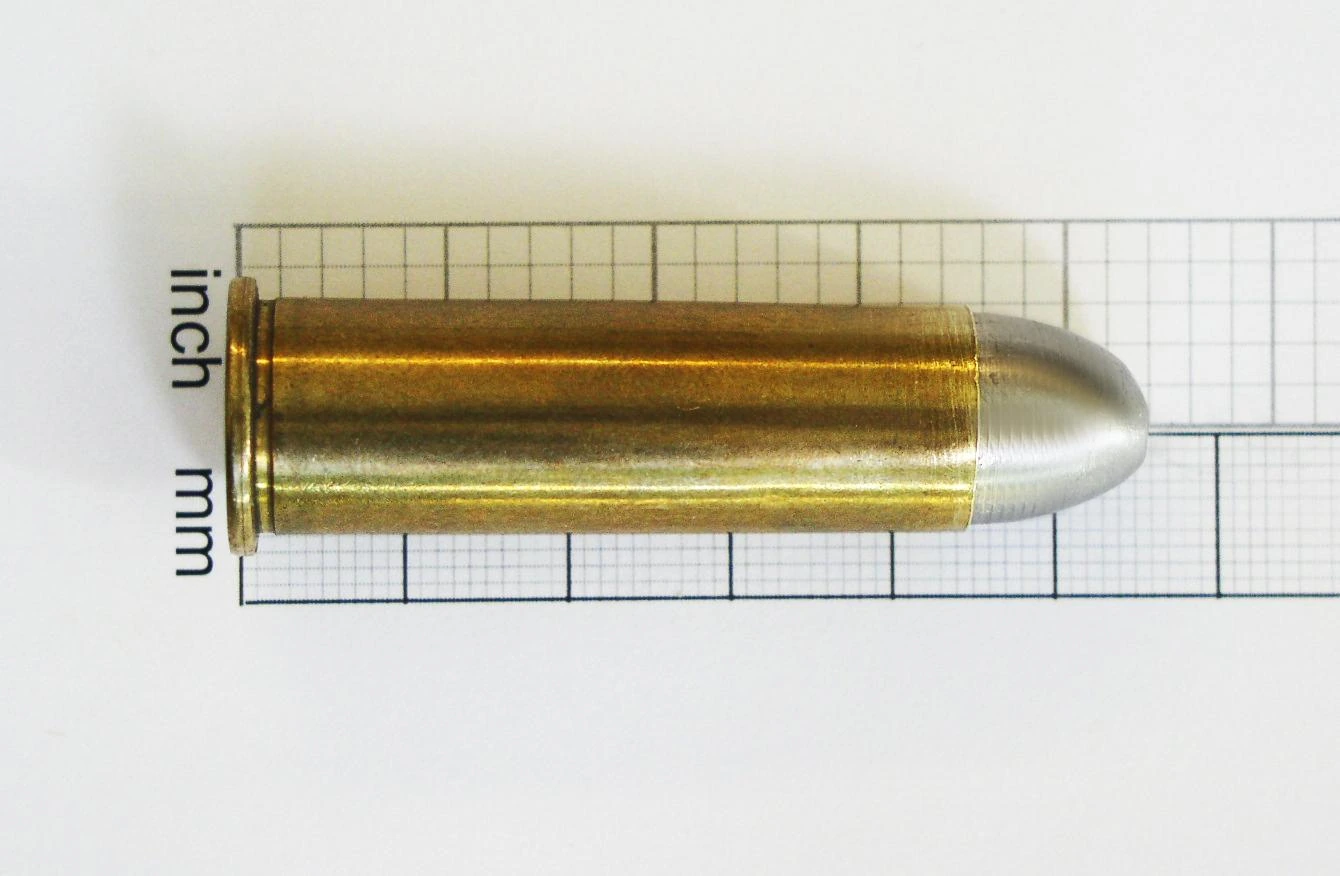
Image credit
- Title
- File:50-70-gov.jpg
- Author
- Kaltduscher at German Wikipedia (Original text: kaltduscher)(attribution required)
- Licence
- CC BY-SA 3.0
- Source
- https://commons.wikimedia.org/wiki/File:50-70-gov.jpg

Detail
The .50-70 Government is a rimmed, straight-walled centerfire rifle cartridge the United States Army adopted in 1866, the first standard metallic-cartridge round it issued after the Civil War. It replaced the muzzle-loading rifle-muskets that had equipped Union and Confederate infantry, firing from breech-loading trapdoor conversions of existing Springfield rifle-muskets and, later, purpose-built trapdoor Springfields. Like other cartridges of its generation named on the American pattern, its name pairs the bullet’s nominal diameter in hundredths of an inch with a second number that described the original loading rather than any dimension of the cartridge.
The Army replaced it as its standard rifle cartridge in 1873 with the smaller-bored .45-70 Government, and the round’s own military service accordingly ran only from 1866 to 1873, though .50-70 rifles and ammunition remained in wider circulation afterward. It used a Benét internal primer, a design that concealed the priming compound inside the case head rather than in an exposed primer pocket.
Case and pressure dimensions here come from C.I.P.’s published standard and are recorded as verified. Three historical bullet weights are recorded from a handloading data page cited by Wikipedia’s infobox, but that page’s published velocities are maximum-handload results tied to a specific powder charge rather than factory-ammunition figures, so no velocity or energy is recorded for this cartridge. No period photograph of a trapdoor Springfield rifle chambered for it appears on this site.
References
- .50-70 Government · 1358587858 · read 2026-09-24
- C.I.P. TDCC datasheet — 50-70 Govt. · 2017-05-17 · read 2026-09-24
Last verified 2026-09-24 · review status: agent-populated