
.44 Magnum
Introduced 1956Elmer Keith and RemingtonCIP standard
Also known as .44 Remington Magnum, 10.9×33mmR: the same cartridge under different names, all of which find this page.
Dimensions and pressure
Generated from the schema, like every specification table on this site, so a figure recorded on this entry cannot be missing from the table.
Identity
- Designed by
- Elmer Keith and Remington
- Introduced
- 1956
- Production
- not recorded
- Standards body
- C.I.P.
- Case type
- Rimmed
- Case shape
- Straight
Dimensions
- Bullet diameter
- 10.97 mm0.4319 insource
C.I.P. G1, maximum bullet diameter.
- Bore diameter
- not recorded
- Case length
- 32.64 mm1.285 insource
C.I.P. L3, maximum case length.
- Overall length
- 40.89 mm1.610 insource
C.I.P. L6, maximum cartridge overall length.
- Rim diameter
- 13.06 mm0.5142 insource
C.I.P. R1.
- Neck diameter
- 11.58 mm0.4559 insource
C.I.P. H2.
- Base diameter
- 11.61 mm0.4571 insource
C.I.P. P1.
Pressure
- Maximum pressure
- 280 MPa40,611 psisource
C.I.P. Pmax 2800 bar; 1 bar = 0.1 MPa exactly.
- Pressure standard
- C.I.P.
SAAMI and C.I.P. measure pressure differently and their figures are not interchangeable, which is why the body is always named beside the figure.
Loads
Velocity is recorded per barrel length as published. A gun page interpolates between these points and never projects beyond them.
Remington 240 gr semi-jacketed hollow point
Remington
- Bullet mass
- 15.55 g240.0 grsource
Published as 240 gr; 1 gr = 0.06479891 g exactly.
- Cartridge mass
- not recorded
- Bullet type
- SJHP
- G1 BC
- not recorded
- G7 BC
- not recorded
| Barrel | Velocity |
|---|---|
| 190.5 mm7.500 in | 359.7 m/s1,180 fps |
Chambered in
Computed from every entry that lists this cartridge. Nothing here is hand-maintained.
- Taurus Raging Bull
Taurus Armas
Gallery
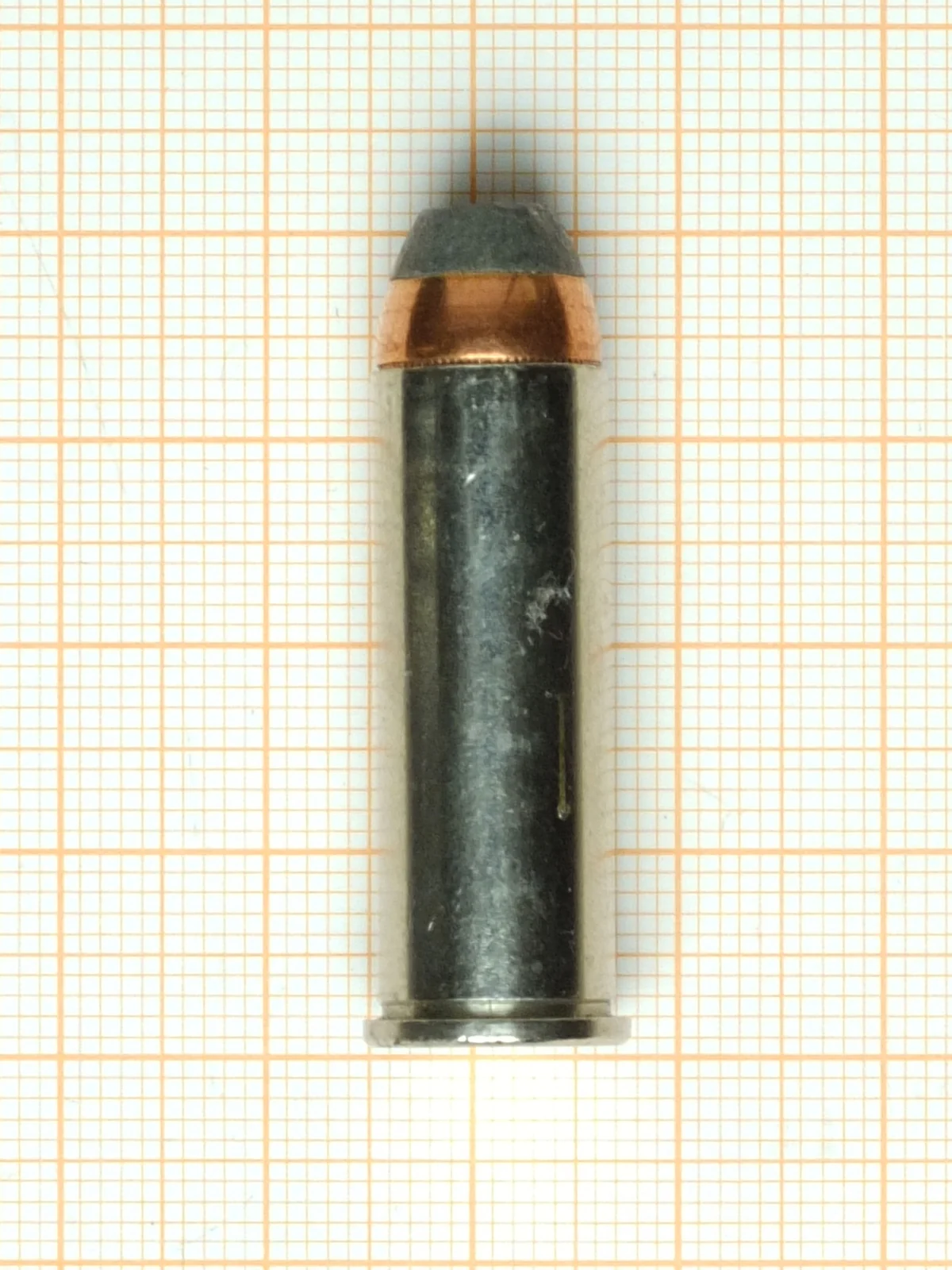
Image credit
- Title
- File:Cartridge .44 Magnum.jpg
- Author
- Grasyl(attribution required)
- Licence
- CC BY-SA 4.0
- Source
- https://commons.wikimedia.org/wiki/File:Cartridge_.44_Magnum.jpg

Detail
The same trick as the .357, applied to the .44 Special: lengthen the case so it cannot be chambered in an older gun, then load it to a pressure an older gun could not survive. Remington and Smith & Wesson did it together in 1955, and the result was for two decades the most powerful production handgun cartridge in the world.
Its reputation is mostly cinematic and its actual constituency is hunters. A 15.6 g bullet at 360 m/s from a revolver, more from a carbine, is a serious short-range hunting proposition and a genuinely unpleasant thing to shoot in a light gun, which is why so many of the revolvers chambered for it are heavy.
The single load below uses a 7.5-inch test barrel, which is longer than most revolvers chambered for the round actually carry. Comparing it directly with a four-inch .357 figure would flatter it twice over.
References
- C.I.P. TDCC datasheet — 44 Rem. Mag. · 2020-11-10 · read 2026-08-31
- .44 Magnum · 1368987370 · read 2026-08-31
Last verified 2026-08-31 · review status: agent-populated