
.44 Henry
Introduced 1860Benjamin Tyler Henry
Also known as .44 Henry Flat, .44 Rimfire, .44 Long Rimfire, 11x23mmRF: the same cartridge under different names, all of which find this page.
Dimensions and pressure
Generated from the schema, like every specification table on this site, so a figure recorded on this entry cannot be missing from the table.
Identity
- Designed by
- Benjamin Tyler Henry
- Introduced
- 1860
- Production
- not recorded
- Standards body
- No standards body
- Case type
- Rimmed
- Case shape
- Straight
Dimensions
- Bullet diameter
- 11.33 mm0.4461 inestimated
From the Wikipedia infobox, uncited there (.446 in).
- Bore diameter
- not recorded
- Case length
- 22.9 mm0.9016 inestimated
From the Wikipedia infobox, uncited there (.903 in).
- Overall length
- 34.2 mm1.346 inestimated
From the Wikipedia infobox, uncited there (1.345 in).
- Rim diameter
- 13.16 mm0.5181 inestimated
From the Wikipedia infobox, uncited there (.518 in).
- Neck diameter
- 11.02 mm0.4339 inestimated
From the Wikipedia infobox, uncited there (.434 in). A heeled bullet seated over a straight case rather than a true bottleneck neck.
- Base diameter
- 11.2 mm0.4409 inestimated
From the Wikipedia infobox, uncited there (.441 in).
Pressure
- Maximum pressure
- not recorded
- Pressure standard
- not recorded
SAAMI and C.I.P. measure pressure differently and their figures are not interchangeable, which is why the body is always named beside the figure.
Loads
Velocity is recorded per barrel length as published. A gun page interpolates between these points and never projects beyond them.
200 gr lead
- Bullet mass
- 12.96 g200.0 grsource
200 gr solid lead heeled bullet, as published by American Rifleman.
- Cartridge mass
- not recorded
- Bullet type
- lead
- G1 BC
- not recorded
- G7 BC
- not recorded
Chambered in
Computed from every entry that lists this cartridge. Nothing here is hand-maintained.
No entry on the site is chambered in it yet.
Gallery
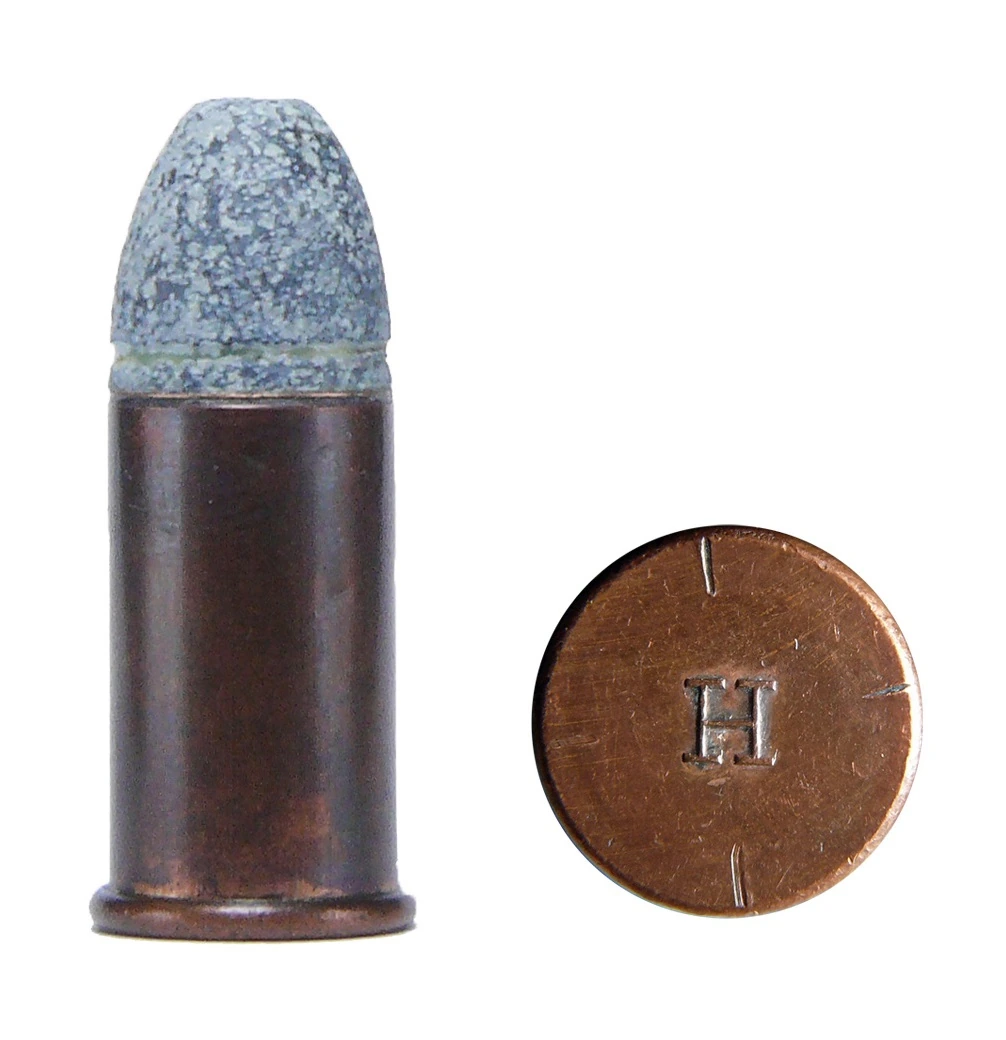
Image credit
- Title
- File:.44 Henry Flat.jpg
- Author
- Jim Miles(attribution required)
- Licence
- CC BY-SA 4.0
- Source
- https://commons.wikimedia.org/wiki/File:.44_Henry_Flat.jpg

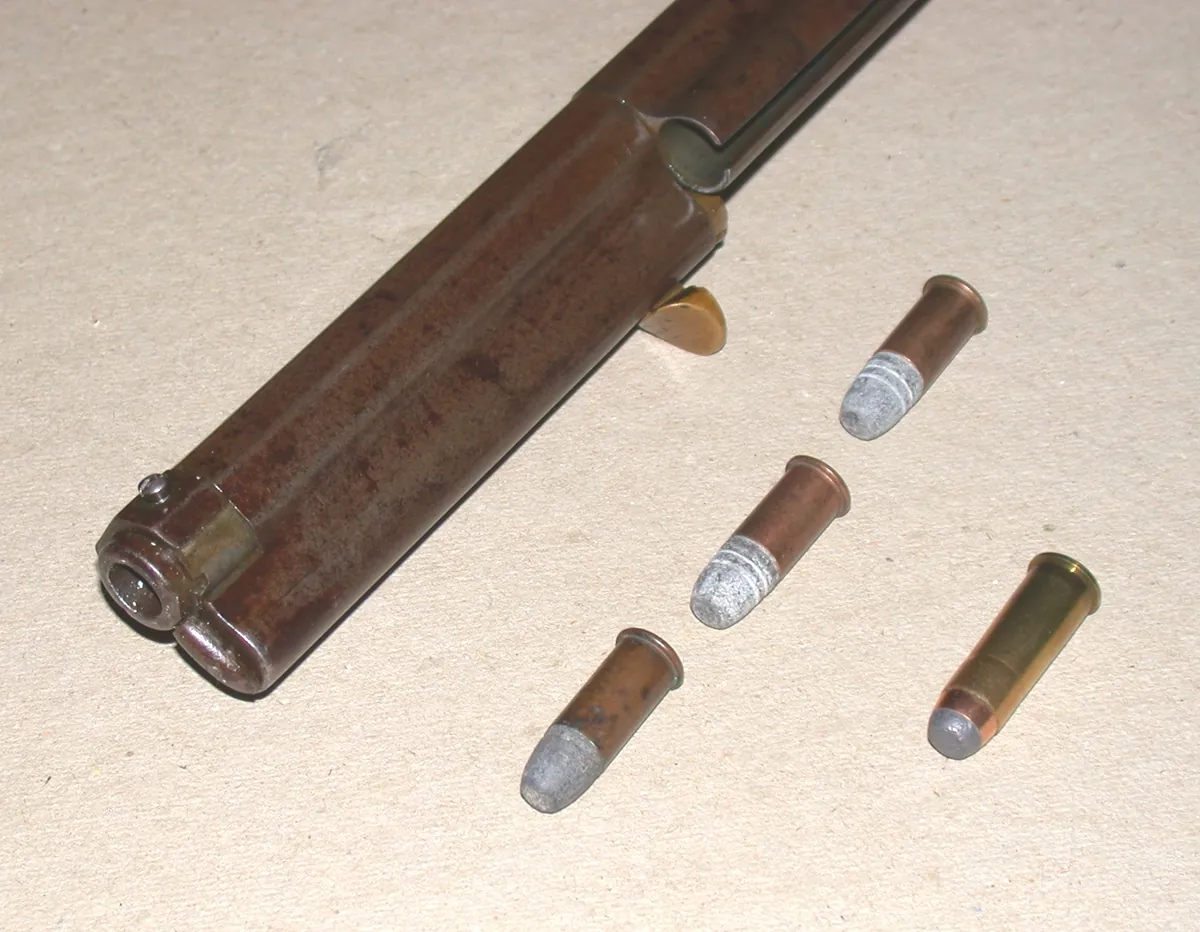
Image credit
- Title
- File:Henry Rifle Loading pos.JPG
- Author
- Hmaag(attribution required)
- Licence
- CC BY-SA 3.0
- Source
- https://commons.wikimedia.org/wiki/File:Henry_Rifle_Loading_pos.JPG

Detail
The .44 Henry is a rimfire cartridge Benjamin Tyler Henry designed alongside the rifle that bears his name while he was foreman at the New Haven Arms Company, patenting both on 16 October 1860. Its significance lies less in its ballistics than in its construction: it was one of the first genuinely reliable self-contained metallic cartridges, at a time when most breechloading rifles still relied on paper or linen cartridges that sealed a breech poorly, or on separate percussion caps in the manner of a muzzleloader. A metallic case that could seal the breech on firing and extract cleanly afterward was the missing piece that made a practical repeating rifle possible, and the Henry rifle built around this cartridge is a direct ancestor of the Winchester line and of lever-action rifles generally.
Its heeled lead bullet was large and slow by the standards of a modern rifle round, giving it a low ballistic coefficient and a pronounced trajectory drop at distance; effective use against a target was generally reckoned in the era at around 100 yards, similar to the practical limits of contemporary muzzleloading infantry rifles in ordinary hands. What set the Henry rifle apart from its muzzleloading and single-shot breechloading contemporaries was not longer range but a sixteen-round magazine, letting it fire far more rounds before a reload was needed than any rifle regularly issued at the time.
The cartridge saw limited but notable use with Union cavalry in the American Civil War, and after the war armed Winchester Model 1866 rifles used by French forces in the Franco-Prussian War and by Ottoman troops in the Russo-Turkish War of 1877–78. Civilian demand was strong enough that several revolver makers, including Smith & Wesson and Colt, chambered handguns for the same round so that owners of Henry and Winchester Model 1866 long guns could share ammunition between rifle and sidearm; Colt briefly built its Single Action Army revolver in .44 Henry between 1875 and 1880 for exactly that reason.
No free dimensional or pressure standard exists for a mid-nineteenth-century American commercial cartridge like this one, so every dimension on this page comes from Wikipedia’s own uncited infobox and is recorded as estimated. Its bullet mass is verified against American Rifleman’s own reporting, but no source pairs a published muzzle velocity with a stated test barrel length, so no velocity is recorded here.
References
- .44 Henry · 1356737768 · read 2026-09-24
- This Old Gun: Model 1860 Henry Rifle · read 2026-09-24
Last verified 2026-09-24 · review status: agent-populated