
.38 ACP
Introduced 1900John Browning
Also known as .38 Automatic Colt Pistol, .38 Auto: the same cartridge under different names, all of which find this page.
Dimensions and pressure
Generated from the schema, like every specification table on this site, so a figure recorded on this entry cannot be missing from the table.
Identity
- Designed by
- John Browning
- Introduced
- 1900
- Production
- not recorded
- Standards body
- No standards body
- Case type
- Semi rimmed
- Case shape
- Straight
Dimensions
- Bullet diameter
- 9.04 mm0.3559 inestimated
No dedicated C.I.P. datasheet exists for .38 ACP; this figure matches the .38 Super's C.I.P. datasheet exactly, since the two cartridges share the same case and bullet and differ only in loaded pressure.
- Bore diameter
- not recorded
- Case length
- 22.86 mm0.9000 inestimated
No dedicated C.I.P. datasheet exists for .38 ACP; this figure matches the .38 Super's C.I.P. datasheet exactly.
- Overall length
- 32.51 mm1.280 inestimated
No dedicated C.I.P. datasheet exists for .38 ACP; this figure matches the .38 Super's C.I.P. datasheet exactly.
- Rim diameter
- 10.31 mm0.4059 inestimated
No dedicated C.I.P. datasheet exists for .38 ACP; this figure matches the .38 Super's C.I.P. datasheet exactly.
- Neck diameter
- 9.75 mm0.3839 inestimated
No dedicated C.I.P. datasheet exists for .38 ACP; this figure matches the .38 Super's C.I.P. datasheet exactly.
- Base diameter
- 9.75 mm0.3839 inestimated
No dedicated C.I.P. datasheet exists for .38 ACP; this figure matches the .38 Super's C.I.P. datasheet exactly.
Pressure
- Maximum pressure
- 182.7 MPa26,498 psiestimated
Wikipedia's infobox figure (26,500 psi), no inline citation of its own. Unlike the case and bullet dimensions, this pressure is genuinely lower than the .38 Super's: the .38 Super is a higher-pressure loading of the same case, not an identical cartridge.
- Pressure standard
- SAAMI
SAAMI and C.I.P. measure pressure differently and their figures are not interchangeable, which is why the body is always named beside the figure.
Loads
Velocity is recorded per barrel length as published. A gun page interpolates between these points and never projects beyond them.
115 gr FMJ
- Bullet mass
- 7.452 g115.0 grestimated
Wikipedia's infobox figure (115 gr), citing the book Cartridges of the World, which cannot carry a `verified` status without a clickable source.
- Cartridge mass
- not recorded
- Bullet type
- FMJ
- G1 BC
- not recorded
- G7 BC
- not recorded
125 gr JHP
- Bullet mass
- 8.1 g125.0 grestimated
Wikipedia's infobox figure (125 gr), citing the book Cartridges of the World, which cannot carry a `verified` status without a clickable source.
- Cartridge mass
- not recorded
- Bullet type
- JHP
- G1 BC
- not recorded
- G7 BC
- not recorded
130 gr FMJ
- Bullet mass
- 8.424 g130.0 grestimated
Wikipedia's infobox figure (130 gr), citing the book Cartridges of the World, which cannot carry a `verified` status without a clickable source.
- Cartridge mass
- not recorded
- Bullet type
- FMJ
- G1 BC
- not recorded
- G7 BC
- not recorded
Chambered in
Computed from every entry that lists this cartridge. Nothing here is hand-maintained.
No entry on the site is chambered in it yet.
Gallery
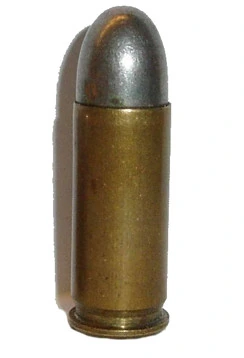
Image credit
- Title
- File:38 ACP.jpg
- Author
- Ken(attribution required)
- Licence
- CC BY-SA 3.0
- Source
- https://commons.wikimedia.org/wiki/File:38_ACP.jpg

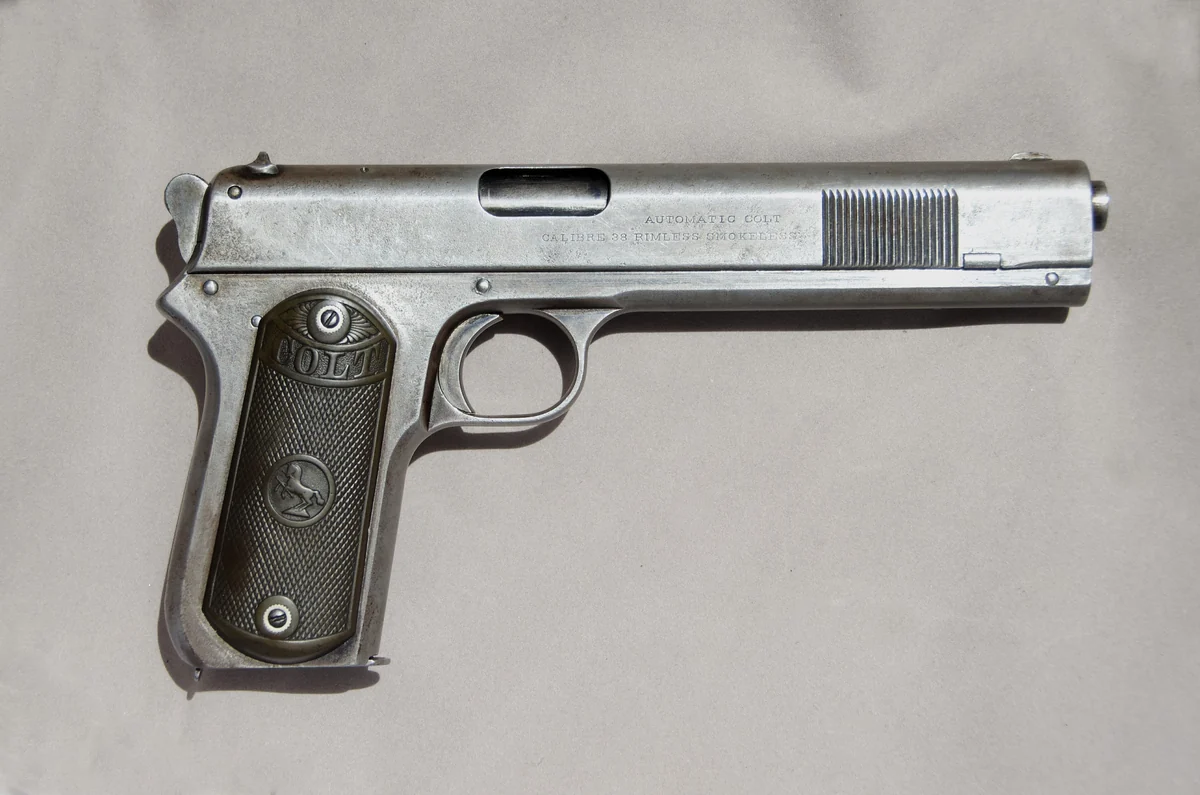
Image credit
- Title
- File:Colt 1902 Sportsman .38 ACP Sn 8637 R DSC 8183.jpg
- Author
- Self Loader(attribution required)
- Licence
- CC BY-SA 4.0
- Source
- https://commons.wikimedia.org/wiki/File:Colt_1902_Sportsman_.38_ACP_Sn_8637_R_DSC_8183.jpg

Detail
The .38 ACP is John Browning’s 1900 pistol cartridge, a semi-rimmed, straight-walled round introduced with the Colt Model 1900 and carried forward through the Model 1902 and 1903 pocket pistols that followed it; the slide of the era’s Colts stamps it “Calibre 38 Rimless Smokeless” rather than the modern name. It was one of the first successful smokeless, self-loading pistol cartridges on the American market and gave those early Colt autoloaders meaningfully more energy than the double-action revolvers they were competing against.
Its main legacy is downstream of itself: in 1929 Colt took the same case, loaded it to substantially higher pressure, and sold the result as the .38 Super for exactly the pistols the .38 ACP had already been chambered in; a 1911-frame gun could be re-barrelled from one cartridge to the other with no other change. The .38 Super went on to become the far more common round, particularly in practical pistol competition, while the original lower-pressure .38 ACP faded to a specialty and collector’s cartridge, still made in small quantities for original Colt pistols that are not rated for the Super’s higher pressure.
No dedicated C.I.P. datasheet exists for .38 ACP, but its dimensions match the .38 Super’s C.I.P.
datasheet exactly, since the two share an identical case and bullet and differ only in loaded
pressure, so this entry’s case and bullet dimensions are recorded as estimated by that comparison
rather than as independently sourced. Its published maximum pressure, unlike those shared
dimensions, is genuinely its own (26,500 psi against the .38 Super’s roughly 36,500 psi SAAMI figure)
and is recorded as estimated from Wikipedia’s uncited infobox. All three of the infobox’s factory
loads are cited to the book Cartridges of the World, which cannot carry a verified status without a
clickable source, so only bullet mass is recorded for each and no velocity or ballistic coefficient
appears here.
References
- .38 ACP · 1265342493 · read 2026-09-02
Last verified 2026-09-02 · review status: agent-populated