
.38-40 Winchester
Introduced 1874Winchester Repeating Arms CompanyCIP standard
Also known as .38 WCF, 38-40 Win.: the same cartridge under different names, all of which find this page.
Dimensions and pressure
Generated from the schema, like every specification table on this site, so a figure recorded on this entry cannot be missing from the table.
Identity
- Designed by
- Winchester Repeating Arms Company
- Introduced
- 1874
- Production
- not recorded
- Standards body
- C.I.P.
- Case type
- Rimmed
- Case shape
- Bottleneck
Dimensions
- Bullet diameter
- 10.17 mm0.4004 insource
C.I.P. G1, maximum bullet diameter.
- Bore diameter
- not recorded
- Case length
- 33.15 mm1.305 insource
C.I.P. L3, maximum case length.
- Overall length
- 40.44 mm1.592 insource
C.I.P. L6, maximum cartridge overall length.
- Rim diameter
- 13.34 mm0.5252 insource
C.I.P. R1.
- Neck diameter
- 10.58 mm0.4165 insource
C.I.P. H2.
- Base diameter
- 11.93 mm0.4697 insource
C.I.P. P1.
Pressure
- Maximum pressure
- 115 MPa16,679 psisource
C.I.P. Pmax 1150 bar; 1 bar = 0.1 MPa exactly.
- Pressure standard
- C.I.P.
SAAMI and C.I.P. measure pressure differently and their figures are not interchangeable, which is why the body is always named beside the figure.
Loads
Velocity is recorded per barrel length as published. A gun page interpolates between these points and never projects beyond them.
Buffalo Bore Heavy 180 gr hard-cast FN
Buffalo Bore
- Bullet mass
- 11.66 g179.9 grsource
Published as 180 gr on Buffalo Bore's own product page.
- Cartridge mass
- not recorded
- Bullet type
- hard-cast flat nose
- G1 BC
- not recorded
- G7 BC
- not recorded
| Barrel | Velocity |
|---|---|
| 139.7 mm5.500 in | 310.9 m/s1,020 fps |
| 609.6 mm24.00 in | 433.1 m/s1,421 fps |
Chambered in
Computed from every entry that lists this cartridge. Nothing here is hand-maintained.
No entry on the site is chambered in it yet.
Gallery
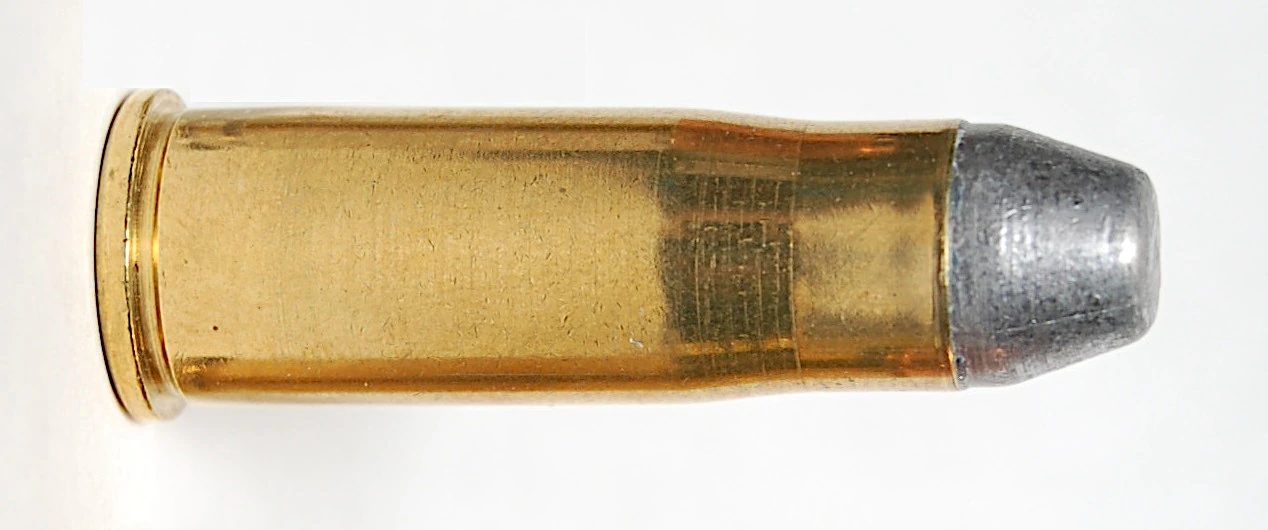
Image credit
- Title
- File:38-40 WCF only.jpg
- Author
- Tad Marko(attribution required)
- Licence
- CC BY-SA 3.0
- Source
- https://commons.wikimedia.org/wiki/File:38-40_WCF_only.jpg

Detail
Winchester introduced the .38-40 in 1874, necking its own .44-40 case down to a bullet just over 10 mm in diameter to sit between that round and the smaller .32-20 in the same rimmed, bottlenecked family. Despite the “38” in its name the bullet is actually .40 caliber. This is a long-standing naming quirk of the black-powder era, when a cartridge’s name described the powder charge and bore loosely rather than a precise bullet diameter. Like its siblings it was built so a Winchester lever rifle and a period revolver could share one box of ammunition.
Colt and other makers chambered revolvers for it specifically to pair with the Winchester 1873 and 1892 rifles, and the round stayed in production until 1937, by which point the dual-caliber rifle-and-revolver arrangement it was built around had fallen out of fashion. It returned to production in 1993, driven by the growth of cowboy action shooting, and modern loadings, including specialist heavy loads for the stronger revolvers and rifles still chambered for it, are again commercially available.
Case, bullet and pressure figures here are transcribed from the current C.I.P. datasheet and are
verified. Buffalo Bore’s own product page for its 180-grain hard-cast load states two muzzle
velocities, one from a 5.5-inch revolver and one from a 24-inch rifle, both with the barrel
length named, which is what lets this entry carry two sourced velocity points for the same
bullet weight rather than the single, barrel-length-free figure that most other published sources
for this cartridge give.
References
- .38-40 Winchester · 1365720108 · read 2026-09-01
- C.I.P. TDCC datasheet — 38-40 Win. · 2002-05-15 · read 2026-09-01
- Heavy 38 WCF aka 38-40 Winchester Pistol & Handgun Ammunition · read 2026-09-01
Last verified 2026-09-01 · review status: agent-populated