
.30-30 Winchester
Introduced 1895Winchester Repeating Arms CompanyCIP standard
Also known as .30 WCF, 7.8x51R: the same cartridge under different names, all of which find this page.
Dimensions and pressure
Generated from the schema, like every specification table on this site, so a figure recorded on this entry cannot be missing from the table.
Identity
- Designed by
- Winchester Repeating Arms Company
- Introduced
- 1895
- Production
- 1895–present
- Standards body
- C.I.P.
- Case type
- Rimmed
- Case shape
- Tapered
Dimensions
- Bullet diameter
- 7.85 mm0.3091 insource
C.I.P. TDCC table 2 datasheet, field G1
- Bore diameter
- not recorded
- Case length
- 51.8 mm2.039 insource
C.I.P. TDCC table 2 datasheet, field L3
- Overall length
- 64.77 mm2.550 insource
C.I.P. TDCC table 2 datasheet, field L6
- Rim diameter
- 12.85 mm0.5059 insource
C.I.P. TDCC table 2 datasheet, field R1
- Neck diameter
- 8.38 mm0.3299 insource
C.I.P. TDCC table 2 datasheet, field H2
- Base diameter
- 10.71 mm0.4217 insource
C.I.P. TDCC table 2 datasheet, field P1
Pressure
- Maximum pressure
- 320 MPa46,412 psisource
C.I.P. TDCC table 2 datasheet, Pmax 3200 bar
- Pressure standard
- C.I.P.
SAAMI and C.I.P. measure pressure differently and their figures are not interchangeable, which is why the body is always named beside the figure.
Loads
Velocity is recorded per barrel length as published. A gun page interpolates between these points and never projects beyond them.
Hornady LEVERevolution 160 gr FTX
Hornady
- Bullet mass
- 10.37 g160.0 grsource
160 gr as published on Hornady's own product page
- Cartridge mass
- not recorded
- Bullet type
- FTX polymer-tip
- G1 BC
- not recorded
- G7 BC
- not recorded
| Barrel | Velocity |
|---|---|
| 609.6 mm24.00 in | 731.5 m/s2,400 fps |
Hornady LEVERevolution 140 gr MonoFlex
Hornady
- Bullet mass
- 9.07 g140.0 grsource
140 gr as published on Hornady's own product page
- Cartridge mass
- not recorded
- Bullet type
- MonoFlex polymer-tip monolithic copper
- G1 BC
- not recorded
- G7 BC
- not recorded
| Barrel | Velocity |
|---|---|
| 609.6 mm24.00 in | 751.3 m/s2,465 fps |
Chambered in
Computed from every entry that lists this cartridge. Nothing here is hand-maintained.
No entry on the site is chambered in it yet.
Gallery
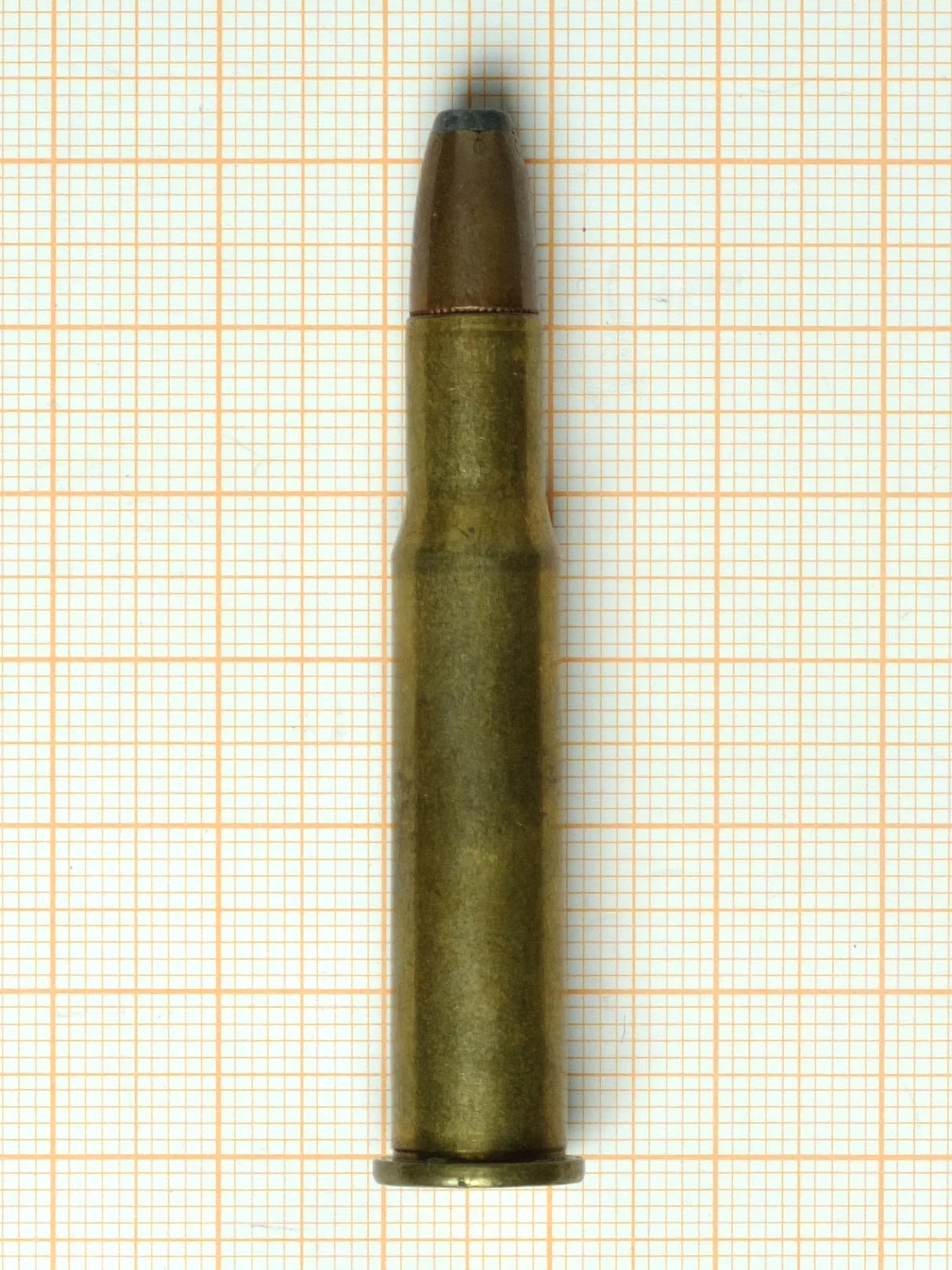
Image credit
- Title
- File:Cartridge .30-30 Wincherster BB CY-SA by Grasyl.jpg
- Author
- Grasyl(attribution required)
- Licence
- CC BY-SA 4.0
- Source
- https://commons.wikimedia.org/wiki/File:Cartridge_.30-30_Wincherster_BB_CY-SA_by_Grasyl.jpg

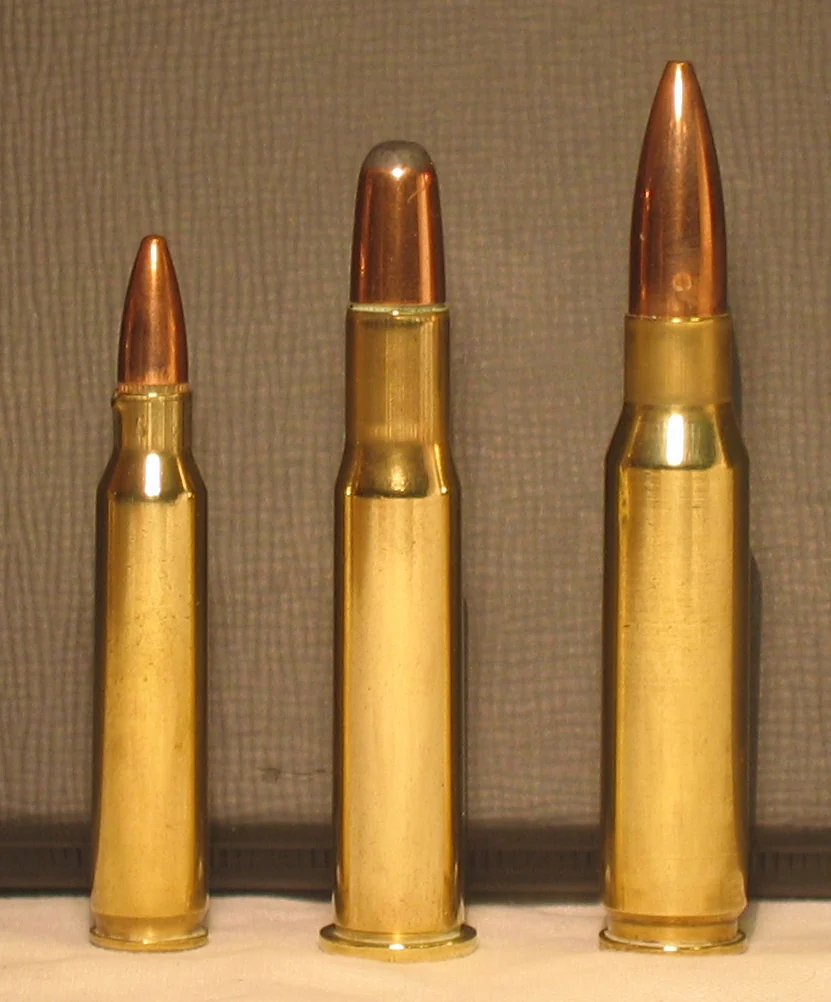
Image credit
- Title
- File:30-30.jpg
- Author
- Boris Barowski
- Licence
- Public domain
- Source
- https://commons.wikimedia.org/wiki/File:30-30.jpg

Detail
The .30-30 Winchester was introduced in 1895 as the smokeless-powder chambering for the Winchester Model 1894 lever-action rifle, and it is usually credited as the first small-bore sporting cartridge loaded with smokeless powder sold in the United States. Its name is a leftover of the black-powder era, when a cartridge’s name paired its nominal calibre with its nominal charge rather than a measured bullet diameter. This is a convention it inherited even though it was never sold as a black-powder round.
Like other rounds built for a rifle with a tubular magazine, its bullet nose is flat or gently rounded rather than pointed, so that recoil cannot drive one cartridge’s tip into the primer of the round ahead of it. That constraint has shaped every factory loading of the cartridge for well over a century, including modern polymer-tipped designs such as Hornady’s FTX and MonoFlex bullets, whose soft, deformable tips are shaped to satisfy the same magazine-safety requirement while behaving more like a spitzer bullet in flight. The cartridge’s rimmed, gently tapered case and modest 51.8 mm case length reflect a design built around a lever-action’s short receiver and tube magazine rather than long-range ballistics, and its retained energy at longer ranges falls off accordingly.
Despite its age the .30-30 remains in wide production and is still regarded as an adequate deer-hunting round at typical woods ranges.
This entry’s dimensions and pressure are transcribed from the C.I.P.’s TDCC datasheet. Both loads carry a manufacturer-stated 24-inch test barrel: Hornady publishes it directly on its own product pages, unlike the Wikipedia ballistics table for this cartridge, which lists five loads with no barrel length attached to any of them and so contributes no velocity here. No SAAMI-published pressure figure was found to compare against the C.I.P. one.
References
- .30-30 Winchester · 1372451303 · read 2026-09-01
- C.I.P. TDCC datasheet — 30-30 Win. (table 2) · 2002-05-15 · read 2026-09-01
- 30-30 Win 160 gr FTX LEVERevolution · read 2026-09-01
- 30-30 Win 140 gr MonoFlex LEVERevolution · read 2026-09-01
Last verified 2026-09-01 · review status: draft