
14.5×114mm
Introduced 1939
Also known as .57 calibre: the same cartridge under different names, all of which find this page.
Dimensions and pressure
Generated from the schema, like every specification table on this site, so a figure recorded on this entry cannot be missing from the table.
Identity
- Designed by
- not recorded
- Introduced
- 1939
- Production
- not recorded
- Standards body
- No standards body
- Case type
- Rimless
- Case shape
- Bottleneck
Dimensions
- Bullet diameter
- 14.88 mm0.5858 inestimated
From the Wikipedia infobox, uncited there.
- Bore diameter
- not recorded
- Case length
- 114 mm4.488 inestimated
From the Wikipedia infobox, uncited there.
- Overall length
- 155.8 mm6.134 inestimated
From the Wikipedia infobox, uncited there.
- Rim diameter
- 26.95 mm1.061 inestimated
From the Wikipedia infobox, uncited there.
- Neck diameter
- 16.5 mm0.6496 inestimated
From the Wikipedia infobox, uncited there.
- Base diameter
- 26.95 mm1.061 inestimated
From the Wikipedia infobox, uncited there.
Pressure
- Maximum pressure
- not recorded
- Pressure standard
- not recorded
SAAMI and C.I.P. measure pressure differently and their figures are not interchangeable, which is why the body is always named beside the figure.
Loads
Velocity is recorded per barrel length as published. A gun page interpolates between these points and never projects beyond them.
B-32 API
- Bullet mass
- 64 g987.7 grestimated
From the Wikipedia infobox, uncited there.
- Cartridge mass
- not recorded
- Bullet type
- B-32 API
- G1 BC
- not recorded
- G7 BC
- not recorded
| Barrel | Velocity |
|---|---|
| 1,350 mm53.15 in | 1,000 m/s3,281 fps |
MDZ HEI
- Bullet mass
- 59.7 g921.3 grestimated
From the Wikipedia infobox, uncited there.
- Cartridge mass
- not recorded
- Bullet type
- MDZ HEI
- G1 BC
- not recorded
- G7 BC
- not recorded
| Barrel | Velocity |
|---|---|
| 1,350 mm53.15 in | 1,000 m/s3,281 fps |
ZP Inc.-T
- Bullet mass
- 60 g925.9 grestimated
From the Wikipedia infobox, uncited there.
- Cartridge mass
- not recorded
- Bullet type
- ZP Inc.-T
- G1 BC
- not recorded
- G7 BC
- not recorded
| Barrel | Velocity |
|---|---|
| 1,350 mm53.15 in | 1,000 m/s3,281 fps |
BS AP
- Bullet mass
- 64.4 g993.8 grestimated
From the Wikipedia infobox, uncited there.
- Cartridge mass
- not recorded
- Bullet type
- BS AP
- G1 BC
- not recorded
- G7 BC
- not recorded
| Barrel | Velocity |
|---|---|
| 1,350 mm53.15 in | 1,006 m/s3,301 fps |
KKV
- Bullet mass
- 66.5 g1,026 grestimated
From the Wikipedia infobox, uncited there.
- Cartridge mass
- not recorded
- Bullet type
- KKV
- G1 BC
- not recorded
- G7 BC
- not recorded
| Barrel | Velocity |
|---|---|
| 1,350 mm53.15 in | 1,000 m/s3,281 fps |
Chambered in
Computed from every entry that lists this cartridge. Nothing here is hand-maintained.
No entry on the site is chambered in it yet.
Gallery
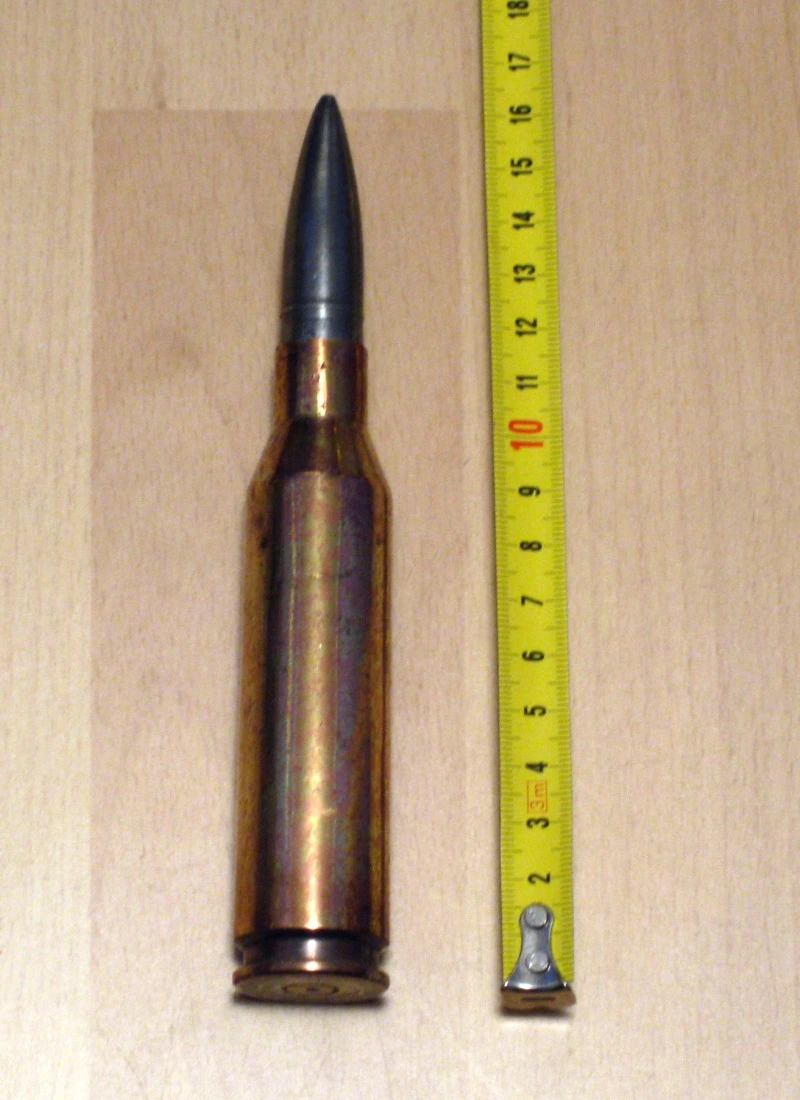
Image credit
- Title
- File:14.5x114mm.jpg
- Author
- Esquilo(attribution required)
- Licence
- CC BY-SA 3.0
- Source
- https://commons.wikimedia.org/wiki/File:14.5x114mm.jpg

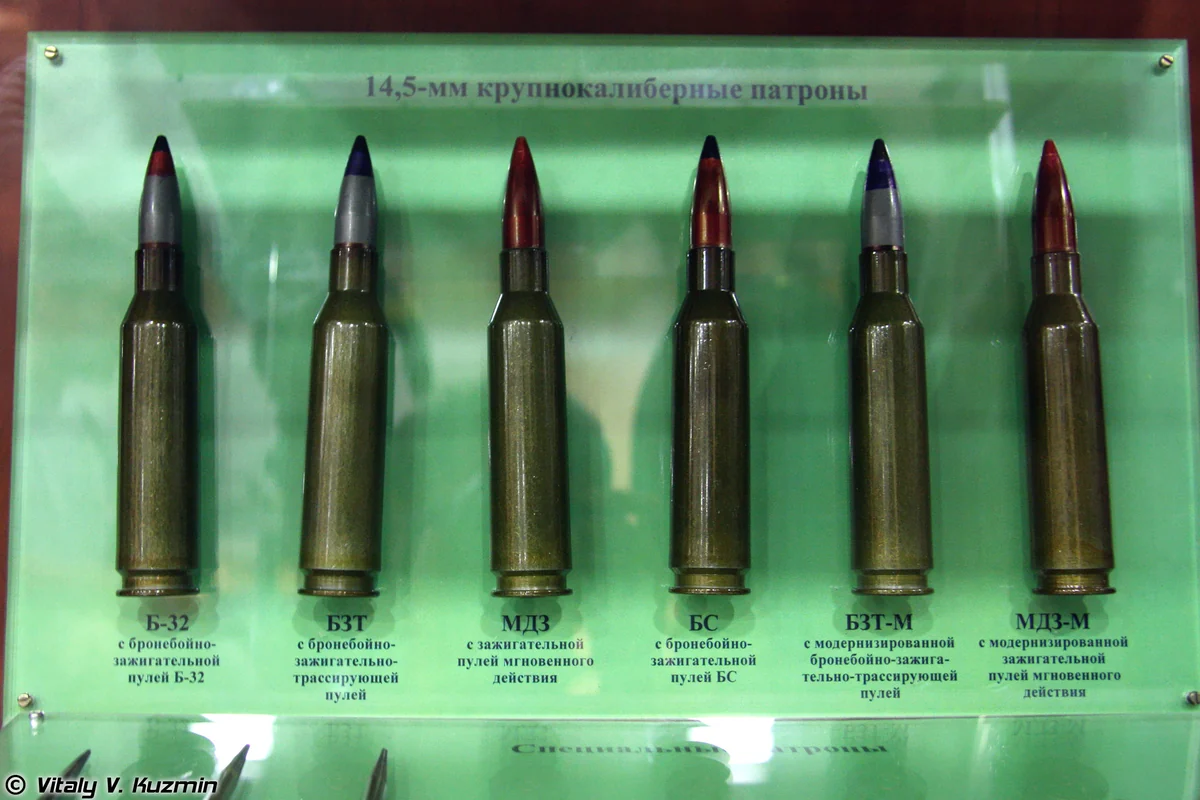
Image credit
- Title
- File:14,5-мм крупнокалиберные патроны - ЦНИИТОЧМАШ 01.jpg
- Author
- Vitaly V. Kuzmin(attribution required)
- Licence
- CC BY-SA 4.0
- Source
- https://commons.wikimedia.org/wiki/File:14,5-мм_крупнокалиберные_патроны_-_ЦНИИТОЧМАШ_01.jpg

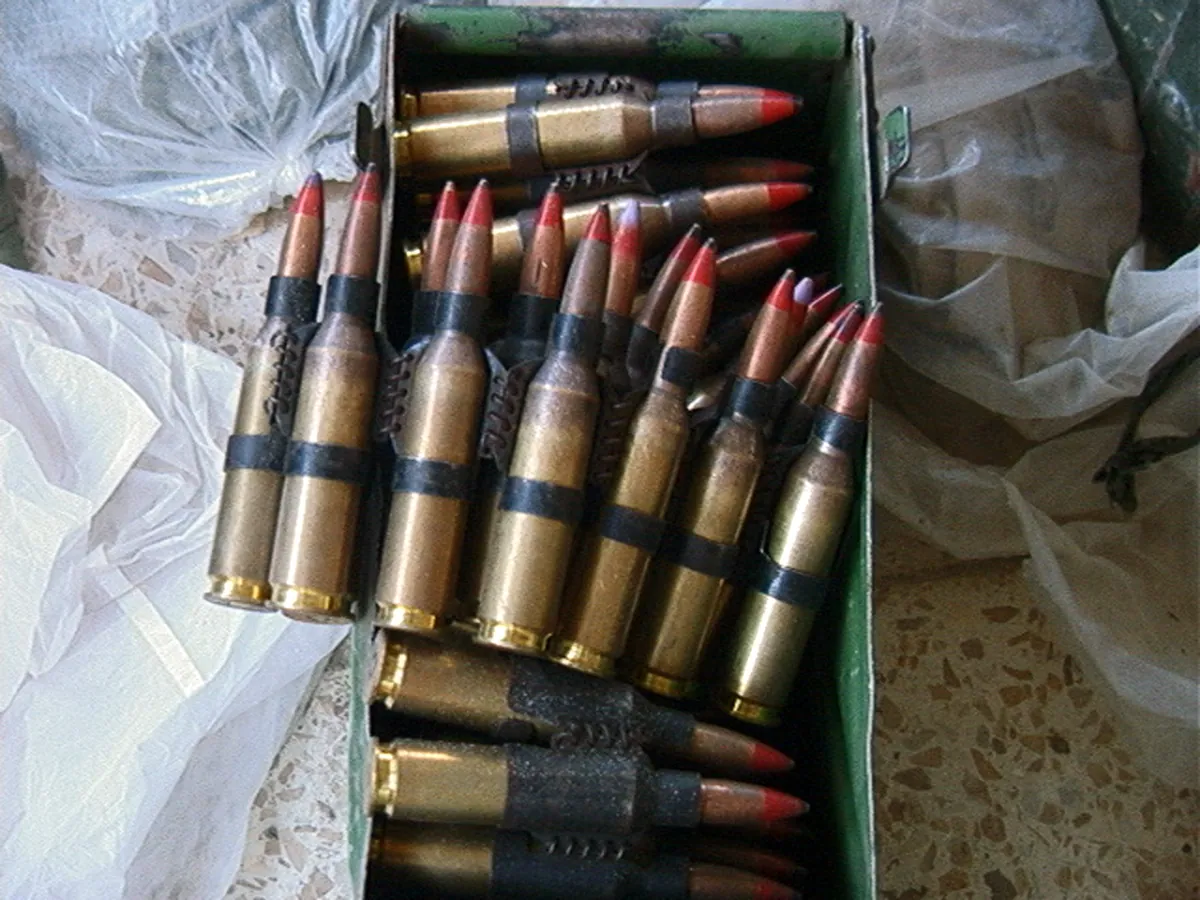
Image credit
- Title
- File:DM-SD-05-00258.JPEG
- Author
- GYSGT MATTHEW M. SMITH
- Licence
- Public domain
- Source
- https://commons.wikimedia.org/wiki/File:DM-SD-05-00258.JPEG

Detail
The 14.5×114mm is a Soviet heavy anti-materiel cartridge developed in 1939 for the PTRD and PTRS anti-tank rifles that armed Red Army infantry against German armour during the Second World War. As tank armour grew too thick for a rifle-fired round to defeat, the cartridge found a second life in a heavy machine gun rather than fading out with the rifles it was designed for: it became the basis of the belt-fed KPV, which in turn arms the ZPU family of towed and vehicle-mounted anti-aircraft guns and serves as the main armament of Soviet-lineage armoured personnel carriers from the BTR-60 through the BTR-80. It remains in production and service across former Soviet states and beyond, and has appeared in most major conflicts fought with Soviet-pattern equipment since, including the Soviet–Afghan War, the Syrian civil war and Libya’s civil conflicts.
Its case shape was chosen to feed and extract reliably across every action type the round was meant to run in (bolt-action rifles, self-loading rifles and a belt-fed machine gun alike) under harsh field conditions, an unusually broad design brief for a single cartridge. Loadings have included armour-piercing incendiary, high-explosive incendiary, tracer and plain armour-piercing bullets, reflecting its use against lightly armoured vehicles, aircraft and material targets rather than as a standard infantry round.
As a cartridge developed for Soviet military service, the 14.5×114mm was never assigned a C.I.P. or SAAMI dimensional standard, and no free technical drawing equivalent to those civilian standards was found for it. Every case dimension and the ballistics of its several loadings on this page are drawn from Wikipedia’s own infobox, uncited there, and are recorded as estimated rather than verified throughout. Wikipedia’s infobox also states a maximum pressure, but without a body responsible for measuring it that figure cannot be recorded here at all, since a pressure reading is only meaningful alongside the standard it was measured under.
References
- 14.5×114mm · 1353965754 · read 2026-09-24
Last verified 2026-09-24 · review status: agent-populated