
Grenadine
Grenadine is a syrup with no alcohol in it, used in 5 drinks on this site.

CC BY 3.0 · Cropped, white-balanced, graded and re-encoded to WebP by eXir.
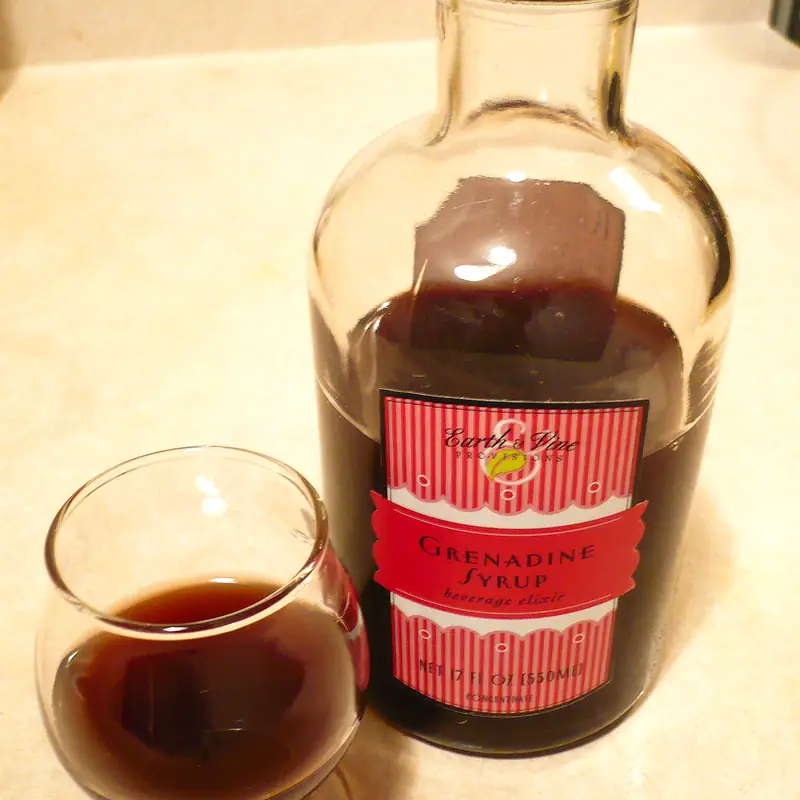
A stoppered glass bottle of dark red grenadine beside a small glass holding a measure of it
Making it
refrigerated and sealed. A shelf life here is conservative bar practice rather than a food-safety authority's figure, and it assumes the preparation was bottled clean and cold.
Widely sold and usually neither pomegranate nor much of a syrup. Reading the ingredients is worth the ten seconds.
Composition
Derived from the ingredient records. The sugar figure is the sucrose dissolved plus the sugar already in the juice. No acidity is carried, because none is carried on the juice: pomegranate is meaningfully acidic and no source consulted reports its titratable acidity, so this syrup reads as less sour than it is. Every figure here is derived from the ingredient records this recipe names, not measured in a bottle: mass and volume are summed over the lines and the density falls out of the two. The method is worth one check: a one-to-one syrup comes out at 1.228 g/ml against the 1.230 published for a 50% sucrose solution at 20 degrees, a difference of 0.15%. It is marked estimated because a derivation is not a measurement.
Used in these drinks
most firstMethod
2 steps · 35mWarm the 250 ml pomegranate juice gently and stir in the 250 g granulated sugar until it has gone. Keep it below a simmer; reducing it makes a thicker syrup than the recipe describes and every figure on this page then understates it.
Cool and bottle. It keeps less well than a plain syrup because the juice in it is food as well as sugar.
The amounts above are the batch this recipe makes, not a portion of it, and they do not scale with any drink count, because a preparation is made once and then measured out of.