
Singapore Sling
Gin against pineapple, lime and three liqueurs, shaken and strained into a glass sized to hold all of it.

CC0 · Cropped, white-balanced, graded and re-encoded to WebP by eXir.
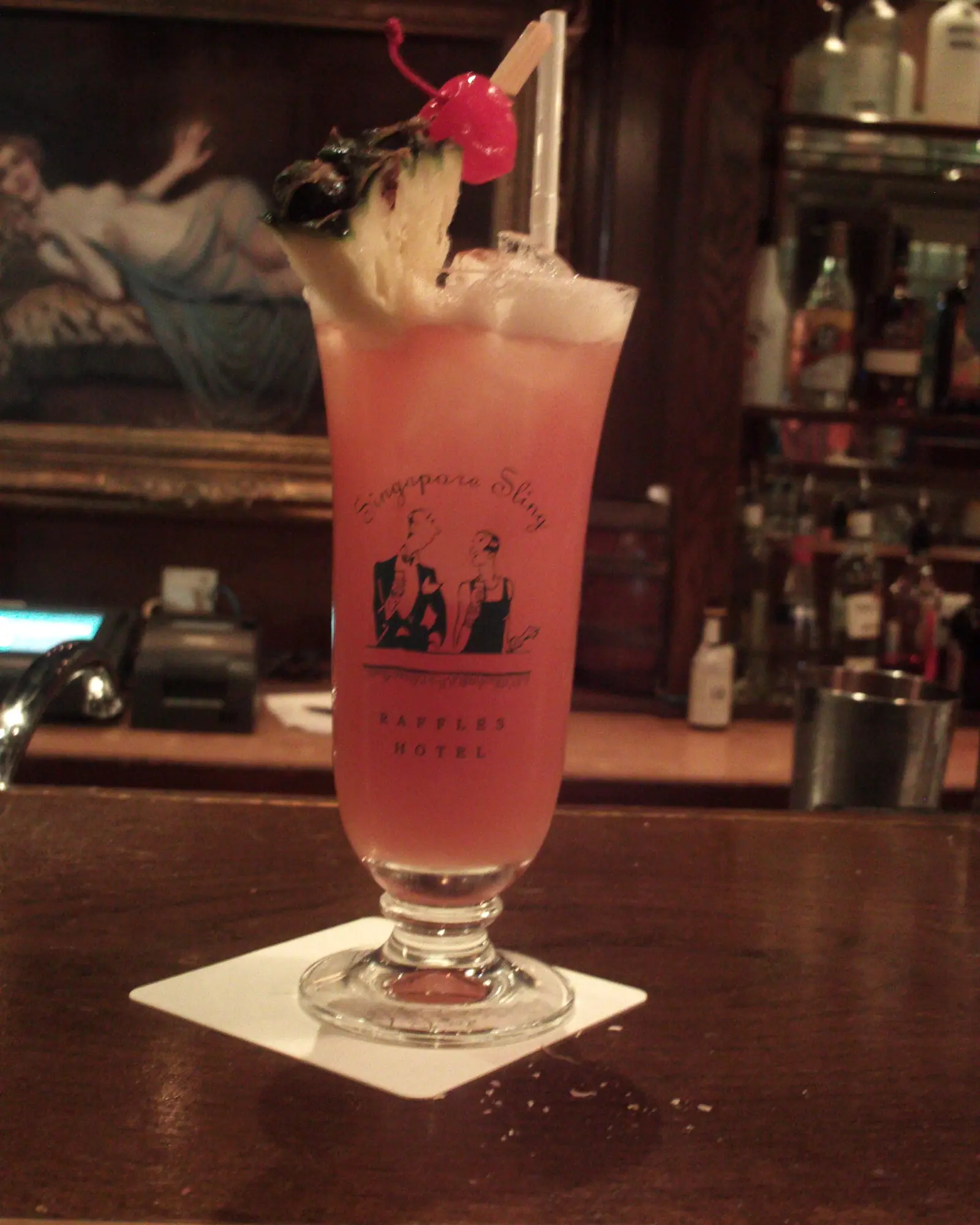
A Singapore Sling in a footed glass on a wooden bar top, its pink-red drink topped with foam and garnished with a pineapple wedge, mint sprig and a cherry on a pick, dark bar shelving blurred behind it
Serving
Drink spec, per drink
Every figure above is per drink and does not move with the count, which is what makes the two service modes comparable. Sugar per litre, strength and standard drinks stay in the units their own authorities publish, because they are figures for comparing rather than for pouring. Dilution is modelled rather than measured, as a fraction of the poured volume before any ice; dotted figures descend from that estimate.
No published account of the production checked (crushed Danish Stevns cherries and stones macerated in neutral spirit, with herbs, spices and oak maturation) names an animal-derived ingredient, and the product carries kosher certification. No producer statement confirming vegan status was opened directly, so this is the honest floor of what was checked rather than a producer confirmation.
The producer lists honey among the botanicals steeped in some published accounts of the recipe, but the maker's own current nutrition disclosure lists no animal-derived ingredient. Recorded as none rather than varies because the one figure available is the producer's own.
The producer's own product page states the bitters are 100% vegan and gluten-free.
Diet and allergen labels are computed from the ingredients listed on this page and nothing else. They cannot account for cross-contamination or for the particular product you buy, and they are not medical or safety guidance.
Ingredients
 15 ml fresh lime juice
 30 ml London dry gin
 15 ml cherry liqueurProprietary
 7.5 ml orange liqueurProprietaryInterchangeable by volume and at the same strength, so the arithmetic barely moves. Curaçao is made from bitter orange peel rather than distilled sweet-orange oil and reads rounder and less clean than Cointreau, which sits oddly against the pineapple's own brightness.flavour: moderate change · strength: no change · sweetness: minor change
 7.5 ml BénédictineProprietary
 120 ml fresh pineapple juice
 10 ml grenadine
 1 dash Angostura Aromatic Bitters (0.9 ml)Proprietary
 1 pineapple (905 g)
 1 cherry a maraschino cherry (6 g)
- 15 ml fresh lime juice
- 30 ml London dry gin
- 15 ml cherry liqueurProprietary
- 7.5 ml orange liqueurProprietary
- 7.5 ml BénédictineProprietary
- 120 ml fresh pineapple juice
- 10 ml grenadine
- 1 dash Angostura Aromatic Bitters (0.9 ml)Proprietary
- 1 pineapple (905 g)
- 1 cherry a maraschino cherry (6 g)
- ~103 ml water
Glass
Vessel
309 ml of liquid, served without ice, inside the 470 ml the glass holds. The build fails if a recipe ever exceeds its stated vessel.
A batch needs a vessel that closes and fits a fridge shelf.
Method
5 steps · 1m 57sSqueeze the 15 ml fresh lime juice and strain out the pips and pulp.
Combine the 30 ml London dry gin, the 15 ml cherry liqueur, the 7.5 ml orange liqueur, the 7.5 ml Bénédictine, the 120 ml fresh pineapple juice, the 15 ml fresh lime juice, the 10 ml grenadine and the 1 dash Angostura Aromatic Bitters (0.9 ml) in a shaker and fill it with cubed ice.
Lime rather than lemon is what sets this apart from most of the sour family, and against the 120 ml fresh pineapple juice its sharper, less rounded acidity is what keeps the drink from reading as simply sweet.
Shake hard for 12s. The pineapple juice foams more than a citrus-only sour does, which is a sign the shake is working rather than a fault.
Strain up into a hurricane glass, with no ice in the glass itself. Between the juice and the shake's own dilution there is already too much liquid to add a fresh charge of ice without the glass running over.
Cut a wedge from the 1 pineapple (905 g) and spear it on a pick with the 1 cherry a maraschino cherry (6 g). Set it across the rim rather than dropping it in.
Common pitfallThe 15 ml cherry liqueur, the 7.5 ml orange liqueur and the 7.5 ml Bénédictine are each a small pour against a large one of juice, and running any single one of them long is the easiest way to tip the drink's balance without changing its colour enough to notice.
Keeping and make-ahead
Batched ahead, this keeps sealed and cold. The water line the engine adds is the dilution figure from the spec panel, not a rule of thumb.
About
A pineapple-and-cherry gin sour credited to Raffles Hotel's Long Bar in Singapore, whose own written record of the drink does not survive from the year it was invented.
The drink is credited to Ngiam Tong Boon, a Chinese-born bartender working the Long Bar of Raffles Hotel in Singapore sometime between 1899 and 1915 1. The hotel's own account narrows this to 1915 specifically and states that Ngiam died later the same year 2, which leaves the drink's credited inventor no time to have refined it himself.
No recipe in Ngiam's own hand survives. The earliest documented text is a note scrawled by a visitor to the bar in 1936 3, and Difford's Guide records that no authentic version from before it survived the Japanese occupation of Singapore in 1942 1. What the hotel now serves as the original recipe was reconstructed well after the drink's own invention, and critics have pointed at the timing: the version in current use dates to a 1970s relaunch of the Long Bar, an era when pink, fruit-forward tiki-style drinks were in fashion, and the recipe that resulted is heavy with pineapple juice and grenadine in exactly that register 1. Whether those two ingredients were part of Ngiam's own drink or added to suit the fashion of the relaunch is disputed rather than settled.
A narrower dispute concerns the cherry component alone: published accounts differ on whether the original called for a sweetened cherry liqueur or a clear, dry cherry eau-de-vie, kirschwasser 1. The name took almost as long to settle as the recipe. Early references describe the drink as a "Straits Sling" or plainly a "Gin Sling," with "Singapore Sling" becoming the fixed name only across the 1920s and into the 1930s 1.
The scale of the disagreement is old news within cocktail writing rather than a modern discovery: no two of the recipes published for this drink have matched, an observation put in print by D. A. Embury in The Fine Art of Mixing Drinks 3. The version served today, at Raffles and everywhere else, is a later reconstruction of a drink whose credited inventor left nothing written down.
- 1Singapore Slingdiffordsguide.com
- 2How the Singapore Sling Conquered the Worldraffles.com
- 3Singapore Slingen.wikipedia.org