
Pimm's Cup
Pimm's No.1 topped with lemon soda, built over ice with a handful of fresh fruit and cucumber.
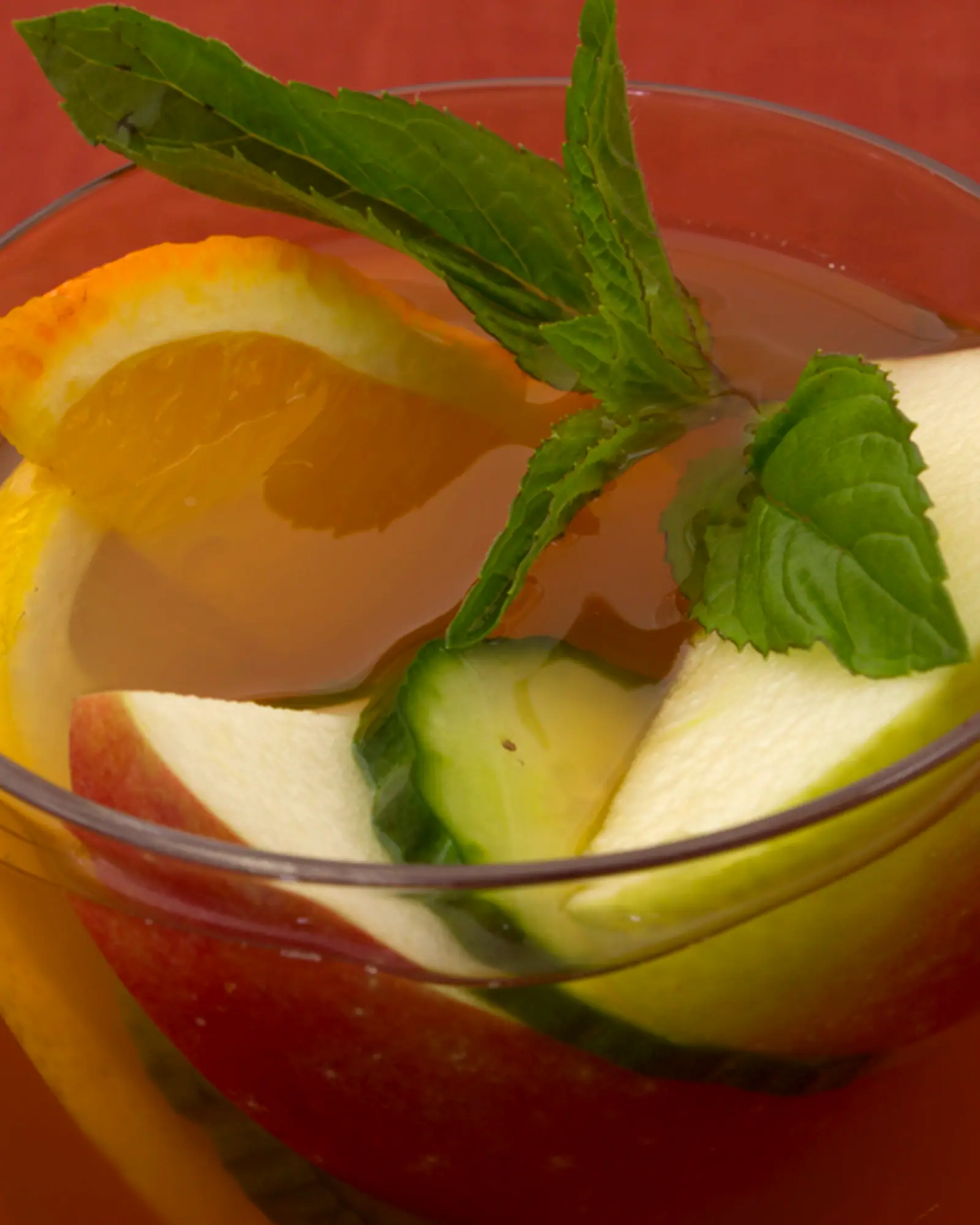

CC BY 2.0 · Cropped, white-balanced, graded and re-encoded to WebP by eXir.
Close overhead view of a Pimm's Cup with mint, cucumber, orange and apple pieces floating in the glass
Serving
Drink spec, per drink
Every figure above is per drink and does not move with the count, which is what makes the two service modes comparable. Sugar per litre, strength and standard drinks stay in the units their own authorities publish, because they are figures for comparing rather than for pouring. Dilution is modelled rather than measured, as a fraction of the poured volume before any ice; dotted figures descend from that estimate.
Diet and allergen labels are computed from the ingredients listed on this page and nothing else. They cannot account for cross-contamination or for the particular product you buy, and they are not medical or safety guidance.
Ingredients
 50 ml Pimm's No.1Proprietary
 100 ml lemon soda
 15 g cucumber
 2 g mint
 20 g fresh strawberries
 ½ orange (15 g)
- 50 ml Pimm's No.1Proprietary
- 100 ml lemon soda
- 15 g cucumber
- 2 g mint
- 20 g fresh strawberries
- ½ orange (15 g)
- ~38 ml water
Glass
Vessel
150 ml of liquid plus 230 ml of cubed ice occupies about 380 ml, inside the 400 ml the glass holds. The build fails if a recipe ever exceeds its stated vessel.
A batch needs a vessel that closes and fits a fridge shelf.
Method
4 steps · 1m 25sFill a Collins glass with cubed ice.
Pour in the 50 ml Pimm's No.1.
Top with the 100 ml lemon soda.
Drop in the cucumber ribbon, mint sprig, sliced strawberry and orange half-wheel.
The fruit and cucumber are not decoration set on the rim but dropped into the glass itself, so the drink keeps picking up their scent as the ice melts and the glass is topped up through the evening.
Common pitfallPimm's alone is closer to a mixer than a spirit at roughly a quarter of the strength of gin, so treating it like a standard liqueur pour and drowning it in soda leaves a drink with almost no flavour of its own.
Keeping and make-ahead
Batched ahead, this keeps sealed and cold. The water line the engine adds is the dilution figure from the spec panel, not a rule of thumb.
About
Pimm's No.1 topped with lemon soda and a handful of fresh fruit and cucumber, developed from a nineteenth-century digestive tonic into a fixture of the English summer.
James Pimm ran an oyster bar in the City of London in the 1820s and served his customers a gin-based tonic of herbs, spices and fruit alongside their oysters, intended to aid digestion and kept deliberately low in alcohol 1. It was served in a small tankard called a "No. 1 Cup," and that vessel gave the drink its name once Pimm's began bottling and selling the recipe commercially, trademarking it in 1912 2. Later versions built on other spirits (Scotch, brandy, rum, vodka and, briefly, tequila) followed under the No. 2 through No. 6 designations, though only a handful are still made today 1.
The drink itself, rather than the bottled base alone, took shape as Pimm's No.1 mixed with lemonade and dressed with fresh fruit and cucumber, served long over ice 2. It reached the United States by the late 1940s, most likely carried over by a British expatriate, and took hold particularly in New Orleans, where Napoleon House in the French Quarter built its own reputation partly on serving it through the city's summers 1 2.
In Britain the Pimm's Cup stayed tied to a specific season rather than spreading evenly through the year, and it is now the closest thing the English summer calendar has to an official drink, poured at Wimbledon, the Chelsea Flower Show and Royal Ascot alike 2. The garnish is treated as part of the recipe rather than an afterthought: what goes into the glass beyond cucumber and mint varies by household and by bar, and the drink has never settled on one fixed fruit bill the way a cocktail with a stricter formula would have 1.
- 1A Brief History Of The Pimm's Cuprevelry.tours
- 2Pimm's cupen.wikipedia.org